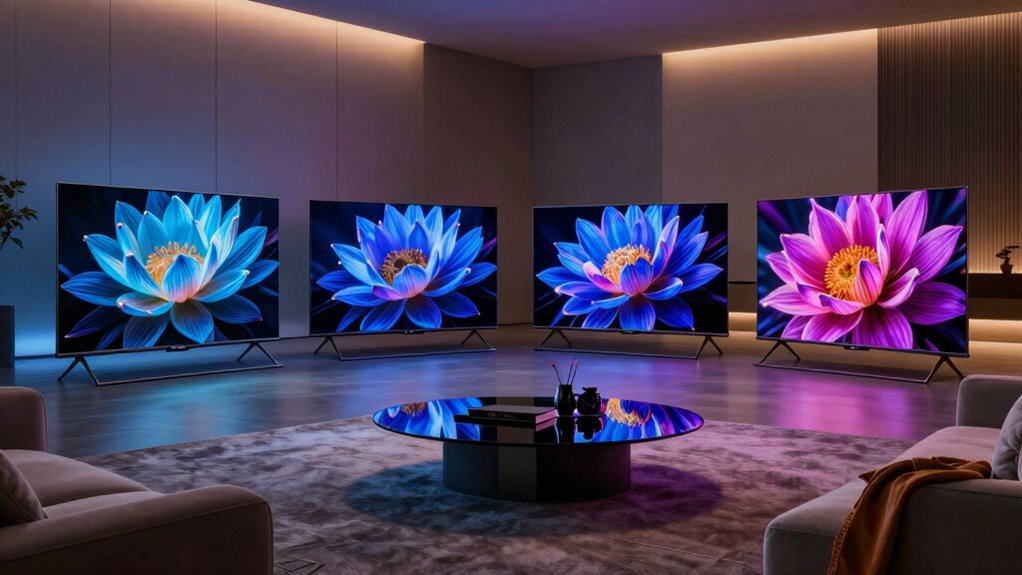

When I compare 77-inch OLED TVs, the main choice is not whether you get deep blacks: all five use OLED. It is whether you value stronger bright-room features, high-refresh gaming, or a simpler 120Hz setup. My leading all-rounder is the LG C5, with Dolby Vision support and AI upscaling. The Samsung S90H is the gaming-first option in this group, pairing a stated 165Hz refresh rate with glare reduction. For a current-generation LG with a 165Hz VRR ceiling, the LG C6 has the broadest gaming feature set listed here.

Prime made for students and young adults
- Fast, free delivery for dorm and study essentials
- Prime Video and Amazon Music included
- Member-only deals
The tradeoffs are practical as well as technical. Samsung’s S85F and S84F offer 120Hz OLED performance but use HDR10-family formats rather than Dolby Vision, while LG’s C5 and C6 support Dolby Vision. I’d choose around the content and room first, then check the installation space: these 77-inch sets are wide, and some weigh more than 60 pounds.
Key Takeaways
- The LG C5 is my balanced movie-and-streaming pick here: it combines Dolby Vision, Dolby Atmos, AI upscaling, and a stated 120Hz refresh rate.
- The Samsung S90H is the gaming and reflection-control specialist, listing 165Hz, G-SYNC, FreeSync Premium Pro, and Glare Free technology.
- The LG C6 lists VRR up to 165Hz alongside Dolby Vision and four HDMI 2.1 inputs, making it the most feature-dense gaming-focused LG in this lineup.
- The Samsung S85F and S84F share a 120Hz, NQ4 AI Gen2 foundation; choose between their specific feature descriptions rather than assuming a large performance gap.
- A 77-inch panel needs a wide, sturdy installation area; the listed Samsung S85F and S84F weigh 63.5 pounds, while the LG C5 is listed at 59.7 pounds.
| LG 77-Inch Class OLED evo AI Super Upscaling 4K C5 Series Smart TV with Dolby Atmos & Vision |  | Best Overall | Display: 77-inch OLED evo | Resolution: 4K | Refresh rate: 120Hz | VIEW ON AMAZON | See Our Full Breakdown |
| Samsung 77-Inch S90H Series OLED 4K Smart TV (2026) |  | Best for Gaming and Reflections | Display: 77-inch OLED | Resolution: 4K | Model year: 2026 | VIEW ON AMAZON | See Our Full Breakdown |
| LG 77-Inch OLED evo C6 4K Smart TV |  | Best LG for Advanced Gaming | Display: 77-inch OLED evo | Resolution: 4K | Processor: Alpha 11 Gen3 AI Processor | VIEW ON AMAZON | See Our Full Breakdown |
| Samsung 77-Inch S85F OLED 4K Smart TV (2025) |  | Best Samsung 120Hz All-Rounder | Display: 77-inch OLED | Resolution: 4K | Refresh rate: 120Hz | VIEW ON AMAZON | See Our Full Breakdown |
| Samsung 77-Inch S84F Series OLED 4K Smart TV (2025) |  | Best for Samsung Smart Features | Display: 77-inch OLED | Resolution: 4K | Refresh rate: 120Hz | VIEW ON AMAZON | See Our Full Breakdown |
| oled tv 77 inch | Display | Resolution | Refresh rate | Processor |
|---|---|---|---|---|
| LG 77-Inch Class OLED evo AI S | 77-inch OLED evo | 4K | 120Hz | — |
| Samsung 77-Inch S90H Series OL | 77-inch OLED | 4K | 165Hz | NQ4 AI Gen3 |
| LG 77-Inch OLED evo C6 4K Smar | 77-inch OLED evo | 4K | — | Alpha 11 Gen3 AI Processor |
| Samsung 77-Inch S85F OLED 4K S | 77-inch OLED | 4K | 120Hz | NQ4 AI Gen2 |
| Samsung 77-Inch S84F Series OL | 77-inch OLED | 4K | 120Hz | NQ4 AI Gen2 |
More Details on Our Top Picks
LG 77-Inch Class OLED evo AI Super Upscaling 4K C5 Series Smart TV with Dolby Atmos & Vision
I rank the LG C5 first because its stated features cover the widest mix of ordinary TV priorities without tying the recommendation to gaming alone. It combines 4K OLED contrast with Dolby Vision, Dolby Atmos, AI super upscaling, and a 120Hz refresh rate. That makes it a sensible centerpiece for streaming, films, and sports, especially if your library includes Dolby Vision titles. Compared with the Samsung S85F and S84F, the C5’s Dolby Vision support is a meaningful format distinction; those Samsung models list HDR10 and HDR10+ instead.
LG also claims a brightness booster for brighter-room performance, which may help the picture hold up better when the room is not fully dark. I would not treat that as a substitute for controlling direct sunlight, but it gives the C5 a broader stated viewing brief than a set described mainly around upscaling. Filmmaker Mode is useful for viewers who want a more cinema-oriented presentation, while webOS and voice, app, and remote controls cover familiar smart-TV routines.
The tradeoff is that this is a large, substantial set, and the listed 59.7-pound weight still calls for careful handling and a suitable mount or furniture. Its listed 204-watt power consumption may also matter to buyers who track household energy use. The supplied details do not list high-refresh VRR features like the LG C6 or Samsung S90H, so competitive gamers may prefer one of those options. I would choose the C5 for a balanced movie-and-TV setup, not for the most advanced gaming specification on this page.
Pros:- Dolby Vision and Dolby Atmos support
- AI super upscaling for lower-resolution sources
- Brightness booster and Filmmaker Mode
- 120Hz refresh rate and webOS smart platform
Cons:- Large 77-inch panel requires substantial space and careful installation
- Listed power consumption is 204 watts
- Provided details do not state VRR beyond 120Hz
Best for: Viewers who want a 77-inch OLED for mixed streaming, films, and everyday TV, with Dolby Vision and a stated brightness boost.
Not ideal for: Competitive gamers prioritizing documented VRR above 120Hz, or buyers who need a lightweight, compact installation.
- Display:77-inch OLED evo
- Resolution:4K
- Refresh rate:120Hz
- HDR formats:Dolby Vision, HDR10, HLG
- Audio:2.2-channel, Dolby Atmos, AI Sound Pro
- Smart platform:webOS
- Response time:0.1ms
- Weight:59.7 pounds
Our verdict“I’d pick the LG C5 for the most balanced stated mix of Dolby Vision, upscaling, and everyday viewing features.”
Samsung 77-Inch S90H Series OLED 4K Smart TV (2026)
The Samsung S90H earns a distinct role because its listed strengths target two common 77-inch setup challenges: fast gaming and room reflections. It specifies a 165Hz refresh rate, NVIDIA G-SYNC, AMD FreeSync Premium Pro, and Glare Free technology. For a PC or console-centered room with bright windows, that combination is more directly relevant than the C5’s stronger emphasis on Dolby Vision, Filmmaker Mode, and mixed-use viewing.
Its NQ4 AI Gen3 processor and 128 neural networks are presented as tools for upscaling and improving motion. That could appeal if your viewing mix includes lower-resolution streams alongside games, although processing results depend on the source. Compared with the LG C6, the S90H also lists a 165Hz rate and adaptive-sync brands, while the C6 provides more specific HDMI 2.1 and Dolby Vision information. The S90H’s product details do not specify HDR formats beyond a general HDR+ reference, nor do they state port count, audio configuration, or dimensions, so I would verify those before planning a multi-device installation.
This is my pick for a buyer who values the gaming-and-glare combination more than a fully documented home-cinema feature set. Its omissions in the supplied specification make it less straightforward to compare for movie formats and connectivity than the C5 or C6. I would not assume the 165Hz figure alone guarantees a benefit with every source; the connected device and supported signal matter too. If Dolby Vision support is a must, the LG C5 or C6 is the clearer choice from this lineup.
Pros:- 165Hz refresh rate listed
- NVIDIA G-SYNC and AMD FreeSync Premium Pro support
- Glare Free technology targets distracting reflections
- NQ4 AI Gen3 processor with stated AI upscaling
Cons:- Supplied details do not confirm Dolby Vision support
- HDMI port count and audio configuration are not specified
- The listed gaming features may matter less to viewers who mainly stream films
Best for: Gamers seeking a 77-inch OLED with a listed 165Hz refresh rate, adaptive sync support, and reflection-reduction technology.
Not ideal for: Film-focused buyers who specifically want confirmed Dolby Vision support or shoppers who need complete port and audio specifications before choosing.
- Display:77-inch OLED
- Resolution:4K
- Model year:2026
- Processor:NQ4 AI Gen3
- AI networks:128
- Refresh rate:165Hz
- Gaming support:NVIDIA G-SYNC, AMD FreeSync Premium Pro
- Reflection feature:Glare Free technology
Our verdict“I’d choose the S90H when gaming refresh features and reflection control outweigh the need for fully documented movie-format support.”
LG 77-Inch OLED evo C6 4K Smart TV
The LG C6 is the strongest fit for someone who wants gaming credentials without giving up LG’s stated cinema format support. Its native refresh rate is 120Hz, with VRR up to 165Hz, G-SYNC compatibility, FreeSync Premium, ALLM, and a 0.1ms response time. The four HDMI 2.1 inputs are especially useful if you have multiple current-generation game systems and want the listed connection standard on each input. Compared with the C5, the C6 provides a more explicit high-refresh and adaptive-sync feature set.
For films, the C6 adds Dolby Vision and Dolby Atmos, plus Brightness Booster Pro and a 40W, 2.2-channel speaker system. The Alpha 11 Gen3 processor and webOS 26 position it as the newer LG option in this selection. It also compares well with the Samsung S90H for buyers who want high refresh gaming, but the C6’s supplied specifications are more complete about HDMI inputs and Dolby Vision. Samsung’s S90H, by contrast, specifically lists Glare Free technology, which may matter more in a reflection-prone room.
The C6’s strength is also its potential overkill: if you mainly watch films and standard streaming, its VRR ceiling may not change your day-to-day experience, and the C5 already offers Dolby Vision and upscaling. A 77-inch screen takes significant wall or console space, and wall-mount hardware is sold separately according to the product details. I see this as a feature-rich gaming and movie hybrid, not the simplest choice for a casual viewer seeking only a large OLED picture.
Pros:- VRR up to 165Hz with G-SYNC and FreeSync Premium
- Four HDMI 2.1 inputs listed
- Dolby Vision and Dolby Atmos support
- Brightness Booster Pro and 40W 2.2-channel speakers
Cons:- Wall-mount hardware is sold separately
- 77-inch size demands considerable wall or console space
- Advanced gaming specifications may be unnecessary for mostly casual viewing
Best for: Gamers who want high-refresh VRR and multiple HDMI 2.1 inputs while keeping Dolby Vision and Atmos for films.
Not ideal for: Casual viewers who will not use advanced VRR, or buyers who want wall-mount hardware included.
- Display:77-inch OLED evo
- Resolution:4K
- Processor:Alpha 11 Gen3 AI Processor
- Native refresh rate:120Hz
- VRR:Up to 165Hz
- HDMI:Four HDMI 2.1 inputs
- HDR and audio:Dolby Vision, Dolby Atmos
- Smart platform:webOS 26
Our verdict“I’d choose the C6 over the C5 when high-refresh gaming and multiple HDMI 2.1 inputs are priorities alongside Dolby Vision.”
Samsung 77-Inch S85F OLED 4K Smart TV (2025)
The Samsung S85F suits buyers who want a straightforward 77-inch OLED with 120Hz motion and Samsung’s NQ4 AI Gen2 processing, without making a 165Hz gaming feature the centerpiece. Its processor uses 20 neural networks for 4K upscaling and picture adjustments, and the set lists four HDMI ports, two USB ports, Bluetooth 5.3, Wi-Fi, and Ethernet. That connection information makes it easier to plan around several sources than the S90H listing, whose port details are not supplied.
For moving content, Motion Xcelerator and 120Hz provide a familiar step up from basic refresh-rate TVs, while Dolby Atmos and built-in Alexa add convenience. The main format distinction is HDR10+: unlike the LG C5 and C6, the S85F does not list Dolby Vision. If your favorite streaming or disc content relies on Dolby Vision, LG is the more direct match. If you already use Samsung’s platform and want HDR10+ support, the S85F’s feature mix may feel more coherent.
Its 63.5-pound weight and large footprint make installation a two-person planning job rather than an afterthought. AI upscaling can improve some lower-resolution material, but the source still limits the result; viewers should not expect every older broadcast to look like native 4K. Compared with the S84F, the S85F has a more clearly stated Dolby Atmos and Alexa feature set in the supplied description, while their core 120Hz and NQ4 Gen2 specifications are similar. I’d put the S85F ahead for buyers who value those named conveniences, not because the information proves a major panel difference.
Pros:- 120Hz refresh rate with Motion Xcelerator
- NQ4 AI Gen2 processor and 4K upscaling
- Four HDMI ports, two USB ports, and Bluetooth 5.3
- Dolby Atmos and built-in Alexa listed
Cons:- HDR format listed is HDR10+, not Dolby Vision
- 63.5-pound weight complicates installation
- Upscaling quality can vary with the source
Best for: Samsung-focused households wanting a 120Hz OLED with multiple listed inputs, HDR10+, Dolby Atmos, and Alexa.
Not ideal for: Viewers who need Dolby Vision, or anyone unable to accommodate a heavy 77-inch set.
- Display:77-inch OLED
- Resolution:4K
- Refresh rate:120Hz
- Processor:NQ4 AI Gen2
- HDR format:HDR10+
- HDMI and USB:Four HDMI, two USB
- Connectivity:Bluetooth 5.3, Ethernet, Wi-Fi
- Weight:63.5 pounds
Our verdict“I’d select the S85F for a Samsung-oriented setup that favors 120Hz performance, useful connections, and HDR10+ over Dolby Vision.”
Samsung 77-Inch S84F Series OLED 4K Smart TV (2025)
The Samsung S84F is another 120Hz OLED choice built around the NQ4 AI Gen2 processor, HDR10 and HDR10+, and Motion Xcelerator. It shares the S85F’s broad position in this roundup: a large Samsung OLED for regular streaming, sports, and gaming, rather than a model defined by a 165Hz ceiling. Its listed Pantone-validated color gives color-conscious buyers a specific point of interest, while Samsung’s smart platform and free streaming channels may suit households that want built-in viewing options.
Compared with the S85F, the S84F’s supplied description calls out HDR10 and HDR10+ and Pantone-validated color, but does not name Dolby Atmos or built-in Alexa. Both list a 120Hz refresh rate, NQ4 AI Gen2 processing, four HDMI ports, and two USB ports. I would not read those information differences as proof that one has a better panel; the descriptions simply emphasize different details. Against the LG C5, the S84F’s key compromise is clearer: it lacks stated Dolby Vision support, though it lists HDR10+.
The set’s listed weight is 63.5 pounds with the stand and 61.9 pounds without it, so the installation still calls for a stable surface or properly rated mount. Network-based smart services require an internet connection and Samsung Account, a practical drawback for buyers who prefer fewer sign-ins or offline use. AI upscaling may help with some content, but it cannot make every source equally clean. I’d choose the S84F when Samsung’s streaming ecosystem and the stated color validation matter more than Dolby Vision or the S85F’s explicitly named audio and voice conveniences.
Pros:- 120Hz refresh rate and Motion Xcelerator
- HDR10 and HDR10+ support
- Pantone-validated color is listed
- Four HDMI ports, two USB ports, Wi-Fi, and Bluetooth 5.3
Cons:- Does not list Dolby Vision support
- Samsung Account and internet are needed for network-based smart services
- Listed weight is 63.5 pounds with stand
Best for: Samsung smart-TV users who want a 120Hz 77-inch OLED with HDR10+, Pantone-validated color, and built-in streaming options.
Not ideal for: Buyers seeking Dolby Vision, avoiding account-based network services, or needing a lighter large-screen installation.
- Display:77-inch OLED
- Resolution:4K
- Refresh rate:120Hz
- Processor:NQ4 AI Gen2
- HDR formats:HDR10, HDR10+
- HDMI and USB:Four HDMI, two USB
- Wireless connectivity:Wi-Fi, Bluetooth 5.3
- Weight:63.5 pounds with stand; 61.9 pounds without stand
Our verdict“I’d choose the S84F for Samsung smart features and its stated color validation, while accepting the lack of Dolby Vision.”

How We Picked
I ranked these sets around the decisions that matter for a 77-inch OLED purchase: viewing conditions, film format support, gaming capability, and how much room the set needs. Because each model is 77 inches with 4K OLED, screen size and basic pixel-level contrast do not separate them much. I gave more weight to the differences that can change what a buyer sees or connects, such as Dolby Vision versus HDR10-family support, refresh rate, VRR, and reflection-control claims.
I also distinguished supplied specifications from assumptions. For example, the Samsung S90H listing names HDR+ and gaming features but does not provide HDMI port counts or audio details, so I do not treat those as confirmed. The LG C6 lists four HDMI 2.1 inputs and VRR up to 165Hz; those details make it easier to assess for a multi-device gaming setup. The C5 has a more complete stated mix of movie, audio, and upscaling features, which supports its all-rounder role.
My order reflects the fit of each set, not a claim that one will suit every room. The C5 ranks first for a balanced mix; the S90H ranks next for its unusually specific gaming and glare features; the C6 follows as a strong gaming and Dolby Vision alternative with a newer processor. The S85F and S84F round out the list as 120Hz Samsung choices. The product information does not establish a decisive difference in their core panel and processor details, so I compare their listed strengths without inventing one.
| oled tv 77 inch | Processor |
|---|---|
| LG 77-Inch Class OLED evo AI S | — |
| Samsung 77-Inch S90H Series OL | NQ4 AI Gen3 |
| LG 77-Inch OLED evo C6 4K Smar | Alpha 11 Gen3 AI Processor |
| Samsung 77-Inch S85F OLED 4K S | NQ4 AI Gen2 |
| Samsung 77-Inch S84F Series OL | NQ4 AI Gen2 |
Factors to Consider When Choosing Oled Tv 77 Inch
I’d start with your room and viewing habits, then compare formats and connections. All five are 77-inch 4K OLED TVs, so the most useful distinctions are how they handle your content and the devices you plan to connect.Choose HDR formats around your movie library
Dolby Vision is listed on the LG C5 and C6, while the Samsung S85F and S84F specify HDR10-family support. The S90H description mentions HDR+ but does not clarify a full format list. If Dolby Vision is important for your streaming subscriptions or disc collection, the LG models are the clearer matches in this set. If your sources support HDR10+, the Samsung S85F and S84F offer that format. OLED can deliver deep blacks, but the supported format still affects which HDR version a compatible source can use.
Match refresh rate and VRR to your games
A stated 120Hz refresh rate appears on the C5, S85F, and S84F, and the C6 lists a native 120Hz panel with VRR up to 165Hz. The S90H specifies 165Hz alongside G-SYNC and FreeSync Premium Pro. Those higher-refresh and variable-refresh features are most useful when paired with compatible gaming hardware and games that can produce higher frame rates. For console and general viewing, 120Hz may be enough; for PC gaming, compare VRR support and the listed HDMI specifications rather than selecting on the refresh number alone.
Think about room brightness and reflections
The LG C5 lists a brightness booster and the C6 lists Brightness Booster Pro, while the Samsung S90H specifically names Glare Free technology. These are not identical claims: brightness enhancement and reflection reduction address different challenges. If your room gets daylight, consider window position, seating angle, and whether reflections land on the screen. No feature makes direct sunlight disappear, so room layout still matters. The S90H has the most explicit reflection-control claim in the supplied details, while LG’s listed brightness features may interest viewers who want additional highlight output.
Plan for installation before choosing a 77-inch panel
A 77-inch screen is wide enough to dominate a typical media wall. Check the usable width and depth of your console, measure the wall for a mount, and confirm that the furniture can support the set. The listed Samsung S85F and S84F each weigh 63.5 pounds with the stand; the LG C5 is listed at 59.7 pounds. The C6 product details say wall-mount hardware is sold separately. I would also leave room for cables, ventilation, and a soundbar rather than measuring only the screen width.
Compare smart features and sound honestly
The LG models use webOS, and the C5 lists AI Sound Pro and WOW Orchestra compatibility. The C6 specifies 40W, 2.2-channel speakers and Dolby Atmos. Samsung’s S85F description names Dolby Atmos and Alexa, while the S84F emphasizes its smart platform and free streaming channels. The supplied S90H details do not state its audio or smart-platform specifics. Built-in TV speakers can simplify setup, but a soundbar may make dialogue and room-filling audio easier to manage; check the exact connection and compatibility details if external audio is part of your plan.
Frequently Asked Questions
Which 77-inch OLED in this group is best for movies?
I’d start with the LG C5 for a mixed movie and streaming setup because it lists Dolby Vision, Dolby Atmos, Filmmaker Mode, and AI upscaling. The LG C6 is also a strong fit if you want those Dolby formats alongside more advanced gaming features. Samsung’s S85F and S84F list HDR10+ rather than Dolby Vision, which may suit a different content mix.
Which model has the most gaming-focused specifications?
The Samsung S90H lists a 165Hz refresh rate, G-SYNC, and FreeSync Premium Pro, while the LG C6 lists VRR up to 165Hz, G-SYNC compatibility, FreeSync Premium, ALLM, and four HDMI 2.1 inputs. I’d compare the exact connections and your gaming device requirements before choosing, since the S90H description does not state its port count.
Do all five TVs support Dolby Vision?
No. The supplied specifications list Dolby Vision for the LG C5 and LG C6. The Samsung S85F and S84F list HDR10-family formats, and the S90H description does not confirm Dolby Vision. If Dolby Vision is a requirement for your viewing library, the two LG models are the clearest choices based on the information provided.
Is a 77-inch OLED suitable for a bright room?
It can work in a bright room, but placement and reflections matter. The LG C5 lists a brightness booster, the C6 lists Brightness Booster Pro, and the Samsung S90H specifically lists Glare Free technology. Those features address different aspects of bright-room viewing, and none guarantees that direct sunlight will not affect the picture. I’d check window angles and seating position before settling on a screen location.
What should I check before mounting a 77-inch OLED?
Measure the wall or console width, confirm the furniture or mount can support the TV’s weight, and plan for cable access and any soundbar. The S85F and S84F are each listed at 63.5 pounds with a stand, while the C5 is listed at 59.7 pounds. The C6 details say wall-mount hardware is sold separately, so check what mounting equipment you need before installation.
Conclusion
For a balanced home setup, I’d choose the LG C5: its Dolby Vision, Dolby Atmos, upscaling, and brightness features suit a broad mix of films and everyday viewing. If gaming is the priority, I’d compare the Samsung S90H for its stated 165Hz refresh and Glare Free technology against the LG C6 for VRR up to 165Hz, four HDMI 2.1 inputs, and Dolby Vision. Samsung households seeking a 120Hz OLED can look at the S85F for its explicitly listed Atmos and Alexa features or the S84F for its stated Pantone-validated color and smart-TV channel offering.
Before deciding, I’d check which HDR formats your favorite content uses, which ports your devices need, and whether the installation area can handle a wide, heavy screen. Those practical details will make more difference to your satisfaction than choosing by model year alone.