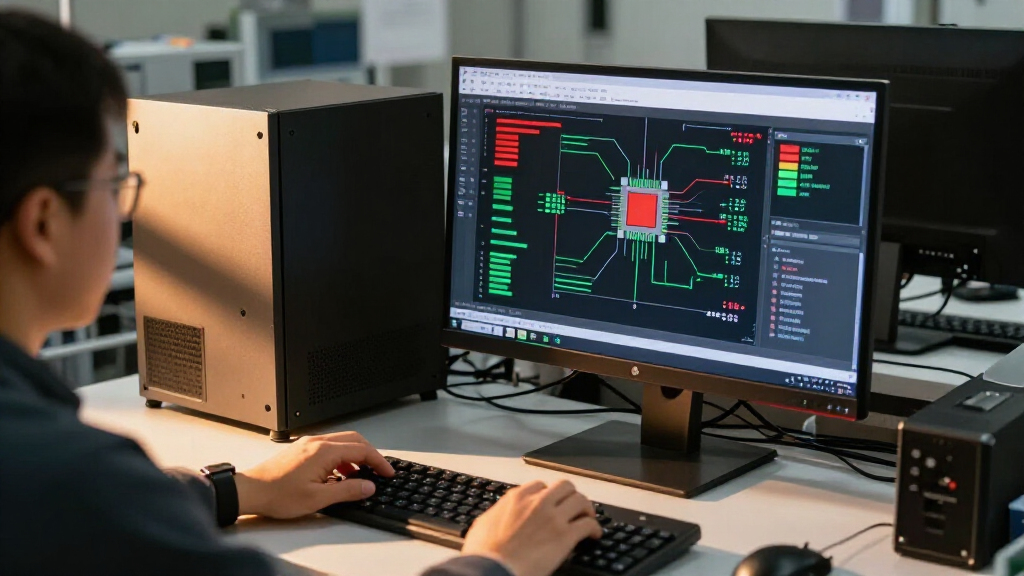

🔍 Read the full analysis: AMD Chip Design And AI: Breaking Down OpenAI’s Reported Results on ThorstenMeyerAI.com

Prime made for students and young adults
- Fast, free delivery for dorm and study essentials
- Prime Video and Amazon Music included
- Member-only deals
TL;DR
OpenAI said on November 18, 2026, that its models rewrote parts of AMD chip designs and produced up to 14% gains across power, performance and area in selected work. The figure is a best-case result against optimized baselines, and the companies have not released enough detail for an independent assessment.
OpenAI said November 18 that its AI models rewrote parts of AMD chip designs, reporting up to 14% improvement in power, performance and area on selected work. The results could show AI assisting in the design of hardware used to run future AI systems, but the headline figure comes from OpenAI, and independent verification has not been published.
In a post titled “Advancing chip design with OpenAI models,” the company described results involving AMD’s flagship GPU and next flagship CPU, as well as OpenAI’s own Jalapeño inference chip. The GPU result was reported as “up to” 14% better power, performance and area, or PPA, compared with what OpenAI called heavily optimized baselines. The company did not identify the specific GPU blocks behind that best result or provide an average across the work.
OpenAI said AMD had verified single-digit PPA gains in key CPU blocks. It also said some model-generated changes had entered a recent AMD design sent for manufacturing, while other changes were added to design files for future versions. AMD CEO Lisa Su praised the work on X, but AMD has not published its own figures, according to the source material.
For Jalapeño, OpenAI said model-proposed changes reduced standard-cell area by about 13% in one unit and 10% in another, with the results validated after the first chips came back. The source material gives differing labels for the first unit—“warp engine” and “vector unit”—so its exact identity is not clear. OpenAI also reported tests of five models on the open-source PicoRV32 and Ibex processor cores, totaling 9,881 scored runs; its newly released GPT-6.2 Astra scored highest. Those benchmark results do not, on their own, establish comparable gains in a commercial processor.
The design work focused on register-transfer-level (RTL) code, which describes how chip circuits operate. OpenAI said its models proposed alternative RTL implementations and that Synopsys tools checked whether the rewrites preserved the original behavior and measured PPA trade-offs. The model proposed changes; conventional design software performed the reported checks.
AI Moves Into Chip Design
If the reported gains carry through to manufactured chips, AI could help engineers improve hardware that is both expensive to develop and central to computing capacity. Better power efficiency can reduce electricity needs for a given workload; improved performance or area can affect how much computing a chip delivers and how much silicon it requires. The reported changes reaching a design sent for manufacturing make the claim more consequential than a software-only experiment, although the source does not establish that the changes have produced measured benefits in deployed hardware.
The finding also points to a possible feedback loop: AI tools may assist with designing processors that will run later AI systems. That is a plausible implication, not a demonstrated industry-wide shift. OpenAI’s claims cover selected designs and blocks, and the available figures do not show how consistently the approach works across chips, how much engineering time it saves, or whether it changes overall manufacturing costs.
Readers should distinguish the 14% best-case figure from a whole-chip improvement. PPA measures three competing design goals, and a change that improves one may affect another. OpenAI’s description does not specify the balance of those metrics for the reported maximum, nor does it say what proportion of the GPU was affected.
Popular right now

Samsung 55-Inch QN70H Neo QLED 4K Smart TV (2026)

TCL F8D Series 75-Inch 4K QLED Smart Fire TV, 144Hz, HDR (75F8D, 2026)

Bose QuietComfort Ultra Earbuds (2nd Gen), Wireless Noise-Cancelling Earbuds, Black
As an affiliate, we earn on qualifying purchases.
From RTL Rewrites to Silicon
RTL is an early stage of chip design. Engineers describe a circuit’s behavior in code, then synthesis tools translate that description into logic gates. Later steps arrange and connect those gates for manufacturing. A better RTL implementation can improve the resulting design, but results at one stage do not automatically equal equivalent gains after placement, wiring and production.
OpenAI’s reported method was to have models generate alternative RTL for existing functions, then use verification tools to check that the alternatives behaved like the original. That check matters because a functionally incorrect rewrite can make a chip unusable. The reported use of Synopsys tools offers a concrete validation step, but it does not replace disclosure of test conditions or independent review of the results.
The companies also have a financial relationship. According to the source material, an agreement dating from October 2025 gives OpenAI a warrant for up to 160 million AMD shares, with vesting tied to deployment of AMD chips. That connection does not disprove the technical claims, but it is relevant when weighing results primarily presented by OpenAI rather than independently audited figures from both companies.
“Su praised the results.”
— AMD CEO Lisa Su, on X, as quoted by Stocktwits
The Missing Measurement Details
The central uncertainty is the scope and reproducibility of the reported gains. OpenAI has not named the GPU blocks behind the 14% maximum, said what fraction of the chip they represent, provided an average result, or explained whether the figure was measured after synthesis or after later physical-design stages. “Up to” signals a top result, not a typical one.
The source material says AMD engineers had spent years optimizing the comparison designs, but the full baseline data and test conditions are not available. Nor is there an independent audit of the AMD or Jalapeño results. Reports by ANI, The Decoder and Inside AI describe OpenAI’s post, but they are not independent tests of the chip designs.
It also remains unclear how many proposed changes were accepted, whether the manufacturing-bound design has completed production, and whether the claimed improvements appear in chips available to customers. OpenAI has not reported a measured cost saving, an overall reduction in development time, or results from deployed systems. The differing names given for one Jalapeño unit also leave a detail of that result unresolved.
Awaiting AMD and Silicon Results
The next useful evidence would be technical data from AMD identifying the affected blocks, the test method, and results across the full design rather than only a maximum. Independent measurements would help establish whether the claimed PPA gains persist through later design stages and in manufactured silicon.
OpenAI said some changes were included in a design sent for manufacturing, but it has not provided a public timetable for production or customer deployment. Until the companies release more detail, the reported figures should be treated as company-reported engineering results—not as independently confirmed performance gains in shipping AMD products.
Key Questions
What did OpenAI report about AMD chips?
OpenAI said its models rewrote parts of AMD chip designs, reporting up to 14% PPA improvement on selected GPU work and single-digit gains in key CPU blocks. It did not publish a full set of results in the source material.
Does the 14% figure apply to the whole GPU?
No such whole-chip improvement is established. OpenAI described the figure as “up to” 14% against heavily optimized baselines, but did not identify the blocks involved or state an average across the GPU.
Who checked whether the redesigned circuits worked?
OpenAI said Synopsys design tools checked that the RTL rewrites preserved the original behavior and assessed their PPA effects. This is the company’s account; no independent audit of the results has been published.
Have the reported improvements reached products?
OpenAI said some changes were included in an AMD design sent for manufacturing. The source material does not confirm production completion, customer deployment, or measured benefits in chips currently in use.
Why is OpenAI’s relationship with AMD relevant?
The source material says OpenAI holds a warrant for up to 160 million AMD shares, vesting as AMD chips are deployed. That financial tie is relevant context for evaluating claims presented mainly by OpenAI, though it does not by itself show that the technical results are inaccurate.
Source: ThorstenMeyerAI.com


