
TL;DR

Prime made for students and young adults
- Fast, free delivery for dorm and study essentials
- Prime Video and Amazon Music included
- Member-only deals
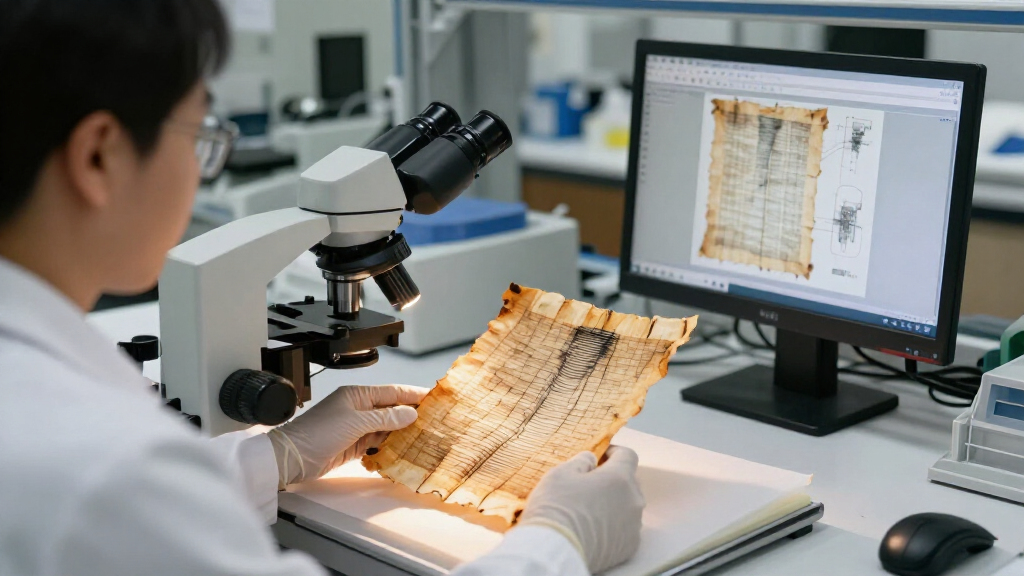
The Vesuvius Challenge awarded its $50,000 First Letters Prize to Liam Warner and Nicola Bodill for identifying readable Greek writing in the Herculaneum scroll PHerc. 306B. Their work makes a short phrase more legible and helps establish that this fragment came from the upper part of the original scroll; the text’s full meaning and the content of the remaining fragment are still unknown.
Liam Warner and Nicola Bodill have revealed readable Greek writing in PHerc. 306B, a carbonized scroll buried in the AD 79 eruption of Mount Vesuvius, earning the Vesuvius Challenge’s $50,000 First Letters Prize. The discovery offers a legible fragment from a scroll no one had previously read and clarifies which part of the original roll this fragment represents.
The Vesuvius Challenge said it reviewed 25 submissions focused on PHerc. 306B before selecting Warner and Bodill’s work. The prize criteria called for 10 readable characters within a four-square-centimeter area. Several other teams identified the same area and recovered seven, eight or nine characters, but did not reach that threshold.
The winning submission improved the visibility of a Greek sequence that had been under discussion for nearly a month. Challenge organizers said the sequence το δι᾽ αὐτό had appeared in multiple submissions, while the following letters remained too faint for agreement. The papyrology team now reads the next letters as αι, rather than the alternative mu or nu proposed in earlier interpretations. The team pointed to a visible diagonal middle stroke in the alpha as evidence for that reading.
The resulting phrase is read as τὸ δι᾽ αὑτὸ αἱρετόν, translated in the report as “that which is in itself desirable.” The report says the expression has parallels in philosophical writing, including Aristotle, Sextus Empiricus and Philodemus. That resemblance offers a possible clue to the fragment’s subject, but does not by itself establish the scroll’s author or the passage’s argument.
A Readable Clue to the Scroll
The result shows that researchers can recover writing from carbonized papyrus without physically opening it, using micro-CT scans and computational methods to distinguish ink from the damaged material. The Herculaneum scrolls were exposed to extreme heat during the eruption and are tightly compressed and distorted. Reading even a short stretch can provide evidence that was inaccessible through ordinary inspection.
The newly legible wording matters because it may connect the fragment to ancient philosophical discussions of what is desirable for its own sake. The Vesuvius Challenge report notes that the phrase has parallels in philosophical treatises and that, in an Epicurean context, it should refer to good and pleasure. Those parallels can guide further study, but the recovered phrase is too brief to settle what the surrounding passage says.
The work also provides practical value for future analysis: it identifies a papyrus layer and helps determine the orientation of the scroll. Those findings can inform efforts to virtually unroll more of PHerc. 306B and its companion fragment, expanding the amount of text available for historians and classicists.
Popular right now

KitchenAid 5.5-Qt Bowl-Lift Stand Mixer, Porcelain White (KSM55SXXX)

TCL 65-Inch QM6K QLED Mini-LED 4K HDR Smart Google TV, 144Hz

Dyson Car+Boat Cordless Handheld Vacuum
As an affiliate, we earn on qualifying purchases.
From Herculaneum to CT Scans
PHerc. 306 was excavated in the 1750s from the Villa of the Papyri at Herculaneum, near the site where the eruption of Vesuvius buried the ancient town. It is now divided into two portions, called PHerc. 306A and PHerc. 306B, and is held at the National Library of Naples. The Vesuvius Challenge says the scroll was micro-CT scanned last year, providing digital images of its tightly wound layers.
Until the new work, the project had not established which fragment represented the upper or lower part of the original roll. Based on the location of the ink and the orientation of the script, the team now identifies 306B as the upper section and the smaller 306A as the lower section. The report says this finding makes 306A more valuable to scan and virtually unroll, though it does not announce a readable passage from that portion.
The Vesuvius Challenge brings together researchers and community participants to recover text from Herculaneum scrolls through imaging and software. This prize recognized a specific achievement: identifying ink and meeting the stated character threshold on a particular scroll, rather than producing a complete transcription.
““The papyrology team agreed on the reading of αι.””
— Vesuvius Challenge
What the Fragment Cannot Yet Tell
The recovered text is a short fragment, not a full reading of the scroll. The proposed translation, “that which is in itself desirable,” is plausible according to the report, but surrounding words are needed to determine how the phrase functions in its original passage. The exact work, author and argument represented by PHerc. 306B have not been established by this discovery.
The report also does not specify the precise date of the prize announcement or provide a full transcription of the recoverable area. While the team says the letter sequence is now readable with greater confidence, further examination may refine the reading. No result from virtual unrolling PHerc. 306A is included in the report.
Further Scans of Both Fragments
The Vesuvius Challenge says the identification of ink in PHerc. 306B makes PHerc. 306A a more valuable target for scanning and virtual unrolling. Researchers can also continue examining the CT data from 306B and testing whether additional layers yield readable text. The report does not give a timetable for those steps or announce a next milestone.
For now, the immediate next stage is closer study of the recovered letters and their setting in the scroll. Any longer passage would help scholars test the philosophical parallels and determine whether the interpretation fits the surrounding text.
Key Questions
What was discovered in PHerc. 306B?
Researchers identified a readable sequence of ancient Greek letters in the carbonized scroll. The Vesuvius Challenge team reads the phrase as τὸ δι᾽ αὑτὸ αἱρετόν, translated as “that which is in itself desirable.”
Who received the First Letters Prize?
Liam Warner and Nicola Bodill received the Vesuvius Challenge’s $50,000 prize for identifying ink and recovering text that met the competition’s target of 10 readable characters within a four-square-centimeter area.
No. The phrase has parallels in philosophical works, but the recovered passage is too short to establish the author, title or full subject of the scroll.
Why is PHerc. 306A relevant?
The project now identifies 306A as the lower portion of the original scroll, with 306B as the upper portion. The Vesuvius Challenge says the new ink identification makes 306A more valuable to scan and virtually unroll; it has not reported a reading from that fragment.
Source: scrollprize.substack.com