🔍 Read the full analysis: 26.7 Million Working Animals And The Tractor Revolution on ThorstenMeyerAI.com

Prime made for students and young adults
- Fast, free delivery for dorm and study essentials
- Prime Video and Amazon Music included
- Member-only deals
TL;DR
U.S. farm horses and mules peaked at 26.7 million in January 1918, then fell to 3.1 million by 1960 as tractors and other machines reshaped agriculture. The historical account links that change to higher farm productivity and fewer farm jobs, while cautioning that the comparison between working animals and people is an analogy, not a prediction.
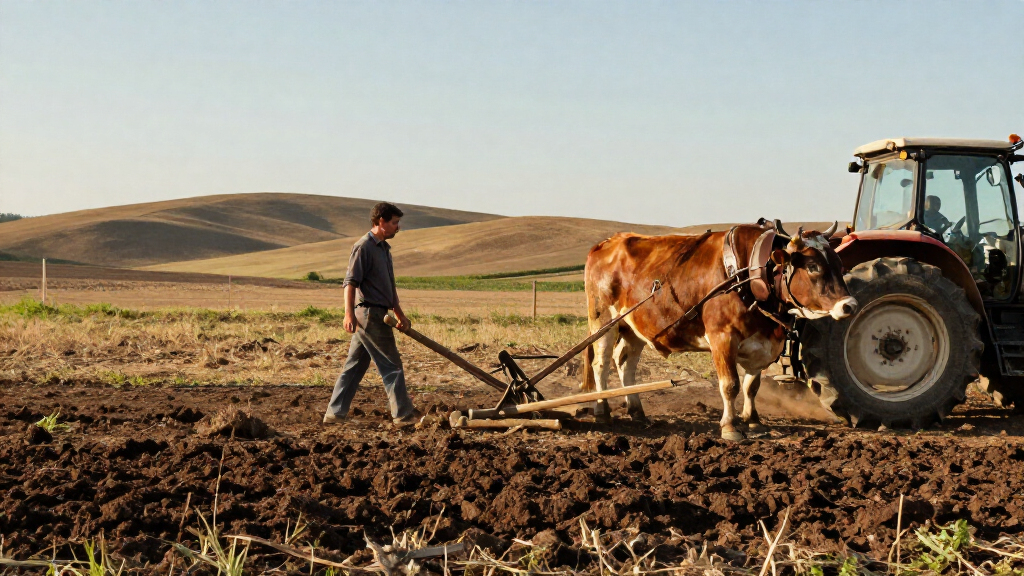
A November 4 report on the history of agricultural mechanization highlights a sharp U.S. shift: the number of horses and mules on farms peaked at 26.7 million on January 1, 1918, then dropped to 3.1 million by 1960 as tractors and other machinery spread. The change freed land used to grow animal feed and reduced the need for farm labor, making the episode a useful but limited comparison for current debates over automation.
Historical statistics cited in the report put the 1918 total at 21.2 million horses and 5.5 million mules. Horses alone had peaked earlier, at 21.4 million in 1915. The animals supplied power for ploughing, sowing, harvesting and hauling, but required feed year-round. In 1915, an estimated 93 million acres of harvested cropland—more than a quarter of the U.S. total—was used to grow feed for horses and mules.
Tractor numbers rose as the working-animal population declined. The report gives estimates of about 1,000 tractors in 1910, 246,000 in 1920, 920,000 in 1930 and 4.69 million in 1960. Around 1955, it says, tractors first outnumbered horses and mules on farms. Ford introduced the Fordson in 1917; the Henry Ford museum describes it as a mass-produced, inexpensive lightweight tractor designed for smaller farms.
Mechanization extended beyond tractors. Combine harvesters on U.S. farms increased from about 4,000 in 1920 to 1.042 million in 1960, according to figures cited in the report. U.S. farm employment peaked at 13.6 million in 1916 and stood at 4.5 million in 1970, while the broader labor force doubled. The report says the transition involved people moving to city jobs; it does not establish that every displaced farm worker moved directly into a particular occupation.
Land and Labor After Mechanization
The decline of working animals was part of a wider restructuring of agriculture, not simply a change in farm equipment. As tractors replaced animal power, farmland once used for feed could be put to other uses. The report estimates that land devoted to horse and mule feed fell from 93 million acres in 1915 to about 5 million acres in 1960. That shift mattered for food production and for the economics of running a farm.
Rising productivity also meant fewer workers were needed in agriculture. The U.S. Department of Agriculture series cited in the article estimates that one farm worker supplied 7.1 people in 1910 and 47.1 in 1970; the latter figure includes people abroad supplied through exports. The broader lesson is that automation can raise output while changing where people work. The figures do not, by themselves, describe the experience or prospects of individual workers.
The history is often invoked in arguments about whether machines will replace people. In 1983, economist Wassily Leontief compared workers to horses displaced by tractors. But the report emphasizes a limit to that analogy: people are not horses, and humans have political rights and can adapt in ways animals cannot. The earlier transition is evidence of major labor-market change, not a timetable for what will happen to workers now.
Popular right now

Roborock Robot Vacuum and Mop Combo with Self-Empty Dock

Apple AirPods Max 2 Wireless Over-Ear Headphones – Midnight

KitchenAid 5.5-Qt Bowl-Lift Stand Mixer, Porcelain White (KSM55SXXX)
As an affiliate, we earn on qualifying purchases.
From Animal Power to Tractors
Tractors existed before the First World War, but early models were heavy and expensive, limiting their use. The Fordson, launched in 1917, was marketed as a lighter, less expensive option. The Henry Ford museum says it was designed to meet the needs of small farmers and became popular in the United States. Tractor adoption accelerated over subsequent decades, alongside the spread of combines, corn pickers, balers and milking machines.
The source’s historical figures require some care in comparison. It notes that tractor counts for several census years were taken on slightly different dates, and that the Agriculture Department counted horses and mules together from 1951. Its feed-land estimates also show the scale of the change: about 90 million acres were still devoted to animal feed in 1920, compared with about 5 million in 1960.
The report also points to present-day machinery, while distinguishing it from the broad adoption of tractors. John Deere introduced a 16-camera autonomy kit in February 2025 for tillage on selected large tractors. China reported that about 74% of ploughing, sowing and harvesting was mechanized in 2023. Those examples show ongoing automation, but they do not establish that autonomous equipment can perform every farm task or replace workers across the sector.
Limits of the Horse Analogy
The historical totals document the decline in farm horses and mules, but they do not trace the outcomes of individual animals or workers. The report says farmers stopped breeding replacements and the population aged out; it does not provide a detailed account of what happened to every animal. Nor do the employment totals show how many workers moved to cities, what jobs they found, or how the changes affected wages and living conditions.
It is also unclear how far the horse-to-tractor comparison can predict the effects of current automation. The report describes autonomy technology used for selected tillage work, not a fully autonomous farm workforce. China’s mechanization figure concerns specified field operations and is a reported national statistic; the source does not provide a detailed breakdown by farm size, region or task. These examples should not be treated as proof that present-day machinery will produce the same labor changes as tractors did.
Tracking Farm Automation Today
The historical account does not announce a new policy or forecast a specific next milestone. The next developments to watch are the scope of autonomous equipment in commercial farming, the tasks it can reliably perform and how its use affects farm employment. Broader comparisons will also depend on consistent data about adoption, productivity and labor across countries and types of farms.
For the U.S. historical series, the Agriculture Department ended its annual horse-and-mule estimates soon after the period covered. Current monitoring therefore centers on machinery and agricultural work rather than a continuing count of working animals. The report’s central figure—26.7 million in 1918—remains a measure of the scale of the earlier system, not a direct forecast of automation’s effects on people.
Key Questions
How many horses and mules worked on U.S. farms at the peak?
The historical figures cited in the report put the combined total at 26.7 million on January 1, 1918: 21.2 million horses and 5.5 million mules.
How many remained by 1960?
The reported count had fallen to 3.1 million farm horses and mules by 1960, a decline of almost 90% from the 1918 peak.
Why did tractors replace working animals?
Tractors supplied farm power without needing feed year-round. The source also describes the spread of relatively affordable tractors and other machinery, while noting that land once used for animal feed could be used for other crops.
Does this history show that machines will replace human workers in the same way?
No. The episode offers the horse economy as an analogy for technological change, not a law or forecast. People can vote and move between kinds of work, and the historical totals alone do not show how individual workers fared.
What examples of current farm automation does the report cite?
It cites John Deere’s February 2025 16-camera autonomy kit for tillage on selected large tractors and a reported Chinese figure that about 74% of ploughing, sowing and harvesting was mechanized in 2023. Those figures relate to particular equipment or operations, not complete automation of farming.
Source: ThorstenMeyerAI.com