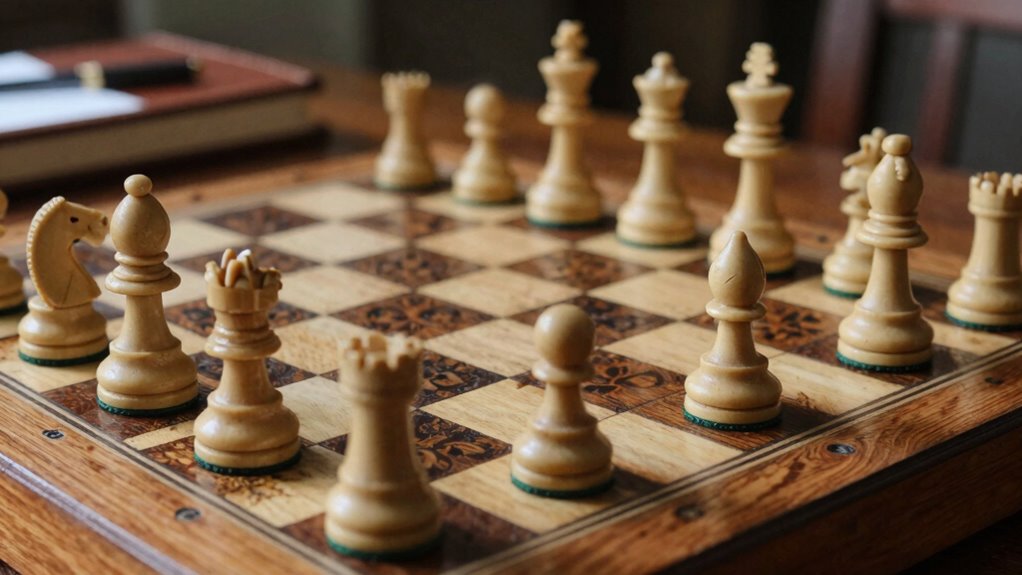

Chess feels like a philosopher’s game because it forces you to weigh moral dilemmas, strategic ethics, and the long-term consequences of your moves. Each decision mirrors real-life challenges involving justice, fairness, and integrity. The game questions your principles and encourages deep thinking about right and wrong, making every match a reflection of human morality. If you keep exploring, you’ll uncover how chess acts as a timeless mirror of philosophical inquiry and ethical complexity.

Prime made for students and young adults
- Fast, free delivery for dorm and study essentials
- Prime Video and Amazon Music included
- Member-only deals
Key Takeaways
- Chess embodies strategic decision-making that mirrors moral and philosophical dilemmas, prompting reflection on ethics and consequences.
- The game’s emphasis on sacrifice and fairness reflects core human values and moral principles.
- Strategic choices in chess mirror real-world ethical challenges, fostering critical thinking about justice and integrity.
- Modern technology enhances chess’s depth, emphasizing the ongoing evolution of morality and strategy in a digital age.
- Chess serves as a timeless metaphor for life’s complex moral landscape, encouraging philosophical inquiry beyond entertainment.

Have you ever wondered why chess has endured for centuries as more than just a game? It’s because chess embodies the essence of philosophical inquiry, challenging your ability to navigate moral dilemmas and consider strategic ethics. Every move you make forces you to weigh the consequences, reflect on fairness, and decide whether victory justifies certain sacrifices. Unlike many games that focus solely on entertainment, chess beckons you to confront questions about right and wrong, about the morality of your choices. Do you prioritize aggressive tactics that threaten your opponent’s king, or do you hold back to preserve a sense of honor? These choices mirror real-life moral dilemmas, where the right course isn’t always clear, and the stakes are high.
Strategic ethics, in chess, refers to the principles that guide your decision-making beyond immediate gains. It’s about understanding the long-term implications of your actions, balancing risk against reward, and recognizing that sometimes, sacrificing a piece may serve a higher purpose. You’re constantly faced with choices that challenge your integrity and sense of fairness—should you play aggressively, risking your position, or adopt a more defensive stance that might prolong the game but limit your chances of victory? This tension between strategy and morality keeps the game profound and ever-evolving. It pushes you to think critically about the ethics of your moves, fostering an awareness that goes beyond the board and into the sphere of human values. Additionally, modern technology has enhanced projector capabilities, allowing for immersive and high-quality viewing experiences that mirror the depth and complexity of strategic thinking in chess. Understanding how digital concepts influence our perception of such complex games highlights the ongoing evolution of strategy and morality in the digital age. Furthermore, the integration of landscaping in chess-themed environments can deepen the immersive experience, emphasizing the natural balance between chaos and order in strategic thinking.
Chess’s enduring appeal lies in its ability to simulate life’s complex moral landscape. It’s a battleground where strategy isn’t purely about winning but about making decisions that align with your principles. As you ponder each move, you’re engaged in an internal dialogue about justice, fairness, and the greater good. This philosophical dimension is what elevates chess from a simple pastime to a mirror of human morality. Every game becomes a reflection of your character, tested through decisions that echo real-world ethical questions. The game’s timeless nature lies in its capacity to provoke deep thought about moral dilemmas and strategic ethics, making it a truly philosophical pursuit. So, the next time you sit down to play, remember: chess isn’t just about the pieces on the board. It’s about exploring the enduring questions that shape human life itself.
As an affiliate, we earn on qualifying purchases.
Frequently Asked Questions
How Does Chess Influence Ethical Decision-Making?
You’re influenced by chess in how you approach ethical decision-making by facing moral dilemmas on the board. As you plan moves, you develop ethical reasoning skills, weighing risks and consequences. Chess teaches you to think ahead, consider different perspectives, and accept responsibility for your choices. These lessons translate to real life, helping you navigate complex moral dilemmas with strategic thinking and integrity, sharpening your ability to make thoughtful, ethical decisions.
Can Chess Improve Critical Thinking Beyond the Game?
They say, “Practice makes perfect,” and that’s true for chess and critical thinking alike. Playing chess sharpens your abstract reasoning and boosts cognitive development, helping you analyze complex problems beyond the game. It trains your mind to see patterns, anticipate consequences, and adapt strategies. So, yes, chess can markedly enhance your critical thinking skills, making you better equipped to tackle real-world challenges with clarity and confidence.
What Are the Psychological Effects of Playing Chess Regularly?
Playing chess regularly boosts your psychological resilience and fosters mindful strategy. As you analyze complex positions, you become more aware of your emotions and develop better self-control. This mental discipline helps you handle stress and setbacks more effectively. Over time, you’ll notice improved focus, patience, and confidence. Chess encourages emotional resilience by teaching you to stay calm under pressure, while mindful strategy sharpens your decision-making skills both on and off the board.
How Does Chess Reflect Human Nature and Morality?
Chess mirrors human nature and morality like a mirror reflecting our deepest choices. You face moral dilemmas with every move, balancing risk and integrity, revealing your strategic morality. Just as life demands decisions with consequences, chess exposes your virtues and flaws—trust, deception, patience. In this game of kings, you confront the complexity of human morality, understanding that every move shapes your character, making chess a timeless reflection of our moral landscape.
Is Chess a Form of Philosophical Expression or Debate?
Yes, chess is a form of philosophical expression and debate. Its abstract strategy invites you to explore complex ideas about conflict, decision-making, and morality. Through symbolic representation of pieces and moves, you engage in a mental dialogue about strategy and ethics. Every game becomes a reflection of your thought process, revealing deeper insights into human nature and the philosophical questions about choice, victory, and moral consequences.
As an affiliate, we earn on qualifying purchases.
Conclusion
So, next time you sit down to play chess, remember—you’re not just moving pieces; you’re engaging in a battle of wits with the universe itself. Every move echoes the profound questions of existence, morality, and strategy that have puzzled philosophers for centuries. Chess isn’t just a game; it’s a mirror of your soul, a cosmic dance of chaos and order. Play it wisely, for in those 64 squares, you hold the universe’s deepest secrets.
As an affiliate, we earn on qualifying purchases.
chess-themed philosophical board game
As an affiliate, we earn on qualifying purchases.
As an affiliate, we earn on qualifying purchases.
Fall Picks
fall essentials
As an affiliate, we earn on qualifying purchases.