

In antiquity, skepticism took two main forms. Academic skeptics aimed to find probable truths through careful reasoning and weighing evidence, acknowledging our cognitive limits. Pyrrhonian skeptics, on the other hand, promoted suspending judgment altogether to achieve mental peace and tranquility. While both paths question certainty, one seeks partial knowledge, and the other embraces doubt fully. Exploring their differences reveals how each approach influenced later thought and practice—if you want to learn more, keep looking into their unique methods.
Key Takeaways
- Academic Skeptics pursued probable knowledge through critical reasoning, emphasizing evidence and rational debate.
- Pyrrhonian Skeptics focused on suspending judgment (epoché) to attain mental tranquility, without seeking definitive truths.
- Academic Skepticism aimed to acknowledge human cognitive limits while still engaging in inquiry.
- Pyrrhonian Skepticism prioritized mental serenity by avoiding dogmatism and embracing ongoing doubt.
- Both paths represent distinct strategies: one seeks probable knowledge, the other seeks peaceful ignorance.
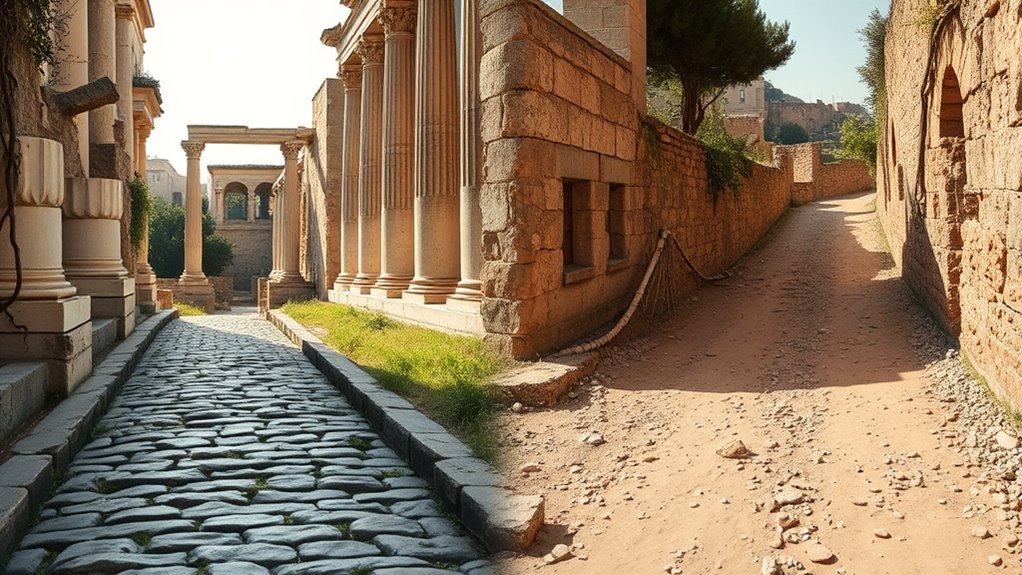
Skepticism in antiquity emerged as a philosophical movement that challenged the certainty of knowledge and promoted questioning accepted beliefs. It questioned whether we can truly know anything with certainty, leading thinkers to explore different ways of approaching doubt. Among these, two prominent paths developed: Academic Skepticism and Pyrrhonian Skepticism. Each offered a distinct method of steering uncertainty, with their own ethical implications and historical influence.
Academic Skeptics, rooted in Plato’s Academy, maintained that knowledge is always uncertain but could be approximated. They believed that through rigorous argumentation and critical examination, we could discern probable truths. Their approach often involved weighing evidence and recognizing the limits of human cognition. Ethically, this stance encouraged humility and caution in making claims, fostering an attitude of open-minded inquiry rather than dogmatism. Historically, Academic Skepticism influenced later philosophical traditions, including medieval thought and the development of scientific skepticism. Its emphasis on reasoned doubt laid groundwork for the scientific method, emphasizing the importance of evidence and continuous questioning.
Academic Skeptics prioritized reasoned doubt, humility, and open-minded inquiry, influencing science and philosophy throughout history.
In contrast, Pyrrhonian Skeptics took doubt to an extreme, advocating for epoché—suspension of judgment—to attain tranquility (ataraxia). They argued that since conflicting arguments exist on all sides, the wise person should refrain from asserting any definitive beliefs. This suspension of judgment wasn’t merely an intellectual exercise; it was a practical approach to achieve peace of mind. The ethical implications here are significant: Pyrrhonists promoted mental serenity by avoiding dogmatism, which could lead to conflicts or anxiety over uncertain truths. Their influence extends beyond philosophy, impacting later contemplative traditions and contributing to understanding how doubt can serve as a tool for personal calm. Unlike Academic Skeptics, who sought probable truths, Pyrrhonian Skeptics aimed for mental tranquility by embracing uncertainty fully, without settling on any particular belief.
Both paths of doubt challenged prevailing notions of certainty but did so differently. Academic Skepticism sought probable knowledge through reasoned debate, emphasizing the importance of ethical humility and critical inquiry. Pyrrhonian Skepticism, meanwhile, embraced doubt as a means to mental peace, advocating for suspension of belief altogether. Their combined influence shaped how we think about knowledge, belief, and the ethical responsibilities tied to epistemology. These ancient skeptics remind us that questioning isn’t just about rejecting certainty but about understanding the limits of our knowledge and the ethical stance we adopt in facing those limits.
Frequently Asked Questions
How Did Academic and Pyrrhonian Skeptics Influence Later Philosophical Thought?
You see that academic and Pyrrhonian skeptics shaped later philosophical thought by challenging epistemological foundations, encouraging questioning of certainty. Their emphasis on doubt influenced modern skepticism, pragmatism, and scientific inquiry, highlighting practical implications like open-mindedness and the importance of evidence. By promoting ongoing inquiry, they helped develop a more critical approach, fostering a mindset that values doubt as a tool for deeper understanding and shaping contemporary debates on knowledge and belief.
What Are the Key Differences in Their Approaches to Doubt?
You might think doubt always leads to uncertainty, but these skeptics show different methods. Academic skeptics seek truth through disciplined doubt, questioning beliefs until they find stable ground. Pyrrhonian skeptics, however, suspend judgment altogether, embracing uncertainty to achieve mental tranquility. Their doubt methodologies differ: one aims at uncovering truth, the other at peace of mind. Both challenge assumptions, but their ultimate goals shape their unique approaches to doubt and knowledge.
Did Skepticism in Antiquity Impact Religious or Political Institutions?
You see that skepticism in antiquity did influence religious and political institutions by shaping skeptical rhetoric, which challenged dogma and authority. This philosophical influence encouraged critical thinking and doubt about accepted beliefs, prompting leaders and thinkers to reconsider doctrines and policies. While it didn’t overthrow institutions directly, it fostered a culture of questioning that impacted how society approached faith, power, and truth, leaving a lasting legacy on Western intellectual history.
How Were Skeptics Perceived by Their Contemporaries?
Imagine standing in a crowded marketplace, your doubts echoing like whispers among the bustling crowd. Skeptics were seen as elusive figures, often misunderstood by their contemporaries. Their public perception ranged from curiosity to suspicion, and their social status varied—some viewed them as wise, others as outcasts. You might find that skeptics challenged accepted beliefs, making them both intriguing and feared, shaping how society accepted or rejected their ideas.
Are There Modern Equivalents of Ancient Skeptical Schools?
Modern skepticism echoes ancient schools, especially through scientific inquiry that questions assumptions and seeks evidence. You might see this in the way scientists hesitate to accept claims without proof, or in critical thinking movements that challenge accepted beliefs. Like Pyrrhonian skeptics, today’s skeptics suspend judgment until evidence supports a conclusion, fostering a mindset that values inquiry over dogma, helping you navigate complex information with a healthy dose of doubt.
Conclusion
Imagine standing at a crossroads, unsure which path leads to truth. That’s what ancient skeptics faced—questioning everything like travelers unsure of the road ahead. Whether you follow the academic path, seeking certainty through reason, or the Pyrrhonian route, embracing doubt itself, you’re walking a journey of self-discovery. Just like explorers charting uncharted territory, your doubts become tools, pushing you forward. In this ancient dance with uncertainty, you find the courage to question, and perhaps, to understand.