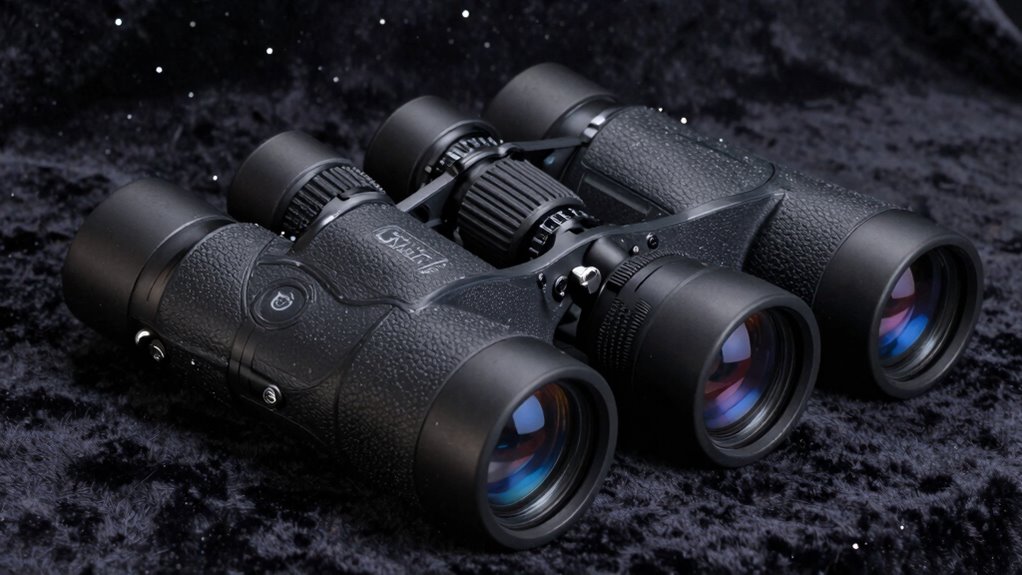
Finding the right binoculars for astronomy under $500 can significantly enhance your stargazing experience. Among the top contenders, the Celestron SkyMaster 15×70 stands out for its high magnification and large lenses, ideal for detailed deep-sky observations. The Celestron Cometron 7×50 offers a beginner-friendly approach with wide fields and easy handling. Meanwhile, the Celestron SkyMaster 20×80 is perfect for those wanting serious low-light performance without breaking the bank. Each of these options balances performance, size, and price differently, making your choice depend on your specific observing needs and portability preferences.
Key Takeaways
- Higher magnification binoculars like the SkyMaster 15×70 excel for detailed deep-sky viewing but require a tripod and are heavier.
- The 7×50 Cometron is best for beginners and casual observers due to its ease of use and wider field of view.
- Large objective lenses improve low-light performance but add weight, making some models less portable.
- Tripod compatibility is essential for high-magnification binoculars to achieve steady images.
- Budget and weight are the main tradeoffs; more powerful models tend to be bulkier and more expensive.
| Celestron SkyMaster 15×70 Astronomy Binoculars for Stargazing and Deep-Sky |  | Best Overall for Deep-Sky Observation | Magnification: 15x | Objective Lens Diameter: 70mm | Water-Resistant: Yes | VIEW ON AMAZON | See Our Full Breakdown |
| Celestron Cometron 7x50mm Astronomy Binoculars |  | Best for Beginners & Casual Use | Magnification: 7x | Objective Lens Diameter: 50mm | Field of View: 6.6° | VIEW ON AMAZON | See Our Full Breakdown |
| Celestron SkyMaster 20×80 Binoculars for Deep-Sky Astronomy |  | Best for Serious Low-Light Performance | Magnification: 20x | Objective Lens Diameter: 80mm | Exit Pupil: 4mm | VIEW ON AMAZON | See Our Full Breakdown |
| 18×70 Professional Astronomy Binoculars for Adults High Powered |  | Best for Professional-Grade Viewing | Magnification: 18x | Objective Lens Diameter: 70mm | Eye Relief: 18mm | VIEW ON AMAZON | See Our Full Breakdown |
| Celestron SkyMaster 25×70 Binoculars for Astronomy, Long-Range & Wildlife |  | Best High-Magnification for Extended Viewing | Magnification: 25x | Objective Lens Diameter: 70mm | Prism Type: BaK-4 | VIEW ON AMAZON | See Our Full Breakdown |
| binoculars for astronomy under 500 | Magnification | Objective Lens Diameter | Tripod Mount | Water-Resistant |
|---|---|---|---|---|
| Celestron SkyMaster 15×70 Astr | 15x | 70mm | ¼”-20 adapter included | Yes |
| Celestron Cometron 7x50mm Astr | 7x | 50mm | Yes | — |
| Celestron SkyMaster 20×80 Bino | 20x | 80mm | Yes | Yes |
| 18×70 Professional Astronomy B | 18x | 70mm | Yes | — |
| Celestron SkyMaster 25×70 Bino | 25x | 70mm | ¼”-20 adapter included | Yes |
More Details on Our Top Picks
Celestron SkyMaster 15×70 Astronomy Binoculars for Stargazing and Deep-Sky
The Celestron SkyMaster 15×70 combines impressive 15x magnification with large 70mm lenses, making it a top choice for those serious about deep-sky objects. It benefits from high-quality BaK-4 prisms and multi-coated optics that produce bright, sharp images even in low-light conditions. Its water-resistant design and rubber armor add durability, suitable for outdoor use. However, its size and weight mean it’s not ideal for handheld use over long periods, requiring a tripod for stability. Compared with smaller or lower-magnification models, this binoculars deliver more detail but at the cost of portability and ease of handling.
Pros:- High magnification and large objective lenses for detailed views
- Bright, sharp images in low-light conditions
- Durable, water-resistant construction with tripod compatibility
Cons:- Heavy and bulky, requiring tripod for extended use
- Less portable, not suited for casual or terrestrial use
- Higher cost compared to smaller binoculars
Best for: Deep-sky enthusiasts seeking detailed views of nebulae, star clusters, and galaxies
Not ideal for: Casual observers or those prioritizing portability and quick setup
- Magnification:15x
- Objective Lens Diameter:70mm
- Water-Resistant:Yes
- Tripod Mount:¼”-20 adapter included
- Prisms:BaK-4
- Housing:Rubber-armored
Our verdict“This binocular excels for serious astronomy where detail and brightness are paramount, but its size limits portability.”
Celestron Cometron 7x50mm Astronomy Binoculars
The Celestron Cometron 7×50 offers a straightforward, user-friendly experience with large 50mm lenses that gather plenty of light. Its wide 6.6° field makes it ideal for scanning large sky areas, perfect for beginners or casual stargazers who want an easy entry point. While it’s lightweight and easy to handle, it lacks the high magnification needed for detailed deep-sky views. Its design is durable and versatile, suitable for outdoor use and terrestrial viewing. The main tradeoff is that it doesn’t include a tripod, which could diminish image stability during long sessions.
Pros:- Easy to use with a wide field of view
- Large objective lenses for bright images
- Tripod adaptability for stability
Cons:- Tripod adapter not included
- Limited magnification at 7x
- Less suited for detailed deep-sky observation
Best for: Beginners and casual observers wanting simple, wide-field viewing
Not ideal for: Experienced astronomers seeking high magnification or detailed deep-sky views
- Magnification:7x
- Objective Lens Diameter:50mm
- Field of View:6.6°
- Close Focus Distance:26.2 feet
- Prism Type:BK7 Porro
- Tripod Mount:Yes
- Weight:Not specified
Our verdict“A reliable, beginner-friendly binocular that offers bright images and wide views but lacks the high magnification for advanced astronomy.”
Celestron SkyMaster 20×80 Binoculars for Deep-Sky Astronomy
The Celestron SkyMaster 20×80 offers a powerful 20x magnification combined with large 80mm lenses, making it a favorite among those wanting detailed views of faint objects. Its high-quality BaK-4 prisms and multi-coated optics produce bright, crisp images, especially in low-light conditions. Tripod mounting is essential given its weight and high magnification, and it’s built with rugged, water-resistant materials. While it excels at deep-sky observation, its bulk and weight make it less convenient for casual terrestrial use or quick setups. It’s a solid choice for dedicated astronomers willing to carry a bit more gear.
Pros:- High magnification and large lenses for detailed views
- Bright, sharp images with low-light conditions
- Tripod compatible and durable for outdoor use
Cons:- Heavy at over 4 pounds
- Bulky, less portable
- Premium price for casual use
Best for: Advanced amateurs seeking high magnification and low-light performance
Not ideal for: Casual users or those needing lightweight, portable binoculars
- Magnification:20x
- Objective Lens Diameter:80mm
- Exit Pupil:4mm
- Tripod Mount:Yes
- Prism Type:BaK-4
- Water-Resistant:Yes
- Included Accessories:Carrying case, neck strap, lens cloth, manual
Our verdict“Ideal for serious amateur astronomers focused on deep-sky objects, but its weight and size limit portability.”
18×70 Professional Astronomy Binoculars for Adults High Powered
The 18×70 Professional Astronomy Binoculars cater to serious hobbyists and professionals, offering high 18x magnification and 70mm lenses for detailed deep-sky exploration. Features like waterproof construction, BAK-4 roof prisms, and smartphone compatibility for digiscoping set it apart. Its weight of nearly 5 pounds means it’s best used with a tripod, but the image quality and low-light capability justify the bulk for dedicated observers. Compared to other high-powered options, this model provides a balanced mix of power, durability, and additional tech features.
Pros:- High magnification and large aperture for detailed views
- Excellent low-light and waterproof performance
- Includes smartphone adapter for digiscoping
Cons:- Heavy and bulky, less portable
- Requires tripod for stable viewing
- Premium price point
Best for: Experienced astronomers and digiscopers seeking high power and versatility
Not ideal for: Casual users or those prioritizing portability
- Magnification:18x
- Objective Lens Diameter:70mm
- Eye Relief:18mm
- Exit-Pupil Diameter:4.7mm
- Coating:Anti-Reflective
- Water Resistance Level:Waterproof
- Tripod Mount:Yes
Our verdict“Best suited for dedicated astronomers needing high power and tech features, despite the weight and cost.”
Celestron SkyMaster 25×70 Binoculars for Astronomy, Long-Range & Wildlife
The Celestron SkyMaster 25×70 offers a potent 25x magnification combined with large 70mm lenses, making it a prime choice for detailed terrestrial and astronomical viewing. It features BaK-4 prisms and multi-coated optics for bright, sharp images, with a rugged, water-resistant exterior. The main tradeoff is weight; at over 4 pounds, it’s best used with a tripod for stability during extended sessions. Its high magnification can be overly sensitive to hand shake, so it’s less suited for casual or quick observation but excellent for focused, stable viewing.
Pros:- High 25x magnification for detailed observation
- Bright images in low-light conditions
- Durable, water-resistant build with tripod compatibility
Cons:- Heavy, requires tripod for prolonged use
- Bulky for everyday or casual use
- Potentially cumbersome for quick setups
Best for: Long-range viewing and serious astronomy enthusiasts
Not ideal for: Casual observers or those needing lightweight, portable options
- Magnification:25x
- Objective Lens Diameter:70mm
- Prism Type:BaK-4
- Water-Resistant:Yes
- Tripod Mount:¼”-20 adapter included
- Included Accessories:Tripod adapter, objective lens caps, rainguard, carrying case, neck strap, lens cloth, manual
Our verdict“A powerful, durable binocular for long-distance viewing, best used with a tripod due to weight and high magnification.”

How We Picked
Our selection process focused on binoculars offering the best balance of optical quality, magnification, durability, and value within the under $500 price range. We prioritized models with large objective lenses for low-light performance, tripod compatibility for stable viewing, and durable, weather-resistant construction. Features like multi-coated optics and high-quality prisms were essential, as they directly impact image brightness and clarity. We also considered user versatility—whether the binoculars are suitable for both astronomy and terrestrial use—and aimed to include options for different experience levels and priorities, from casual stargazers to more serious hobbyists.
| binoculars for astronomy under 500 | Tripod Mount | Prism Type |
|---|---|---|
| Celestron SkyMaster 15×70 Astr | ¼”-20 adapter included | — |
| Celestron Cometron 7x50mm Astr | Yes | BK7 Porro |
| Celestron SkyMaster 20×80 Bino | Yes | BaK-4 |
| 18×70 Professional Astronomy B | Yes | — |
| Celestron SkyMaster 25×70 Bino | ¼”-20 adapter included | BaK-4 |
Factors to Consider When Choosing Binoculars For Astronomy Under 500
Choosing the right binoculars for astronomy under 500 depends on your specific observing goals, portability needs, and experience level. The key factors include magnification, objective lens size, weight, and compatibility with a tripod. Higher magnification provides more detail but often requires stabilization, while larger lenses improve low-light performance but add bulk. Balancing these features against your planned use—whether deep-sky exploration, terrestrial viewing, or casual stargazing—will help you find a model that offers the best value and experience.Magnification and Field of View
Magnification determines how close objects appear, but higher magnification often means a narrower field of view and more sensitivity to hand shake. For astronomy, a range between 7x and 20x offers good detail without excessive instability. Wide field of view is beneficial for scanning large sky areas and locating objects, especially for beginners. Consider your comfort with holding heavier binoculars at higher magnifications, or plan to use a tripod for stability with models above 15x.
Objective Lens Size and Light Gathering
The objective lens size, measured in millimeters, directly impacts low-light performance. Larger lenses—such as 70mm or 80mm—collect more light, making them excellent for night sky viewing, but they also increase weight and bulk. For casual or portable use, 50mm lenses strike a balance between brightness and convenience. Think about where you’ll be observing most often—out in the open or in more confined spaces—and choose accordingly.
Portability and Stabilization
Weight and size are critical when considering how portable your binoculars will be. Compact models around 1-2 pounds are easier to carry and handle for quick viewing, but may sacrifice some light gathering power. Heavier, bulkier models often require a tripod—almost essential at high magnifications—to produce steady images, especially for deep-sky observations. If you plan to travel or hike with your binoculars, prioritize lighter, more compact options or invest in a sturdy tripod for stability.
Durability and Weather Resistance
Outdoor conditions vary, so selecting binoculars with water resistance and rugged construction extends their lifespan. Features like rubber armor, sealed housing, and waterproofing help protect against dust, moisture, and accidental drops. These qualities are especially valuable if you’ll be observing in unpredictable weather or rugged terrains, ensuring your investment remains protected over time.
Frequently Asked Questions
Can I use these binoculars for terrestrial viewing as well?
Absolutely. Most binoculars in this range are versatile enough for both astronomy and terrestrial use. A wider field of view and lower magnification, like 7x50s, make for easier landscape viewing and birdwatching. Higher magnification models can still be used on land but might require a tripod for stability, especially at magnifications above 15x.
Is a tripod necessary for all high-magnification binoculars?
For binoculars with magnification above 15x, a tripod is highly recommended to counteract hand shake and produce clear, stable images. While some models include tripod adapters, the added bulk makes them less convenient for quick or casual use. Smaller magnifications, like 7x or 10x, can often be handheld comfortably.
How important are the prism types and coatings?
Prisms and coatings directly influence image brightness, contrast, and sharpness. BaK-4 prisms generally outperform BK7, offering brighter and clearer images. Multi-coated optics reduce glare and light loss, especially in low-light conditions typical of night sky viewing. Investing in good-quality optics ensures better viewing experiences without necessarily increasing the budget.
Are waterproof and fog-proof features necessary?
These features are highly beneficial if you plan to use your binoculars outdoors in varying weather conditions. Waterproof and fog-proof models prevent internal fogging and water damage, helping your binoculars withstand rain, dew, and humidity. Such durability extends the lifespan and maintains optical performance over time.
What should I prioritize if I want portability?
If portability is your main concern, look for compact models with smaller objective lenses, ideally under 50mm. These are easier to carry and handle, especially for casual or travel use. However, remember that smaller lenses may reduce low-light performance, so balance size with your typical observing environment and needs.
Conclusion
If you are a beginner or casual stargazer, the Celestron Cometron 7×50 provides excellent value with its wide field and ease of use. Serious deep-sky enthusiasts will find the Celestron SkyMaster 15×70 or 20×80 models more suitable for their need for brightness and detail, despite their size and weight. For those seeking professional-grade features without crossing the $500 mark, the 18×70 Professional Astronomy Binoculars offer a balanced package of power, durability, and tech integration. Ultimately, your choice hinges on your observing goals, portability preferences, and budget constraints, but each of these options can significantly enhance your night sky adventures.