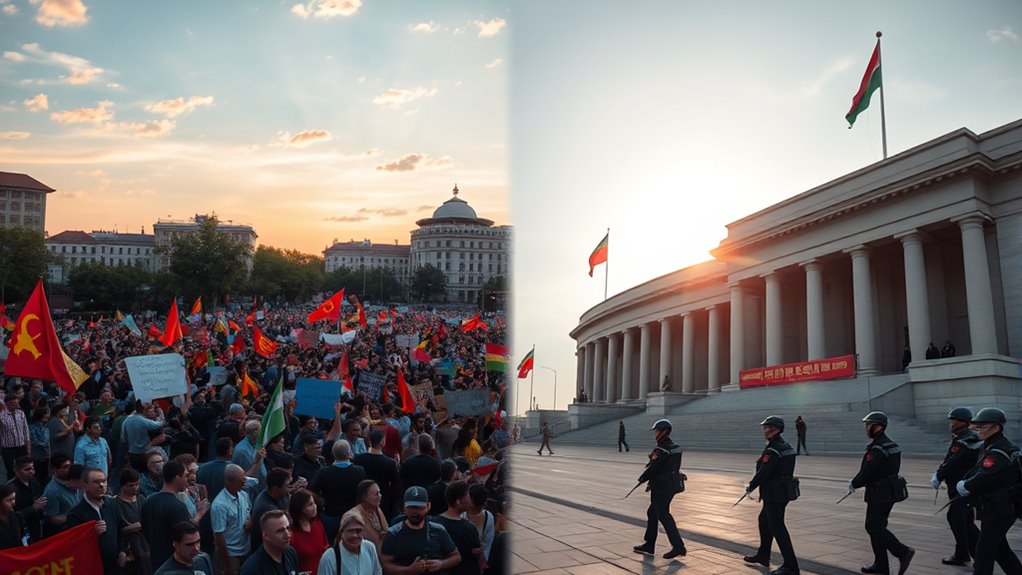

As 2025 ends, understanding the difference between democracy and authoritarianism shows how governance impacts freedom, stability, and society. Democracies prioritize free elections, civil liberties, and transparency, fostering social cohesion and accountability. In contrast, authoritarian regimes control power through censorship, repression, and limited participation, often sacrificing stability for control. Recognizing these differences helps you see which systems promote resilience and human rights. If you want to explore how these approaches shape our world further, there’s more to uncover.
Key Takeaways
- Democratic systems emphasize transparent elections, civil liberties, and social cohesion, promoting societal resilience and accountability.
- Authoritarian regimes often manipulate elections, restrict freedoms, and prioritize control, leading to repression and reduced public trust.
- Global trends in 2025 highlight rising threats to democracy from misinformation, polarization, and authoritarian resurgence.
- Democratic institutions remain vital for safeguarding individual freedoms and adapting to geopolitical shifts.
- Understanding the differences underscores the importance of defending democratic principles amid evolving global challenges.
Democracy and authoritarianism represent two fundamentally different approaches to governance, each shaping societies in unique ways. As 2025 draws to a close, it’s clear that these differences continue to influence global stability, development, and individual freedoms. In democracies, election integrity is paramount. You are guaranteed that elections are fair, transparent, and reflect the true will of the people. This process empowers you to participate actively, knowing your vote counts and contributes to shaping policies and leadership. Civil liberties are also central in democratic systems. You enjoy freedoms of speech, assembly, and press—allowing you to express your opinions without fear of repression. These liberties foster open debates, accountability, and a vibrant civil society that holds leaders responsible.
In contrast, authoritarian regimes often manipulate or undermine election integrity. You might find that elections are staged or heavily controlled, serving the interests of a ruling elite rather than reflecting genuine popular choice. This lack of transparency erodes trust and leaves you feeling powerless, as your voice is often silenced or ignored. Civil liberties are frequently restricted in such systems. You may face censorship, surveillance, or persecution if you challenge the government or voice dissenting opinions. These restrictions suppress public participation and hinder societal progress, creating an environment where fear and conformity replace free expression and critical thinking.
The impact of these governance models extends beyond individual freedoms. Democracies tend to promote social cohesion and stability because they incorporate diverse voices and provide mechanisms for conflict resolution. You benefit from a system where your rights are protected, and you can seek justice through independent courts and free media. Conversely, authoritarian regimes often prioritize control and stability at the expense of personal freedoms. While they may claim to bring order, this often results in repression, human rights abuses, and a lack of accountability. You might notice that dissent is met with harsh punishments, and corruption can flourish unchecked, as there are few checks on those in power.
As global democracies face challenges such as misinformation, polarization, and threats to election integrity, you need to be vigilant. Protecting civil liberties becomes even more *essential* in maintaining trust and ensuring that governments remain accountable to the people they serve. Recognizing the importance of free and fair elections is crucial for safeguarding democracy and preventing authoritarian tendencies from gaining ground. Conversely, authoritarian regimes may appear stable on the surface but usually lack the resilience and adaptability that come with democratic institutions. Understanding these fundamental differences helps you recognize the importance of safeguarding democratic principles and civil liberties, especially as the world navigates complex geopolitical shifts heading into 2026.
Top picks for "democracy authoritarianism global"
Open Amazon search results for this keyword.
As an affiliate, we earn on qualifying purchases.
Frequently Asked Questions
How Do Hybrid Regimes Impact Global Stability?
Hybrid regimes can threaten global stability by undermining civil liberties and weakening political stability. You might notice that these regimes often mask authoritarian tendencies with democratic elements, making it harder to identify threats early. This ambiguity fosters uncertainty, encourages regional tensions, and can destabilize neighboring countries. As a result, hybrid regimes challenge the international order, and their unpredictable nature can lead to increased conflicts and instability worldwide.
What Role Does Technology Play in Authoritarian Control?
You’re playing with fire when you ignore how technology fuels authoritarian control. It enables surveillance capitalism, allowing regimes to monitor citizens constantly, and digital censorship, which suppresses dissent and manipulates information. This digital toolbox gives authoritarian leaders a powerful edge, making it easier to tighten grip on power and stifle opposition. As the saying goes, “the pen is mightier than the sword,” but in this case, the digital device is mightier than ever.
Can Democracies Recover From Democratic Backsliding?
Yes, democracies can recover from backsliding if you actively support popular protests and strengthen electoral resilience. When citizens stand up against erosion of democratic norms, it inspires political accountability and reforms. Your participation in protests and voting helps rebuild trust and safeguards institutions. By staying engaged, you guarantee that democratic processes remain robust, preventing future backsliding and promoting a resilient, vibrant democracy that responds to your needs.
How Do Cultural Differences Influence Governance Models?
You see, cultural differences substantially shape governance models, with over 70% of countries valuing cultural conformity in their policies. These values influence whether a nation adopts more centralized or diverse governance structures. When you consider governance diversity, it becomes clear that cultural norms guide how leaders balance tradition and innovation. Your understanding of these influences helps explain why some countries prioritize collective harmony, while others emphasize individual freedoms in their governance systems.
What Metrics Best Measure Democratic Quality?
You should look at metrics like electoral integrity and civil liberties to measure democratic quality effectively. Electoral integrity assesses how free and fair elections are, reflecting the health of your democracy. Civil liberties protect individual freedoms, ensuring citizens can participate without fear. Together, these indicators give a clear picture of democratic strength—highlighting whether your governance respects rights and maintains fair electoral processes.
Conclusion
As 2025 draws to a close, you see democracy and authoritarianism standing side by side—each shaping, each challenging, each influencing the world stage. You recognize the fragile balance between freedom and control, transparency and secrecy, progress and repression. You understand that your choices, your voices, your vigilance can tip the scales. In this ongoing struggle, you hold the power—power to defend democracy, to challenge authoritarianism, to shape a future rooted in justice, in hope, in unwavering resolve.