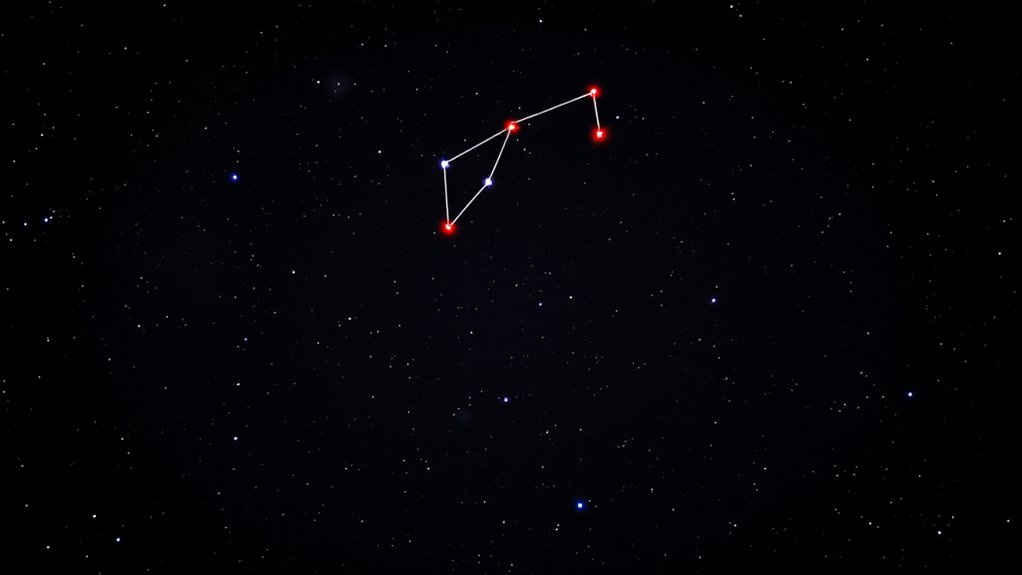

Imagine your night sky as a storybook, with Orion the Hunter standing tall among shimmering stars. Follow his constellation pattern, starting with his Belt of three bright stars, then find Betelgeuse on his shoulder and Rigel on his foot. Visualize his figure by connecting these stars and learning the myth of a mighty hunter chasing celestial creatures. Keep exploring; each star has a story waiting to unfold, revealing more about Orion’s legendary place in the cosmos.
Key Takeaways
- Orion the Hunter appears as a prominent constellation in the winter night sky, recognizable by Orion’s Belt and bright stars like Betelgeuse and Rigel.
- Use Orion’s Belt as a celestial landmark to locate the constellation and trace its outline across the sky.
- Mythologically, Orion is depicted as a mighty hunter, adding storytelling depth to star gazing and helping memorize his pattern.
- Find a dark, clear location and utilize stargazing apps to identify Orion and understand its position relative to other stars.
- Repeated observation and visualizing Orion’s mythic story enhance recognition and transform star gazing into an engaging storytelling experience.

On clear nights, the night sky transforms into a storybook filled with shimmering characters and guiding constellations. As you look up, Orion the Hunter begins to emerge, his figure etched across the darkness in brilliant stars. Learning about constellation myths can deepen your connection to this celestial pattern, turning star gazing tips into a captivating adventure. Many ancient cultures saw Orion as a mighty warrior or a great hunter, and these stories are woven into the very fabric of the stars. When you spot Orion’s Belt, you’re seeing three bright stars in a neat line—his waist, according to myth. Recognizing these key features makes it easier to identify him among the vast sky.
On clear nights, Orion’s stars tell stories of warriors and hunters across the cosmos.
To truly appreciate Orion, you should start with simple star gazing tips. Find a dark place away from city lights, which can drown out the faint glow of stars. Use your phone with a stargazing app to locate Orion, especially during winter months when he’s most visible. Once you’ve found Orion’s Belt, trace the outline of his figure, noting his shoulders, hips, and the sword hanging from his belt. The brightest star in Orion, Betelgeuse, marks his shoulder, while Rigel shines as his foot. These stars serve as celestial landmarks, guiding your understanding of the constellation’s shape. Additionally, understanding the contrast ratio of the night sky can help you better see faint stars and details in the dark.
As you gaze, take a moment to learn the constellation myths that surround Orion. Many stories tell of him as a giant hunter, chasing after celestial animals or battling monsters. These myths not only add depth to your stargazing experience but also help you memorize the patterns. Visualizing Orion’s mythic story makes it easier to remember his position against the starry backdrop. Remember, the key to good star gazing is patience. Wait for a clear night, settle into a comfortable spot, and let your eyes adjust to the dark. The more you observe, the more Orion begins to feel like an old friend guiding you through the cosmos.
With practice, you’ll recognize Orion quickly, and his myth will come alive each time you find him. The combination of constellation myths and star gazing tips transforms an ordinary night under the stars into an extraordinary journey. As you connect the stars to stories, Orion’s figure becomes more than just a pattern—he’s a legendary figure shining brightly in the universe, waiting for you to discover his tale. So, when the night sky beckons, remember that you’re not just looking at stars—you’re exploring stories written across the cosmos, and Orion is the hero leading the way.
Top picks for "orion hunter night"
Open Amazon search results for this keyword.
As an affiliate, we earn on qualifying purchases.
Frequently Asked Questions
How Can I Identify Orion Easily in the Night Sky?
To identify Orion easily in the night sky, start with celestial navigation by finding three bright stars that form Orion’s Belt, a distinctive straight line. Use constellation myths to remember Orion’s shape as a hunter with a sword and shield. Look for the three stars in a row and nearby bright stars like Betelgeuse and Rigel, which make Orion stand out among other constellations.
What Stories Are Associated With Orion Across Different Cultures?
When you look into Orion’s mythological origins, you’ll find stories that span cultures. In Greek mythology, he’s a mighty hunter, while in Egyptian tales, he’s linked to Osiris. Many cultures see Orion as a symbol of heroism and guidance. You’ll find that his story is a thread woven into different cultural fabrics, showing how a single constellation can hold many stories that are worth exploring.
When Is the Best Time to Observe Orion in the Sky?
You’ll want to observe Orion when it’s most visible, which depends on seasonal visibility and celestial alignment. In the Northern Hemisphere, you can see Orion best during winter months, from late fall to early spring, when it rises in the evening sky. In the Southern Hemisphere, it’s prominent during summer months. Keep an eye on the night sky during these times for a clear view of Orion’s striking constellation and its myths.
What Equipment Is Recommended for Viewing Orion’S Features?
You won’t believe your eyes when you see Orion’s features! To get the most out of your view, use a powerful telescope, like a reflector or refractor, depending on your needs. Binoculars with high magnification can also reveal stunning details. Don’t forget accessories like a sturdy tripod, extra lenses, and filters to enhance clarity and contrast. These tools transform your night sky exploration into an unforgettable adventure!
How Does Orion’S Position Change Throughout the Year?
Throughout the year, you’ll notice Orion’s position shifts due to seasonal star shifts caused by Earth’s orbit. In winter, Orion appears prominent in the evening sky, but as seasons change, it drifts westward and becomes less visible, rising later at night. This movement helps you with celestial navigation, allowing you to track seasons and locate other constellations by understanding Orion’s changing position and its relation to nearby stars.
Conclusion
As you gaze at Orion tonight, remember he’s one of the most recognizable constellations, visible in over 80 countries worldwide. This incredible reach shows how the night sky unites us across cultures and continents. Just think—his three-star belt is a celestial landmark that’s been guiding travelers and storytellers for thousands of years. Next time you look up, realize you’re part of a global tradition, connected by the timeless wonder and stories of Orion the Hunter.