

Hermes’ winged sandals, or talaria, symbolize divine speed, helping you understand how ancient Greeks viewed swift movement and messaging. These sandals represent more than just quick travel—they embody cleverness, communication, and divine intervention, allowing Hermes to deliver messages and guide souls effortlessly. They remind us of the importance of rapid movement in ancient logistics and cultural beliefs. Exploring their symbolism reveals how speed and innovation shaped both myth and modern thinking—keep exploring to discover more.

Prime made for students and young adults
- Fast, free delivery for dorm and study essentials
- Prime Video and Amazon Music included
- Member-only deals
Key Takeaways
- Hermes’ winged sandals, or talaria, symbolize divine speed and agility, enabling swift movement for messaging and transport in Greek mythology.
- They represent revolutionary concepts of instant communication and rapid logistics in ancient cultures.
- The talaria embody mythological innovation, illustrating divine ability to traverse vast distances instantly, symbolizing quick divine intervention.
- Modern metaphors link Hermes’ sandals to efficiency, responsiveness, and the importance of swift action in communication and transportation.
- The sandals highlight the divine role in facilitating timely messages, guiding souls, and maintaining connections between gods and mortals.
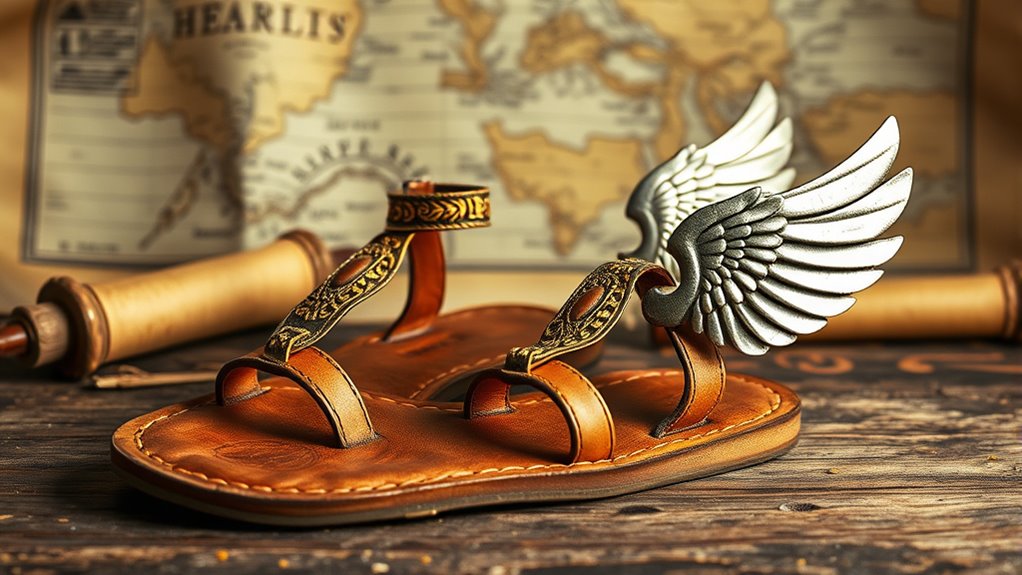
Hermes’ winged sandals, known as the talaria, are legendary symbols of speed and agility in Greek mythology. When you think of swift movement, these sandals immediately come to mind, embodying mythological symbolism that extends beyond mere transportation. They represent not just physical speed but also communication, cleverness, and the swift delivery of messages. In ancient times, Hermes was seen as the messenger of the gods, and his winged footwear encapsulates this role perfectly. These sandals enabled him to traverse the world swiftly, delivering divine messages, guiding souls to the underworld, and even assisting gods and mortals alike in urgent tasks. Through their mythological symbolism, the talaria became more than just footwear—they became a symbol of rapid movement, timely communication, and divine intervention. The idea of speed was so central to Hermes’ identity that it influenced how ancient cultures envisioned divine and mortal interactions across distances.
In the context of ancient transportation, these sandals symbolize a groundbreaking leap in how stories of travel and logistics were imagined. Unlike the slow chariots or cumbersome ships used in antiquity, Hermes’ winged sandals allowed for instantaneous movement across vast distances. Imagine yourself donning the talaria; you’d effortlessly glide through the air, bypassing obstacles, borders, and delays that hampered ordinary means of travel. This mythological innovation highlights how ancient cultures envisioned speed as a divine attribute, emphasizing Hermes’ unique role in the pantheon. His sandals made it possible for gods to stay connected with mortals, for messengers to deliver essential news swiftly, and for travelers to reach their destinations almost instantaneously. The mythological symbolism embedded in the talaria underscores their significance in conceptualizing the importance of quick communication and transportation in ancient civilizations.
Moreover, Hermes’ winged sandals serve as an enduring metaphor for modern concepts of speed and efficiency. They remind you that in both myth and reality, swift movement is often linked to intelligence and purpose. The ancient transportation methods may have been slow, but the myth of Hermes’ talaria inspired generations to think beyond physical limitations and aim for rapid, effective solutions. Whether you’re delivering a message or rushing to an appointment, the image of Hermes’ wings encourages a mindset of agility and responsiveness. Today, the idea of “winged” speed persists in our language and symbols, rooted in the mythological symbolism of Hermes and his legendary sandals. They continue to symbolize not just swift movement but also the power of communication, innovation, and divine assistance.
As an affiliate, we earn on qualifying purchases.
Frequently Asked Questions
How Did Hermes Acquire His Winged Sandals?
You might wonder how Hermes got his winged sandals. According to myth, these sandals are part of his mythical origins, gifted by the gods to symbolize his role as messenger and swift traveler. Their symbolic significance highlights his speed and agility, enabling him to move quickly across gods and humans alike. The sandals represent his divine authority and connection to communication, making him an essential figure in Greek mythology.
Are There Any Modern Equivalents Inspired by Hermes’ Sandals?
Imagine a world where you’re faster than the eye can see—modern equivalents of Hermes’ sandals. Today, you find them in cutting-edge sneaker technology and wearable fitness devices. These innovations boost your speed, track your movement, and keep you connected. Just as Hermes’ sandals symbolized swift communication, today’s gear helps you stay linked and agile, bridging ancient myth and modern ingenuity in a race toward a more active, connected future.
What Materials Were Used to Craft Ancient Winged Sandals?
You might wonder what materials crafted ancient winged sandals, reflecting mythological symbolism and material craftsmanship. Historically, artisans used leather for the main structure, providing flexibility and durability. The wings and decorative elements often featured gold or silver accents to symbolize divine power and speed. These materials combined functionality with symbolic meaning, showcasing the skill of ancient craftsmen and their desire to embody Hermes’ swift messenger role through both myth and material.
Did Other Gods Have Similar Footwear or Accessories?
Imagine gods donning divine footwear that mirrors their powers—like Athena’s helmet of wisdom or Apollo’s lyre. While Hermes’ winged sandals symbolize speed, other mythological accessories highlight their unique traits. For instance, Athena’s aegis offers protection, and Poseidon’s trident commands the seas. These divine accessories visually reinforce each god’s domain, making their mythological identities as vivid as the stories they inspire.
How Did Hermes’ Sandals Influence Ancient Transportation Methods?
You see, Hermes’ sandals symbolize mythical speed and divine messaging, revolutionizing how gods communicated and traveled. While they didn’t directly influence ancient transportation methods, they inspired ideas of swift movement and divine authority. This mythological symbol emphasized the importance of rapid communication and mobility, influencing ancient cultures’ views on transportation and courier systems. So, Hermes’ sandals became a powerful metaphor for speed and divine connection, shaping cultural perceptions of movement and messaging.
As an affiliate, we earn on qualifying purchases.
Conclusion
As you imagine Hermes soaring through the skies with his winged sandals, think of how ancient messengers relied on them like modern email—speeding messages across vast distances in moments. Just as Hermes’s swift wings revolutionized communication, today’s logistics and technology keep us connected faster than ever. So next time you send a message or receive a package, remember the legendary god’s wings—reminding you that speed and messaging have always been about breaking barriers.
As an affiliate, we earn on qualifying purchases.
As an affiliate, we earn on qualifying purchases.
Halloween Picks
halloween
As an affiliate, we earn on qualifying purchases.