
📊 Full opportunity report: US GLP-1 Pharmacy Index: Stock, Doses, And Prices on IdeaNavigator AI — validation score, market gap, and execution plan.

Prime made for students and young adults
- Fast, free delivery for dorm and study essentials
- Prime Video and Amazon Music included
- Member-only deals
TL;DR
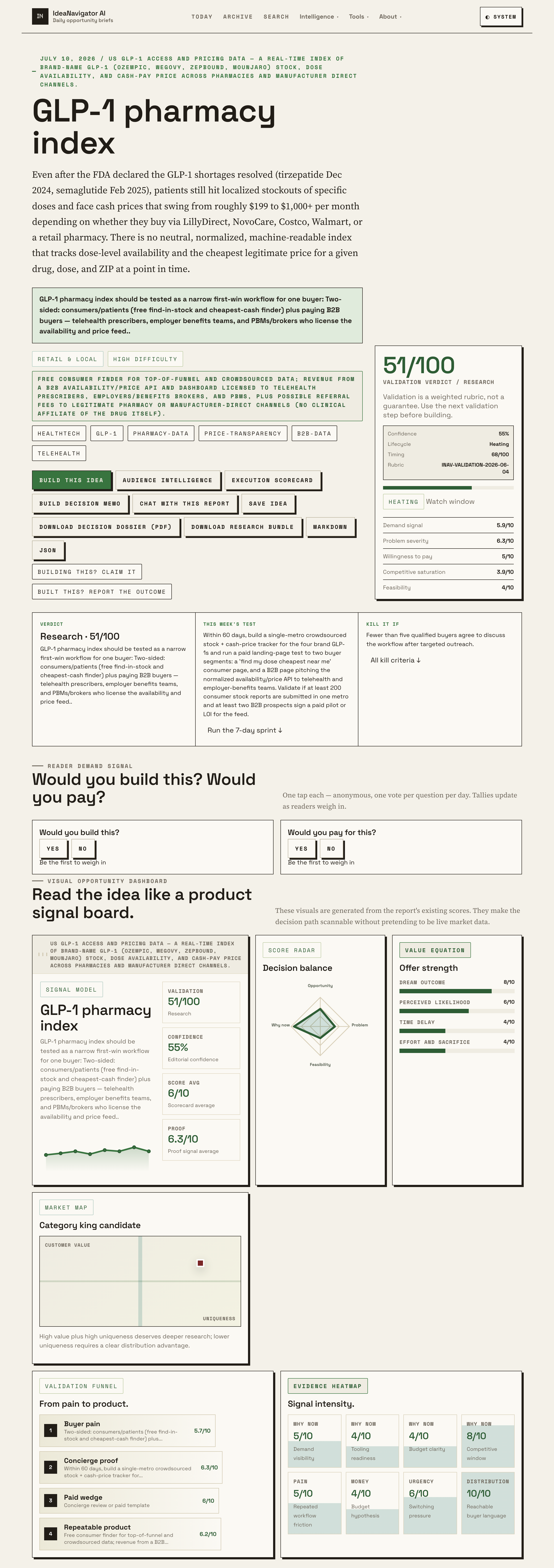
A proposal calls for a US index showing dose-level availability and cash prices for four brand-name GLP-1 drugs by ZIP code. The concept is an early-stage business proposal, not an operating service: its suggested tests include collecting 200 consumer stock reports in one metro and securing two paid pilots or letters of intent from business customers.
IdeaNavigator AI has proposed a US GLP-1 pharmacy index that would show dose-level stock and cash prices for four brand-name drugs by ZIP code, addressing local supply gaps and price differences that persist after federal shortage declarations ended. The proposal describes a planned service, not a currently available index, and its claims about local availability and prices are not independently verified here.
The proposed tool would cover Ozempic, Wegovy, Zepbound and Mounjaro. Patients could search for a specified drug and dose near them and compare cash prices from manufacturer-direct channels, including LillyDirect and NovoCare, as well as Costco, Walmart and retail pharmacies. Crowdsourced reports would contribute stock information, while a normalized price layer would aim to make offers easier to compare.
IdeaNavigator AI says cash prices can range from about $199 to more than $1,000 per month, depending on the product and purchase channel. The proposal does not specify the doses, time period, eligibility rules or price components behind that range. The figures should be treated as an estimate in the proposal, not a verified current price list.
The business model would pair a free consumer search and alert service with a paid availability and price feed for telehealth prescribers, employers and benefits brokers, and pharmacy benefit managers. The proposal also identifies possible referral fees from legitimate pharmacy or manufacturer-direct channels. It recommends beginning with a single metro and testing demand over 60 days, with targets of 200 consumer stock reports and two paid pilots or letters of intent from business customers.
A Shift From Shortages to Local Gaps
The proposed index responds to a change in the access problem: a drug can be off a federal shortage list while a particular dose remains difficult to find in a particular area. A national shortage status does not tell a patient which nearby pharmacy has a dose available today or what the cash price would be. A ZIP and dose-level view could make that difference visible, if reports are current and reliable.
For patients paying cash, comparing channels could help identify lower-cost legitimate options. For organizations that cover prescriptions or support prescribing, standardized local data could help them understand availability and compare prices. IdeaNavigator AI says employers report GLP-1s account for roughly 20% of pharmacy spend, but the proposal gives no survey, population or time period for that figure. It is an attributed estimate, not a universal measure.
The index would only be useful if its information is accurate and timely. Pharmacy inventory can change quickly, and crowdsourced reports may be uneven across neighborhoods or doses. Price comparisons would also need to distinguish eligibility conditions and what each quoted amount includes. Without those details, a low listed price may not be comparable or available to every patient.
Top picks for "pharmacy index stock"
As an affiliate, we earn on qualifying purchases.
Federal Shortage Status Changed
The proposal says the FDA declared the tirzepatide shortage resolved in December 2024 and the semaglutide shortage resolved in February 2025. Those dates are presented as context for the business case; the proposal does not supply FDA records or explain the regulatory criteria. The index idea rests on a distinction between national shortage status and local, dose-specific availability.
IdeaNavigator AI also points to changes in how brand-name drugs are sold for cash, including manufacturer-direct channels and offers associated with Costco and Walmart. It cites the launch of the TrumpRx portal in February 2026 as part of that expanding landscape. These developments leave patients facing multiple channels and terms, according to the proposal, but it does not provide a dated comparison of their prices or coverage.
The suggested first version would focus on four branded drugs and public price information, rather than attempting to track every weight-loss medicine. That narrower scope would make a one-metro test more manageable, while leaving open whether users and business buyers would find the resulting coverage broad enough to rely on.
Coverage and Price Data Remain Untested
No working product, pharmacy data agreements, or participating business customers are identified in the proposal. It is unclear how the service would verify stock reports, how often it would refresh listings, or how it would handle stale or conflicting information. The proposal also does not define what qualifies as the cheapest legitimate price or how it would account for eligibility requirements and other conditions attached to cash offers.
The quoted price range and employer-spending estimate lack stated methods and comparison baselines. It is also unknown whether patients would submit enough reports to make a metro-level finder useful, or whether telehealth and employer-benefits buyers would pay for the feed. Those are questions the proposed pilot is meant to test, not results already achieved.
A Proposed 60-Day Market Test
The next step proposed by IdeaNavigator AI is a single-metro test lasting 60 days. It would combine crowdsourced stock reports with normalized public cash-price information for the four drugs, then present separate offers: a consumer finder and a business pitch for an availability and price API.
The stated validation targets are at least 200 consumer stock reports in the metro and two business prospects signing a paid pilot or letter of intent. The proposal does not name a launch date, metro, development team or committed partners. Until those details emerge and the targets are tested, the index remains a business concept rather than a confirmed service.
Source: IdeaNavigator AI
Key Questions
Is the GLP-1 pharmacy index already available?
No. IdeaNavigator AI describes a proposed product and a pilot plan; it does not identify an operating index.
Which medicines would it cover?
The proposed first version would track Ozempic, Wegovy, Zepbound and Mounjaro by drug, dose and ZIP code.
What prices would the index compare?
It would compare cash prices from manufacturer-direct channels and participating retailers or pharmacies. The proposal cites a range of about $199 to more than $1,000 per month, but does not provide enough detail to verify or directly compare those figures.
How would the proposal be tested?
It suggests a 60-day test in one metro, aiming for 200 consumer stock reports and two paid pilots or letters of intent from business buyers.
Source: IdeaNavigator AI
Halloween Picks
halloween
As an affiliate, we earn on qualifying purchases.