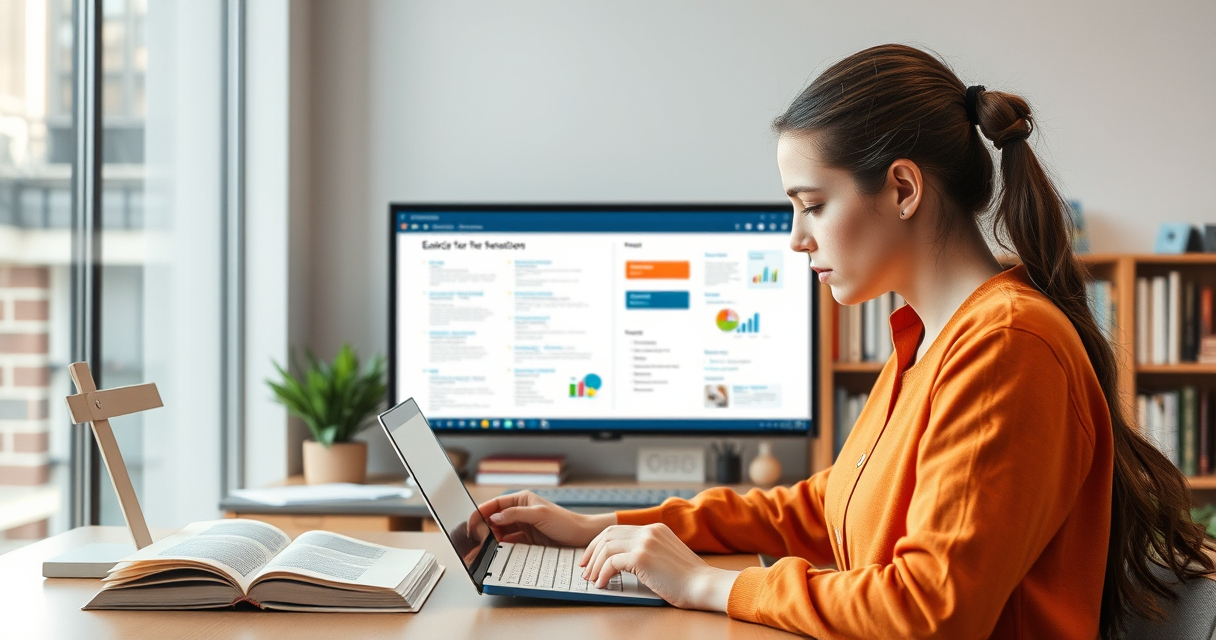
Education becomes more useful when facts, tools, and practical skills work together. A reference book can clarify a difficult idea, a calculator can make complex coursework manageable, and a microscope can turn an abstract lesson into direct observation. The right workspace technology also matters: students, teachers, researchers, and lifelong learners all benefit from dependable ways to write, organize, analyze, present, and protect their work.
This hub is an orientation to the broad world of education, science, and reference resources. It explains how to choose materials by purpose, build an effective study system, evaluate scientific tools, and make sensible technology decisions without buying equipment simply because it looks advanced. Use it to identify what you actually need, then follow the linked guides for deeper comparisons in each category.
Start With the Learning Goal
Before choosing a book, device, or digital tool, define the job it must perform. A student preparing for an exam has different needs from a parent supporting home experiments, an educator demonstrating scientific principles, or an independent learner exploring a new subject. The most useful resource is not necessarily the most comprehensive one. It is the one that fits the learner’s current question and level of understanding.
Understand, calculate, observe, or create
Most educational resources serve one or more of four basic functions. Reference materials help readers understand concepts and check facts. Calculators and software support analysis. Laboratory and observation tools make phenomena visible or measurable. Computers and workspace equipment help people create, store, and communicate what they learn.
Separating these functions prevents mismatched purchases. Someone who needs quick explanations may benefit more from a well-organized reference book than from specialized equipment. A student working through algebra, chemistry, physics, or statistics may need a calculator that matches the course rules. A learner studying specimens or electronics may gain more from a suitable microscope than from another general textbook.
scientific reference books for students
As an affiliate, we earn on qualifying purchases.
As an affiliate, we earn on qualifying purchases.
Building a Reliable Reference Library
A useful reference library does not need to be enormous. It needs to cover foundational concepts, provide clear navigation, and help the reader move from a basic definition to a deeper explanation. Start with the subjects used most frequently, such as mathematics, biology, chemistry, physics, earth science, or general scientific literacy.
The guide to educational science reference books is a practical starting point for comparing resources intended to support study and exploration. When considering any reference title, look beyond the topic printed on the cover. Examine its intended audience, organization, diagrams, glossary, index, examples, and publication context.
Choose the right level
A book that is too elementary may offer definitions without enough explanation, while an advanced academic text may assume knowledge the reader has not yet developed. The best level is usually one that explains familiar ideas clearly while introducing some challenging material. Sample pages, tables of contents, and indexes can reveal more about suitability than promotional descriptions.
Use multiple kinds of sources
No single source is ideal for every question. General encyclopedic references are helpful for orientation, textbooks provide structured instruction, handbooks support quick lookup, and primary research presents original findings. Educational websites and videos can add demonstrations, but their authority, citations, date, and purpose should be checked carefully.
For important claims, compare multiple credible sources. Distinguish established scientific consensus from a hypothesis, personal interpretation, or preliminary result. Record where information came from so that it can be revisited and cited correctly.
digital microscopes for home experiments
As an affiliate, we earn on qualifying purchases.
As an affiliate, we earn on qualifying purchases.
Choosing Calculators for Coursework
A scientific calculator is often one of the most frequently used tools in secondary and higher education. The right model depends on the course, permitted exam features, notation style, display, and the functions a learner is expected to use. More functions are not automatically better. An unfamiliar interface can slow down routine work and make errors harder to notice.
Students can begin with the guide to the best scientific calculators for students. Learners who regularly move between classrooms, libraries, laboratories, and examination rooms may also want to compare portable scientific calculators.
Check rules before choosing
Schools, instructors, testing organizations, and individual examinations may restrict calculator capabilities. Confirm the applicable policy before buying or relying on a model. Pay attention to graphing, symbolic algebra, programmability, equation solving, stored notes, and communication features, since these may affect whether a calculator is permitted.
Learn the interface early
A calculator supports reasoning; it does not replace it. Learners should understand the operation being performed, estimate the likely result, and recognize impossible outputs. Practice entering fractions, exponents, roots, logarithms, trigonometric expressions, and scientific notation before using the calculator under time pressure. Parentheses, angle modes, and order of operations are common sources of avoidable mistakes.
scientific calculator for physics and chemistry
As an affiliate, we earn on qualifying purchases.
As an affiliate, we earn on qualifying purchases.
Turning Science Into Direct Observation
Hands-on observation helps connect vocabulary and theory with visible evidence. Microscopes can support lessons involving plants, fibers, insects, manufactured materials, electronics, and other suitable specimens. Digital models can make images easier to share on a screen, document for reports, or discuss with a group.
The guide to digital microscopes for students can help readers explore this category. The intended activity should guide the choice. Inspecting a circuit board, viewing a leaf surface, and studying prepared biological slides may call for different working distances, lighting arrangements, stands, and magnification ranges.
Prioritize stability and usable images
Advertised magnification alone does not determine whether a microscope is educationally useful. Stability, focus control, illumination, field of view, sensor quality, and specimen preparation all influence the result. A stable stand and repeatable focusing can be more valuable than an extreme headline specification that is difficult to use in practice.
Build good laboratory habits
Plan the observation before collecting images. Label specimens, control lighting, keep the working surface clean, and record relevant settings. Include scale when measurements matter, and separate direct observations from interpretations. Students should also follow appropriate safety practices and avoid unknown biological or chemical materials.
organization software for students
As an affiliate, we earn on qualifying purchases.
As an affiliate, we earn on qualifying purchases.
Creating an Effective Study and Research Workspace
A productive workspace reduces friction between having an idea and recording it. It should support reading, writing, calculation, communication, and file management without creating unnecessary distraction. Comfort and reliability matter because educational work often involves long periods of concentration.
Computer selection
Choose a computer according to required software, portability, display needs, connectivity, battery expectations, and serviceability. A learner working mainly with documents and browser-based research has different requirements from someone processing large images, editing media, or running technical applications. The overview of business laptops offers one route into comparing portable computers suited to sustained productivity.
Typing and input
Frequent writers may care about keyboard layout, key feel, noise, ergonomics, and reliability. Shared rooms and quiet study areas make sound especially important. Readers building a writing-focused setup can consult the guide to mechanical keyboards for office use while considering whether a mechanical design fits their environment.
Displays for visual work
Monitor requirements become more demanding when coursework involves photography, design, scientific imaging, or visual media. Screen size and resolution affect working space, but color management, viewing conditions, connectivity, and calibration practices also matter. The guide to color-accurate monitors for photo editing provides a focused comparison for users whose work depends on consistent visual output.
Protecting Educational and Research Files
Notes, drafts, datasets, photographs, recordings, and project files may represent hundreds of hours of work. Saving everything on one computer creates a single point of failure. A sensible backup routine is part of scholarship, not merely an administrative chore.
Keep working files organized with descriptive names and consistent folders. Maintain more than one copy, place at least one copy on a separate device or service, and test whether important files can actually be restored. Versioned backups are useful when a file is overwritten or corrupted rather than physically lost.
Media-heavy projects require particular attention because large files can quickly consume storage. The guide to backup drives for video editors is relevant not only to professional editing but also to students and educators managing substantial collections of video or other large assets.
Learning Through Applied Technology
Science and education extend beyond textbooks and conventional laboratory tools. Household electronics, audiovisual systems, and security devices can become case studies in electrical power, networks, acoustics, signal processing, human factors, and system design. The key is to approach them as systems rather than isolated gadgets.
For example, a wired doorbell project can prompt questions about existing wiring, transformer compatibility, network coverage, placement, and privacy. Readers exploring that category can use the guide to wired video doorbells as an entry point while treating safe installation and manufacturer requirements as essential constraints.
Likewise, an audiovisual setup can illustrate signal paths, channel configurations, display standards, latency, and connectivity. The guide to AV receivers for gaming addresses a specialized use case, but the underlying comparison process is broadly educational: map every source, output, format, and cable requirement before selecting the central component.
How to Evaluate Any Educational Product
A disciplined comparison process is more dependable than choosing by popularity or a long feature list. Begin with requirements, identify constraints, and determine which characteristics affect actual learning or work.
- Define the primary user, subject, level, and activity.
- List required features separately from optional conveniences.
- Check compatibility with courses, examinations, software, ports, file formats, and existing equipment.
- Consider setup, maintenance, storage, portability, and accessibility.
- Verify specifications with current manufacturer documentation when compatibility is critical.
- Read comparison guides as orientation, then confirm details for the exact model or edition under consideration.
- Plan for safe use, data protection, and responsible disposal or recycling.
Also account for the total system. A microscope may need a stable workspace and compatible viewing device. A laptop may need adapters, storage, or specialized software. A monitor’s usefulness depends partly on the computer driving it and the conditions in the room. A low-cost item that requires several additional purchases may not be the simplest option.
A Practical Path Forward
Start small and build around genuine needs. Establish a trustworthy reference foundation, add an appropriate calculator when coursework requires it, and introduce observation equipment when it supports a defined learning activity. Then improve the workspace and backup system according to the volume and complexity of the work.
The strongest education setup is not the one with the most books or devices. It is a coherent collection in which every resource has a role: references explain, analytical tools support reasoning, scientific instruments reveal evidence, and workspace technology helps preserve and communicate the result. Reassess the system as subjects, skills, and projects change. That keeps the learner—not the equipment—at the center of education.