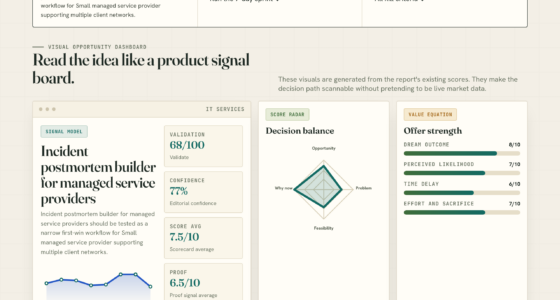

📊 Full opportunity report: Revolutionizing AI: SAP Prefers Owning The System Of Record, Not Outsourcing Brainpower on ThorstenMeyerAI.com — validation score, market gap, and execution plan.
TL;DR
SAP is shifting its AI approach by focusing on owning and controlling enterprise data rather than outsourcing model development. Its new AI layer, Joule, integrates deeply with SAP’s systems, aiming to dominate the enterprise data layer and reshape AI deployment.
SAP has launched Joule, its new AI layer integrated across over 35 enterprise solutions, marking a significant strategic shift: the company now prioritizes owning the system of record rather than outsourcing AI model development. This move underscores SAP’s focus on controlling enterprise data to maintain its market dominance and redefine enterprise AI deployment.
Most of the world’s business transactions, including purchase orders, invoices, payroll, and supply chain data, still pass through SAP systems. Recognizing this, SAP’s AI strategy centers on owning and leveraging this data rather than building or outsourcing large-scale models. Joule, introduced in mid-2026, is positioned as a comprehensive AI interface embedded within SAP’s core solutions such as S/4HANA Cloud, SuccessFactors, and Ariba. As of Q1 2026, Joule supports over 30 specialized agents and 2,500 skills, with plans to expand further by Q3 2026.
SAP has committed €100 million to a partner fund aimed at developing custom agents on Joule Studio, a low-code platform that enables system integrators to build tailored solutions. The company reports tangible customer benefits, including a 40-60% reduction in HR process cycle times and a 16% decrease in operational costs for a major retailer and an Argentine airport operator, respectively. The overarching strategic concept is ‘the Autonomous Enterprise,’ with agents becoming as integral as human operators.
Own the system of record.
Rent nobody’s brain.
SAP’s AI bet is the incumbent’s inversion of the frontier race: don’t build the smartest model — own the data smart models are useless without, and meter access through Joule, an orchestration layer indifferent to which model wins.
The stack — where SAP chose to stand
You can switch AI vendors in an afternoon. You cannot switch your general ledger.
Honest bull / bear
Bull
- Best data-layer position of any incumbent — the one place hyperscalers can’t reach
- Knowledge Graph is context no model scale substitutes for
- Model-agnostic: owns the layer above commoditizing models
- Named, operational customer outcomes (40–60% HR cycle time, 90% admin cut)
Bear
- Consumption pricing is hard for CFOs to forecast — adoption stalls
- “Activated” ≠ “adopted”: the €100M fund admits demand needs subsidizing
- Depends on frontier models it doesn’t control
- Innovation tax: everything must work across a regulated installed base
Why SAP’s Data-Centric AI Strategy Matters
This shift is significant because SAP controls a vast amount of mission-critical enterprise data, giving it a unique advantage in enterprise AI. By owning the data layer, SAP aims to dominate the infrastructure that underpins business operations, making it less vulnerable to model or platform shifts from hyperscalers or frontier labs. This approach could redefine how enterprise AI is built and deployed, emphasizing data ownership over model innovation.
However, this strategy also introduces risks, including dependency on third-party models, variable AI costs, and challenges in driving widespread adoption of Joule within complex, regulated environments. Its success hinges on how well SAP can convert initial deployments into sustained, operational AI use cases.

SQL Server 2025 Unveiled: The AI-Ready Enterprise Database with Microsoft Fabric Integration
As an affiliate, we earn on qualifying purchases.
As an affiliate, we earn on qualifying purchases.
SAP’s AI Strategy and Enterprise Data Dominance
Until now, SAP’s AI efforts have focused on integrating AI features into its existing enterprise solutions, with a growing emphasis on automation and intelligent workflows. The launch of Joule marks a strategic pivot: rather than competing in the open model market, SAP is strengthening its position at the foundational data layer, leveraging its control over enterprise metadata and workflows. This approach aligns with SAP’s broader goal of enabling the ‘Autonomous Enterprise,’ where intelligent agents operate alongside humans within a secure, governed data environment.
Past initiatives, such as the acquisition of Prior Labs and investments in Knowledge Graph technology, support this vision by enhancing SAP’s ability to understand and manipulate enterprise data structures. The company’s focus on reducing custom code and accelerating migration to S/4HANA cloud further reinforces this data-centric AI strategy.
“Joule is not just an assistant; it’s the new interface to our business systems, embedding AI deeply into the operational fabric.”
— SAP executive at Sapphire 2026

Practical Microsoft Copilot Studio: Build, Connect, and Deploy AI Agents
As an affiliate, we earn on qualifying purchases.
As an affiliate, we earn on qualifying purchases.
Uncertainties in SAP’s Data-Driven AI Approach
It remains unclear how quickly and extensively SAP can drive adoption of Joule across its large, complex customer base. The variable costs associated with AI usage and the dependency on third-party models also pose risks to the long-term viability of this strategy. Additionally, the extent to which SAP can maintain its competitive advantage as other cloud providers develop similar data ownership initiatives is still uncertain.

AI NATIVE – KNOWLEDGE GRAPHS: Designing Knowledge Maps & Knowledge Graphs (The AI-Native Series)
As an affiliate, we earn on qualifying purchases.
As an affiliate, we earn on qualifying purchases.
Next Steps for SAP’s Enterprise AI Leadership
SAP will likely focus on expanding Joule’s capabilities, increasing customer adoption, and demonstrating measurable ROI. The company’s €100 million partner fund aims to catalyze development of custom solutions, while ongoing migrations to S/4HANA cloud will serve as a testing ground for broader AI deployment. Monitoring how SAP manages costs, model dependencies, and user engagement will be critical in assessing the success of this strategic shift.
AI for Small Business Owners: A Practical Explanation and Go-To Guide
As an affiliate, we earn on qualifying purchases.
As an affiliate, we earn on qualifying purchases.
Key Questions
What is Joule and how does it differ from traditional AI solutions?
Joule is SAP’s integrated AI layer embedded within its enterprise solutions, designed to leverage and control enterprise data rather than relying on external models or generic chatbots. It acts as a central interface that understands business-specific workflows and metadata.
Why is owning the data layer important for SAP’s AI strategy?
Owning the data layer allows SAP to maintain control over mission-critical enterprise information, making its AI solutions more secure, context-aware, and less vulnerable to external model shifts. This positions SAP as a foundational infrastructure provider for enterprise AI.
What are the main risks associated with SAP’s approach?
Risks include dependency on third-party models, unpredictable AI usage costs, slow adoption within complex organizations, and potential competitive disadvantages if other providers develop similar data-centric strategies.
How does SAP plan to accelerate Joule’s adoption?
Through a €100 million partner fund to develop custom agents, expanding Joule’s capabilities, and integrating it more deeply into core SAP solutions, with the goal of turning initial deployments into operational AI workflows.
What is the long-term impact of SAP’s strategy on the enterprise AI market?
If successful, SAP’s focus on data ownership could shift the industry toward a model where infrastructure and data control become the primary value drivers, potentially redefining enterprise AI deployment standards.
Source: ThorstenMeyerAI.com