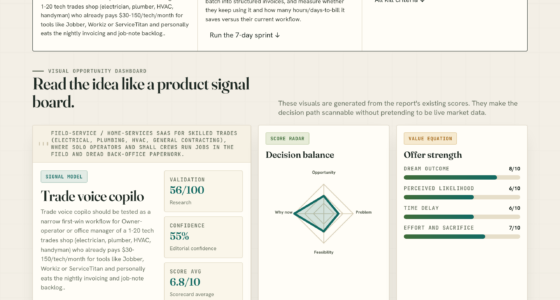
📊 Full opportunity report: A Skill Is a Folder, Not a Prompt: What Anthropic Learned Running Hundreds of Them on ThorstenMeyerAI.com — validation score, market gap, and execution plan.

Prime made for students and young adults
- Fast, free delivery for dorm and study essentials
- Prime Video and Amazon Music included
- Member-only deals
TL;DR
Anthropic has learned that modeling AI Skills as folders—containing instructions, scripts, and references—improves consistency, onboarding, and scalability. This shifts AI development from ad-hoc prompts to institutionalized capabilities.
Anthropic has announced a new approach to developing AI Skills, emphasizing that Skills are not merely saved prompts but structured folders containing instructions, scripts, and assets. This shift aims to make AI capabilities more consistent, scalable, and maintainable across organizations.
In a detailed write-up, Anthropic explains that its internal experience shows Skills should be viewed as containers—folders with instructions, reference documents, scripts, and configuration—rather than simple prompt snippets. This conceptual change allows AI agents to discover, read, and execute complex workflows, embedding organizational knowledge directly into the AI system.
Anthropic’s engineering team has applied this model across hundreds of Skills, which cluster into nine categories, including data analysis, code scaffolding, verification, and operational procedures. The most valuable Skills, according to Anthropic, are those that verify outputs—ensuring accuracy and reducing mistakes—highlighting the importance of built-in quality checks.
The company emphasizes that creating a Skill involves more than scripting prompts; it requires capturing non-obvious, context-specific knowledge, including ‘gotchas’—traps and edge cases—that prevent errors. Properly described and bundled, Skills serve as durable assets that improve with use, becoming more refined over time.
A Skill is a folder, not a prompt
Anthropic published what it learned running hundreds of Skills across its own engineering org. Read as a business memo, the point is bigger than a coding trick: this is how ad-hoc prompting becomes durable institutional capability — the SOPs your agents actually follow, versioned and shared.
“A Skill is just a clever markdown prompt you save in a file.”
A folder the agent can discover, read & run — instructions, scripts, references, templates, config & on-demand hooks.
The knowledge of how your organization actually operates can be captured, versioned, shared & executed — and the thing capturing it is a humble folder with a script and a gotchas list inside. For the builder, that’s context engineering with real tools attached. For whoever owns the budget, it’s the difference between AI that starts from zero every morning and an asset that compounds. Caveats: best practices are still evolving, checked-in Skills cost context, and curation beats accumulation. Start with one Skill, one gotcha, and the category that catches your mistakes.
Transforming AI Development into Organizational Assets
This development signifies a shift in how organizations build, maintain, and scale AI capabilities. By treating Skills as structured folders rather than prompts, companies can achieve greater consistency, reduce onboarding time, and develop a reusable library of institutional knowledge. This approach moves AI from ad-hoc scripting towards a disciplined, asset-based methodology that can continuously improve and adapt, potentially reducing costs and increasing reliability in AI deployment.
AI development organizational tools
As an affiliate, we earn on qualifying purchases.
As an affiliate, we earn on qualifying purchases.
From Prompt Engineering to Asset-Based AI Capabilities
Until now, most teams have relied on prompt engineering—crafting and reusing specific instructions—to guide AI behavior. However, this approach is brittle, hard to maintain, and difficult to scale. Anthropic’s internal experiments with hundreds of Skills reveal that organizing knowledge into folders with instructions, scripts, and references creates a more durable and scalable system. This insight aligns with broader industry trends toward modular, reusable AI components.
Anthropic’s focus on verification Skills underscores the importance of quality assurance in AI workflows, especially as models are integrated into operational processes. The company’s framework aims to codify best practices and reduce reliance on ad-hoc prompt tuning, which often leads to inconsistent results.
“Viewing Skills as folders containing instructions and assets fundamentally changes how we build and maintain AI capabilities.”
— Thorsten Meyer, AI researcher at Anthropic
As an affiliate, we earn on qualifying purchases.
Remaining Questions on Skill Implementation and Scalability
While Anthropic demonstrates promising results, it is not yet clear how broadly this approach can be adopted across different organizations and AI systems. Questions remain about the best practices for cataloging, updating, and maintaining Skills at scale, as well as how this model integrates with existing AI pipelines.
Further, the actual impact on operational efficiency and error reduction in real-world deployments needs more empirical validation.
AI scripting and reference folders
As an affiliate, we earn on qualifying purchases.
As an affiliate, we earn on qualifying purchases.
Next Steps for Adoption and Industry Validation
Organizations interested in this approach should consider auditing their current prompt practices and exploring structured folder-based Skills. Industry-wide, more case studies and benchmarks are expected to emerge, validating the effectiveness of this methodology. Anthropic plans to refine its framework and share more detailed best practices to facilitate broader adoption.
Additionally, future research will likely focus on automation tools for Skill creation, versioning, and maintenance, aiming to integrate this paradigm into standard AI development workflows.
As an affiliate, we earn on qualifying purchases.
Key Questions
What exactly is a Skill in Anthropic’s framework?
A Skill is a structured folder containing instructions, reference documents, scripts, and configuration assets that guide an AI agent’s behavior for specific tasks, rather than just a saved prompt.
How does this approach improve AI consistency?
By encapsulating organizational knowledge within Skills, AI outputs become more predictable and aligned with established procedures, regardless of who runs the task.
Can existing prompt-based systems adopt this folder approach?
Transitioning requires rethinking how instructions are stored and managed. While not trivial, organizations can begin by cataloging current prompts into structured folders and gradually building more complex Skills.
What are the main benefits of Skills as folders?
Benefits include improved consistency, easier onboarding, better maintenance, and the ability to continuously refine organizational knowledge embedded in AI workflows.
Is this approach applicable to all AI systems?
While demonstrated at Anthropic, the principles are adaptable, but success depends on the specific AI architecture and organizational commitment to structured knowledge management.
Source: ThorstenMeyerAI.com
Halloween Picks
halloween
As an affiliate, we earn on qualifying purchases.