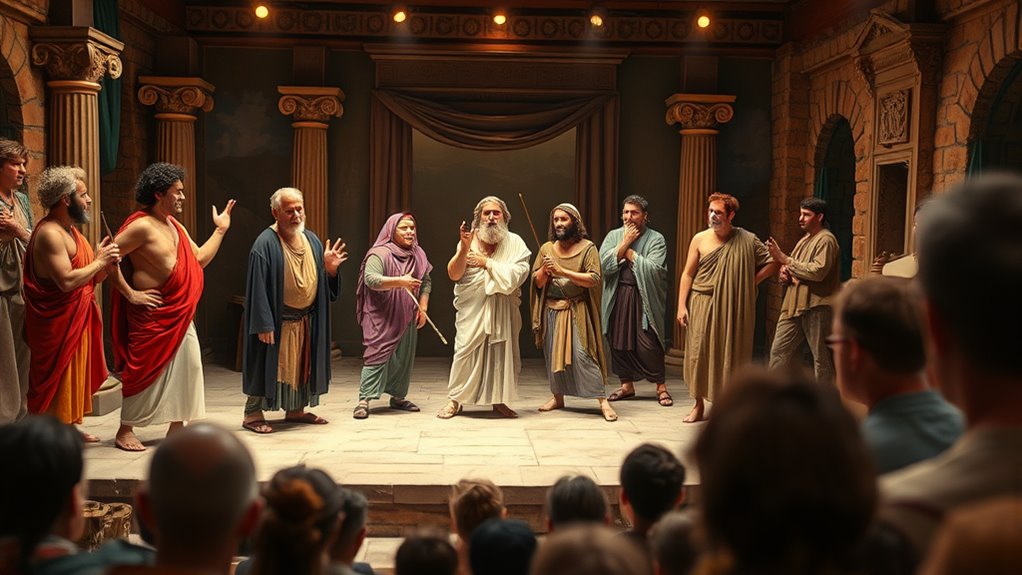

Aristophanes uses comedy as a sharp tool to criticize philosophers and skeptics, exposing societal flaws through satire and humor. His plays mock figures like Socrates, highlighting their odd ideas and societal influence. This humor reveals tensions between traditional values and new philosophical trends, encouraging audiences to question authority and surface contradictions. If you’re curious, you’ll discover how his comedic approach challenged power and provoked introspection in ancient Athens.
Key Takeaways
- Aristophanes uses comedy to satirize philosophers, exposing their flaws and societal impact through humor.
- His plays critique philosophical trends like relativism and sophistry, questioning their influence on Athenian society.
- Humor serves as a societal mirror, revealing tensions between traditional values and new intellectual ideas.
- Comedy provokes audiences to reflect on societal and moral issues, challenging authority and societal pretensions.
- Satire functions as a social critique, encouraging skepticism of philosophical claims and authority figures in Athens.

Comedy has long served as a powerful tool for critiquing society’s flaws, often revealing uncomfortable truths through humor. When you explore Aristophanes’ plays, you see how satirical humor becomes a sharp lens for societal critique. His comedies aren’t just meant to entertain; they function as clever commentaries that challenge the ideas and behaviors of his time. Aristophanes uses humor to expose the absurdities in politics, philosophy, and social norms, making his audience laugh while forcing them to confront uncomfortable realities. Through satire, he dismantles pretensions and questions authority, all while keeping the tone lively and engaging.
In his works, Aristophanes often targets prominent philosophers and skeptics, turning their ideas into comedic material that highlights both their flaws and the societal reactions to them. For instance, he ridicules Socrates, portraying him as a figure obsessed with strange ideas and absurd arguments. By doing this, Aristophanes doesn’t just mock the philosopher; he satirizes the philosophical movement itself and the societal credence it garnered. His humor becomes a form of societal critique, revealing how intellectual trends can sometimes lead society astray or become objects of ridicule. This use of satirical humor acts as a mirror, reflecting the tensions between new philosophical ideas and traditional values.
What makes Aristophanes’ satire particularly powerful is how he combines humor with a keen sense of critique. His comedy isn’t merely to amuse but to provoke thought and self-reflection. You see this clearly in plays like “The Clouds,” where he lampoons Socrates and the sophists, pointing out the dangers of philosophical relativism and the erosion of moral standards. His humor exposes contradictions in societal attitudes toward knowledge and authority, prompting audiences to question whether they’re being duped by clever rhetoric or superficial ideas. Recognizing the role of satire in his plays helps us understand how humor functions as a form of social and political critique in ancient Athens.

Four Plays by Aristophanes: The Birds; The Clouds; The Frogs; Lysistrata
Used Book in Good Condition
As an affiliate, we earn on qualifying purchases.
As an affiliate, we earn on qualifying purchases.
Frequently Asked Questions
How Did Aristophanes Influence Later Comedic and Philosophical Traditions?
You see, Aristophanes’ ancient influence shaped both comedic and philosophical traditions by blending sharp satire with social critique. His comedic legacy inspired later playwrights like Plautus and Menander, who adopted his humor and wit. Philosophically, his satire challenged thinkers to question authority and dogma, paving the way for later skeptics and satirists. His work remains a foundational influence on comedy’s role as social critique today.
Are Aristophanes’ Satirical Targets Still Relevant Today?
You might be surprised to find that Aristophanes’ satirical targets still hold timeless relevance today. His sharp critique of political corruption, pretentious philosophers, and societal folly echoes in modern politics and social debates. These themes have modern implications, showing that satire remains a powerful tool for questioning authority and exposing hypocrisy. By examining his work, you see how comedy continues to serve as a mirror reflecting contemporary issues.
What Are the Main Differences Between Comic Critique and Philosophical Critique?
You see, comic critique uses intentional humor to highlight flaws, making it engaging and memorable, whereas philosophical critique relies on reasoned argument and moral critique to explore ideas deeply. Comic critique often aims to entertain while prompting reflection, while philosophical critique seeks truth and understanding. Both challenge beliefs, but comedy does so through satire and exaggeration, and philosophy through logical analysis and moral questioning.
How Did Audiences in Aristophanes’ Time Interpret His Satire?
Imagine a vivid tapestry where every thread hints at deeper meaning; that’s how you might view Aristophanes’ satire. His audience perceived his satire as lively and humorous, yet they also sensed the sharp satirical intent behind it. They appreciated the playful critique of philosophers and skeptics, understanding it as both entertainment and a subtle commentary. This dual perception allowed them to enjoy the comedy while recognizing the pointed social and intellectual observations.
Can Aristophanes’ Comedy Be Considered Effective Social Critique?
You can see Aristophanes’ comedy as effective social critique because his satire has strong satirical effectiveness and influences society by highlighting flaws in politics, philosophy, and customs. His sharp humor exposes hypocrisy and prompts audiences to question authority, making his plays a mirror for social issues. By doing so, he sparks conversations that challenge the status quo, proving comedy’s power to shape public opinion and encourage societal change.

Frogs and Other Plays (Penguin Classics)
As an affiliate, we earn on qualifying purchases.
As an affiliate, we earn on qualifying purchases.
Conclusion
You might think comedy just aims to entertain, but Aristophanes proves it can also challenge ideas. His satires on philosophers and skeptics aren’t just jokes—they’re sharp critiques that make you think. Some may argue comedy isn’t serious enough to critique philosophy, but Aristophanes shows that humor can reveal truths and spark reflection. So, next time you laugh at a joke, remember, comedy can be a powerful way to question and understand the world.

A Pocketful of Hellfire: A Ken Socrates Novel
As an affiliate, we earn on qualifying purchases.
As an affiliate, we earn on qualifying purchases.

Plato and a Platypus Walk into a Bar . . .: Understanding Philosophy Through Jokes
Thomas Cathcart and Daniel Klein, Plato and a Platypus Walk Into a Bar…: Understanding Philosophy Through Jokes, paperback
As an affiliate, we earn on qualifying purchases.
As an affiliate, we earn on qualifying purchases.