📊 Full opportunity report: Liquid vs Air Cooling for 24/7 Inference Rigs on ThorstenMeyerAI.com — validation score, market gap, and execution plan.
TL;DR
For 24/7 AI inference rigs, air cooling generally offers greater reliability, lower cost, and quieter operation. Liquid cooling provides higher thermal headroom but introduces potential failure points.
For continuous AI inference systems, air cooling remains the preferred choice over liquid cooling due to its simplicity, reliability, and cost-effectiveness, according to industry analysis.
Most 24/7 inference rigs benefit from air cooling because it has fewer failure points and requires less maintenance. High-quality dual-tower air coolers can dissipate 200–250W, sufficient for many high-performance CPUs under sustained load, and they typically last longer without intervention.
Liquid cooling, specifically all-in-one (AIO) units, can handle higher thermal loads—up to 360W—making them suitable for the hottest CPUs under continuous operation or in compact cases where large air coolers won’t fit. However, AIOs contain pumps and seals that have limited lifespans, usually around 5–7 years, and are more susceptible to leaks and degradation over time.
While modern AIOs are reliable, their sealed-loop design and moving parts introduce potential failure points that can lead to system downtime, especially in unattended setups. The total cost of ownership for liquid cooling is also higher due to the need for eventual replacement of units and pumps.
Liquid vs air
for a 24/7 inference rig.
For an always-on machine the question isn’t “which cools better” — it’s which one still works in three years without you thinking about it. That reframing makes air the default for most rigs. Answer three questions in Part 2 to find yours.
- Nothing to fail — fan swaps in minutes
- Lasts a decade+; lower total cost
- Quieter floor — no pump hum (~40–45 dBA)
- Trivial maintenance — wipe & repaste
- Tall — can block RAM, dumps heat in case
- Best headroom — ~360W TDP sustained
- Compact block — fits tight cases, clears RAM
- Exports heat out the radiator & room
- Pump fails at 5–7 yrs; replace whole unit
- Costs 2–3× more over its life; pump hum
- You run it 24/7 and want set-and-forget.
- Your CPU is mainstream-to-high-end (or power-capped).
- A big tower fits your case.
- You value lower cost and a quieter floor.
- Your CPU is too hot for air under sustained all-core load.
- A big tower won’t fit (compact / multi-GPU case).
- You need to export heat out of a warm room.
- RAM clearance is tight.
Reliability and Long-Term Suitability of Cooling Choices
Choosing between air and liquid cooling impacts system longevity, maintenance costs, and operational stability. For AI inference rigs that run continuously without intervention, air cooling's durability and simplicity often outweigh the thermal advantages of liquid cooling, making it the safer choice for long-term reliability.

be quiet! Dark Rock Pro 5 Quiet Cooling CPU Cooler | Immensely High Airflow | 7 high-Performance Copper Heat Pipes | Speed Switch | Thermal Grease | BK036
Dark Rock Pro 5 features 7 high-performance copper heat pipes and a special black coating with ceramic particles....
As an affiliate, we earn on qualifying purchases.
As an affiliate, we earn on qualifying purchases.
Cooling Strategies for Continuous AI Workloads
Most existing guides focus on gaming PCs, optimizing for peak temperatures and benchmarks, which differ from AI inference systems that require stable, sustained performance over years. Historically, air cooling has been favored for its reliability, but the demand for higher thermal headroom has driven adoption of liquid cooling in some high-end setups. Recent developments show that quality air coolers can match or exceed the performance of mid-range AIOs for most workloads, while offering superior longevity.
"For set-and-forget AI inference systems, the simplicity and reliability of air cooling make it the best choice over liquid solutions."
— Thorsten Meyer, AI cooling expert
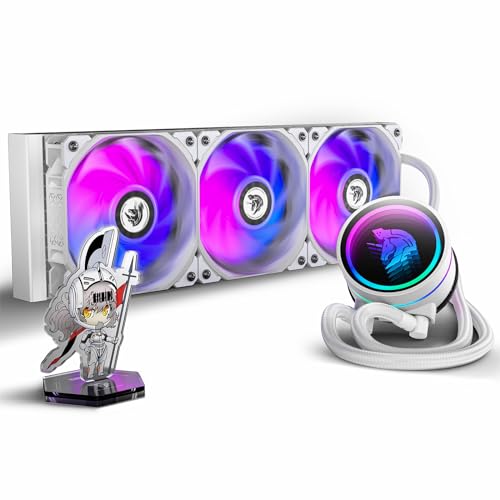
AsiaHorse WK-A360 ARGB All-in-One AIO CPU Liquid Cooler, Wandering Knight 360mm Water Cooling System with Dual High-Performance Pump and 3×120mm PWM Fans, Compatible with Intel & AMD CPUs (White)
Ceramic Bearing Design: Our WK-A360 aio cooler employs ceramic bearings that do not chemically react with coolant, ensuring...
As an affiliate, we earn on qualifying purchases.
As an affiliate, we earn on qualifying purchases.
Long-Term Performance and Failure Risks of Liquid Cooling
It remains unclear how rapidly the degradation of AIOs occurs in real-world, continuous use scenarios, and whether recent models have improved lifespan and leak resistance significantly. Data on failure rates over extended periods is limited, and manufacturers' warranties may not fully reflect long-term reliability.

ID-COOLING FX240 PRO Liquid CPU Cooler for Desktop - 240mm AIO Cooler, 2 x 120mm High-efficient Fans, Special CD Pattern Pump Header, Intel & AMD Compatible
【Premium AIO Cooler】A premium CPU liquid cooler for gaming and high-performance computing systems. | TDP: 300W
As an affiliate, we earn on qualifying purchases.
As an affiliate, we earn on qualifying purchases.
Future Developments in Cooling Technologies for AI Rigs
Research into more durable, maintenance-free liquid cooling solutions continues, potentially extending lifespan and reducing failure risk. Meanwhile, advances in high-performance air coolers may further consolidate their position as the default choice for 24/7 AI inference systems. Monitoring real-world long-term performance data will be key to guiding future decisions.
EXNOS 2000CFM Portable Evaporative Air Cooler for Indoor Use
【Wide-Area Airflow & Efficient Cooling】- Powered by high-efficiency evaporative cooling technology, this swamp cooler delivers an impressive airflow...
As an affiliate, we earn on qualifying purchases.
As an affiliate, we earn on qualifying purchases.
Key Questions
Is liquid cooling worth the extra cost for a 24/7 AI inference rig?
Generally, no. For most systems, air cooling provides sufficient thermal performance with greater reliability and lower total cost of ownership.
How often do AIO liquid coolers typically fail in continuous operation?
While modern AIOs are reliable, pumps and seals tend to have a lifespan of about 5–7 years, with failures potentially causing system downtime or damage.
Can high-end air coolers handle the thermal load of overclocked CPUs used in AI inference?
Yes, high-quality dual-tower air coolers can dissipate 200–250W, sufficient for many workloads, though overclocked or very high-TDP CPUs may require larger or more specialized cooling solutions.
What maintenance is required for air cooling systems?
Periodic dust cleaning and thermal paste reapplication are the main tasks, whereas liquid cooling may require monitoring for leaks or pump failure over time.
Source: ThorstenMeyerAI.com