

📊 Full opportunity report: The Role Of The Local Document Pipeline In AI Development on ThorstenMeyerAI.com — validation score, market gap, and execution plan.
TL;DR
This article examines how the local document pipeline architecture supports AI development by processing data entirely within organizations. It highlights confirmed technical principles and ongoing challenges, emphasizing its importance for data governance and model agility.
This week, industry practitioners emphasized the importance of a local document pipeline architecture that processes data entirely within organizational infrastructure. This approach supports scalable, maintainable AI models, addressing challenges of data governance, model flexibility, and operational reliability.
The architecture described involves a pipeline that ingests, normalizes, and processes documents entirely within an organization’s own systems, avoiding external data transfer. Key principles include treating models as fixed appliances—single-purpose CLI tools—and maintaining strict separation between data ingestion, OCR, extraction, and storage. The pipeline relies heavily on PostgreSQL for queuing and transactional job management, ensuring crash safety and concurrency control without additional message brokers.
Practitioners highlight that each component—such as OCR and extraction models—is designed to be replaceable and configurable, enabling rapid updates and model swaps without disrupting the entire system. Provenance tracking, via content hashes and detailed metadata, supports compliance and auditing, especially in regulated environments. These practices aim to keep the pipeline maintainable over multiple model versions, with version-controlled prompts and schemas for extraction.
Documents in. Typed rows out.
Nothing leaves the building.
The reference architecture this week was pointing at: a hash, a Postgres queue, two model passes, a review loop, provenance columns — boring architecture around rapidly-improving models. Commands live in the companion repo; the design lives here.
Five stages, one spine
Idempotent by content hash: reprocessing is always safe, “did we do this file?” is a primary-key lookup. Two model passes on purpose — transcription errors and extraction errors have different fixes.
The four principles everything hangs on
Exceptions are the product
Confidence routing
Low-confidence fields, schema failures, unparseable pages → human_review jobs in the same queue. Corrections stored as data — your ground-truth set for the next model swap builds itself.
Field observations
Exception rate is dominated by input quality, not model quality — a scanner upgrade often beats a model upgrade. And a 93% benchmark means the real design problem is the other 7%.
- Low volume: under ~10–20K pages/month, one week of this engineering costs more than a year of API invoices.
- Prebuilt schemas fit: if your documents are exactly the invoice/receipt/ID categories and DSGVO permits, the cloud prebuilt tier is the honest recommendation.
- Degraded inputs: phone photos and crumpled scans invert the benchmarks (Real5-OmniDocBench). Test on YOUR documents first.
- No owner: a local pipeline is infrastructure. If nobody patches it and watches the dead-letter queue, buy the cloud’s real product — their ops team.
DSGVO: what local removes
The Auftragsverarbeitung surface for processing itself — no vendor DPA, no transfer analysis, no sub-processor audits for the core path.
DSGVO: what remains
GDPR itself. Purpose limitation, retention, deletion, access controls — local processing is still processing. Simplifies compliance; never waives it.
POSTGRESQL 18 FOR BEGINNERS: Build Real-World Database Projects Using SQL, JSON, and Python
As an affiliate, we earn on qualifying purchases.
As an affiliate, we earn on qualifying purchases.
Why a Local Document Pipeline Is Essential for AI Scalability
The described architecture matters because it offers organizations full control over data processing, reduces reliance on external services, and enhances compliance with data privacy regulations. It also improves model agility—allowing rapid updates and swaps—while maintaining transparency and traceability. This approach addresses operational challenges faced by large-scale AI deployments, such as ensuring data provenance and fault tolerance, which are critical for enterprise adoption and regulatory approval.
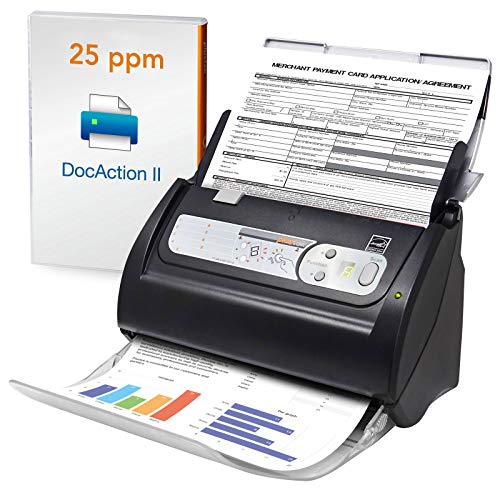
Plustek PS186 Desktop Document Scanner, with 50-Pages Auto Document Feeder (ADF). for Windows 7/8 / 10/11 (Intel/AMD only)
Up to 255 customize favorite scan file setting with "Single Touch" , Support Windows 7/8/10
As an affiliate, we earn on qualifying purchases.
As an affiliate, we earn on qualifying purchases.
Evolution of In-House Data Pipelines in AI Development
Recent industry discussions and demonstrations, including those from Hugging Face and other AI leaders, have emphasized the shift toward local inference and data processing. Historically, AI models relied heavily on cloud-based pipelines, but concerns over data privacy, governance, and operational control have driven a move toward in-house architectures. The development of lightweight, modular components—such as narrow CLI models and transaction-based queues—has made local pipelines more feasible and maintainable. This trend aligns with broader regulatory developments, including the EU’s AI Act, which emphasizes transparency and data control.
“The pipeline running in production is described at the level that stays true across model versions—every version-pinned command lives in the companion repo, because model tooling this young rots in weeks.”
— Thorsten Meyer
local document pipeline automation tools
As an affiliate, we earn on qualifying purchases.
As an affiliate, we earn on qualifying purchases.
Unresolved Challenges in Local Document Pipeline Implementation
While the architecture is well-defined, it is still unclear how widely organizations are adopting these principles at scale. Specific challenges include integrating diverse document sources, managing schema evolution, and ensuring robust review workflows for edge cases. Additionally, the impact on overall system latency and resource utilization remains under investigation, as does the ability to maintain security and compliance in highly regulated contexts. The community continues to explore best practices for scaling these pipelines effectively.

Amazon Fire TV Stick 4K Plus (newest model) with AI-powered Fire TV Search, Wi-Fi 6, stream hundreds of thousands of movies and shows, free & live TV, find shows faster with Alexa+
Advanced 4K streaming – Elevate your entertainment with the next generation of our best-selling 4K stick, with improved…
As an affiliate, we earn on qualifying purchases.
As an affiliate, we earn on qualifying purchases.
Next Steps for Adopting and Scaling Local Pipelines
Organizations are expected to focus on standardizing pipeline components, developing shared repositories for version control, and automating schema and prompt updates. Further demonstrations and case studies will clarify how these architectures perform at enterprise scale, especially regarding latency, cost, and compliance. Industry groups and tool vendors are likely to release enhanced tooling to simplify deployment and monitoring, making local pipelines more accessible for broader adoption.
Key Questions
Why is a local document pipeline important for AI development?
A local pipeline provides organizations with full control over data processing, enhances privacy, and allows rapid updates, making AI models more scalable and compliant with regulations.
What are the main components of this architecture?
Key components include data ingestion, OCR processing, extraction models, a transaction-based queue in PostgreSQL, and provenance-aware storage, all designed to be modular and replaceable.
What challenges remain in implementing these pipelines?
Challenges include integrating diverse document sources, schema evolution management, ensuring security and compliance, and scaling the architecture without latency or resource issues.
How does this approach impact model updates?
Because models are treated as fixed, version-controlled appliances, updates are simplified to configuration changes or model swaps, reducing operational risk and downtime.
Source: ThorstenMeyerAI.com