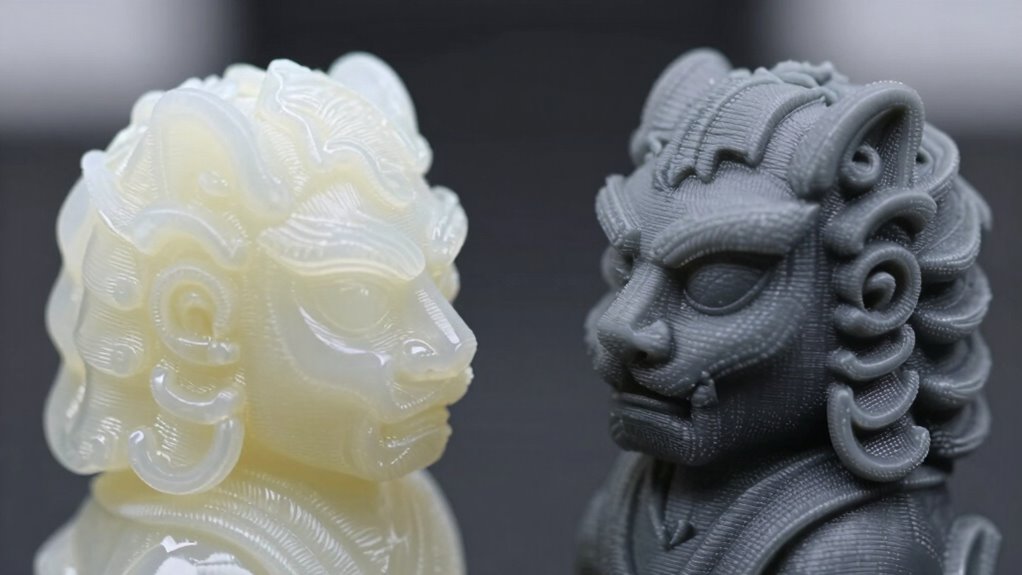

Choosing between resin and FDM 3D printing depends on your specific goals. If you need highly detailed, smooth surface finishes for jewelry or miniatures, resin打印s are ideal, but they require more post-processing and are less durable. For larger, functional parts that must withstand stress or environmental wear, FDM offers better durability with easier, cheaper post-processing. To discover which method aligns best with your project needs, explore further details below.

Prime made for students and young adults
- Fast, free delivery for dorm and study essentials
- Prime Video and Amazon Music included
- Member-only deals
Key Takeaways
- Choose resin for high-detail, intricate models like jewelry or miniatures; opt for FDM for larger, functional prototypes.
- Prioritize resin if surface finish and precision are critical; select FDM for durability and stress-resistant parts.
- Consider resin if you accept longer post-processing and higher costs; FDM is ideal for quick, low-cost, bulk printing.
- Use resin for projects requiring fine resolution; FDM is better suited for larger, mechanical, or less detailed objects.
- Match material properties to project needs: resin offers smooth detail; FDM provides toughness and ease of use.

When choosing between resin and FDM (Fused Deposition Modeling) 3D printing, understanding their fundamental differences can help you select the right technology for your project. One of the key factors to consider is material durability. Resin prints tend to produce objects with a smooth, detailed finish and can offer high levels of precision, but they often lack the robustness found in FDM parts. FDM prints, made from thermoplastic filaments like ABS or PLA, generally provide better material durability, making them suitable for functional prototypes, mechanical parts, or objects that need to withstand regular use. If your project requires parts that need to endure stress, wear, or environmental factors, FDM is often the more practical choice.
Resin offers high detail and precision, while FDM provides greater durability for functional, stress-resistant parts.
Another important consideration is post processing requirements. Resin printing involves a more involved cleanup process. After printing, you typically need to rinse your parts in alcohol to remove excess resin, followed by curing under UV light to harden the object fully. This extra step can extend your production time and requires additional safety precautions because uncured resin can be toxic. In contrast, FDM prints usually need minimal post processing. You might just remove support structures, sand rough edges, or do some minor finishing work, but the overall process is straightforward and less labor-intensive. If you prefer a quicker turnaround with less cleanup, FDM offers advantages here.
Cost is also a crucial factor. Resin printers and their materials are generally more expensive upfront and per print compared to FDM setups. Resin materials tend to be pricier, and the supplies needed for post processing add to the costs. FDM printers are more accessible and economical, especially for larger or bulk prints, since filament costs are lower and the process is simpler. If budget constraints are significant, FDM might be the better choice. Additionally, resin printing may require specialized equipment like UV curing stations, which can increase overall costs. Considering the cost differences can help you make a more informed decision based on your project’s scope and budget.
Furthermore, your project’s complexity and required resolution can influence your decision. Resin printers excel at producing highly detailed, intricate parts with fine features, which is invaluable for jewelry, miniatures, or detailed prototypes. FDM, while capable of producing larger, durable parts, may not match resin’s level of detail but offers better strength and suitability for larger, more functional objects. Understanding material properties can further guide your selection based on the specific demands of your project. Selecting the right technology enables you to optimize both quality and efficiency in your production process.
Ultimately, your choice boils down to your specific goals. If you need precise, detailed models with a focus on surface finish, resin printing is advantageous, despite its more involved post processing and higher costs. If durability, ease of use, and lower costs are priorities, FDM provides a practical and efficient solution. Understanding these differences helps you align your project needs with the right 3D printing technology.
resin 3D printer for detailed miniatures
As an affiliate, we earn on qualifying purchases.
As an affiliate, we earn on qualifying purchases.
Frequently Asked Questions
Which Printing Method Is More Environmentally Friendly?
FDM printing tends to be more environmentally friendly because it uses less resin waste and produces fewer harmful fumes. You’ll find it offers better material durability and cost efficiency over time, making it a sustainable choice. Resin printing, while detailed, generates more chemical waste and requires careful disposal. If your goal is eco-friendliness, FDM is likely the better option, aligning with your desire for sustainability and efficient material use.
How Do Post-Processing Times Compare Between Resin and FDM Prints?
Imagine you’re printing a detailed miniature with resin and a large object with FDM. Resin post-processing involves curing, which can take 30 minutes to several hours, depending on the model. FDM prints mainly need filament drying or cooling, usually taking 10-30 minutes. Generally, resin curing is more time-consuming, so post-processing times are longer for resin prints compared to quicker FDM filament drying.
What Are the Safety Concerns for Each Printing Type?
You should be cautious about safety concerns with each type. For resin printing, avoid inhaling resin fumes, and always handle resin carefully to prevent skin contact. For FDM printing, manage filament waste properly to reduce environmental impact, and be cautious when removing supports, as sharp tools can cause injuries. Both require good ventilation and protective gear to guarantee safe operation and prevent health issues.
Can Both Methods Print With Flexible or Elastic Materials?
You can definitely explore flexible materials with both methods, but it’s a bit of a tightrope walk. Resin printers can handle certain elastic resins, providing fine detail, while FDM printers often support flexible filaments like TPU or TPE, offering better material compatibility for elastic parts. Just remember, each method has its quirks, so knowing your flexible material options helps you pick the right tool for your project’s needs.
Which Printer Offers Better Scalability for Industrial Production?
FDM printers offer better scalability for industrial production because they handle a wider range of materials, including high-performance plastics, which boosts material compatibility. They also tend to have lower initial costs and faster print speeds, making them more cost-efficient for large-scale projects. Resin printers excel in detail but are typically slower and more expensive to operate at scale. So, for mass production, FDM is generally the smarter choice.
FDM 3D printer for functional prototypes
As an affiliate, we earn on qualifying purchases.
As an affiliate, we earn on qualifying purchases.
Conclusion
Ultimately, choosing between resin and FDM printing depends on your specific needs and goals. Resin offers precision and smooth finishes, ideal for detailed models, while FDM provides durability and affordability for larger projects. Remember, “the right tool for the job makes all the difference.” By understanding your priorities—whether quality or cost—you’ll make a choice that best serves your creative and practical ambitions. Pick wisely, and let your projects flourish.
UV curing station for resin prints
As an affiliate, we earn on qualifying purchases.
As an affiliate, we earn on qualifying purchases.
resin and filament 3D printing starter kit
As an affiliate, we earn on qualifying purchases.
As an affiliate, we earn on qualifying purchases.
Halloween Picks
halloween
As an affiliate, we earn on qualifying purchases.