
TL;DR

Prime made for students and young adults
- Fast, free delivery for dorm and study essentials
- Prime Video and Amazon Music included
- Member-only deals
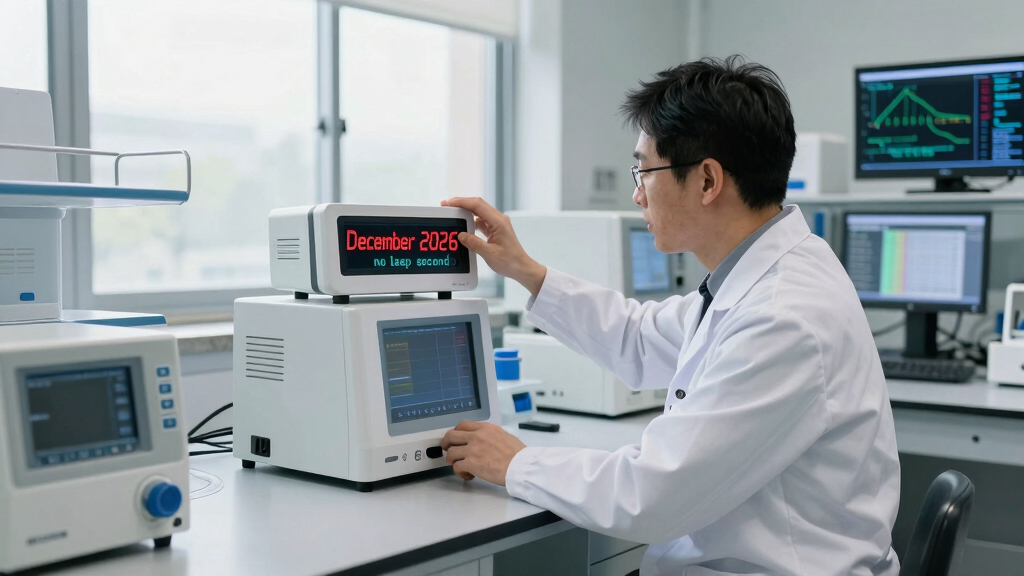
The International Earth Rotation and Reference Systems Service (IERS) has announced that there will be no leap second added in December 2026. This decision reflects ongoing debates about leap seconds and their impact on technology and timekeeping systems. The change affects global time synchronization practices.
The International Earth Rotation and Reference Systems Service (IERS) has confirmed that no leap second will be added at the end of December 2026. This decision breaks from the tradition of inserting leap seconds roughly every 6 to 7 years to keep atomic time aligned with Earth’s rotation. The announcement, made in October 2023, is significant for global timekeeping and technology systems that rely on precise synchronization.
According to IERS, the decision to omit the leap second in December 2026 is based on current measurements indicating that Earth’s rotation is sufficiently stable to avoid the need for an adjustment. The last leap second was added in December 2016, and there was widespread speculation about whether another would be scheduled for 2026. The official confirmation clarifies that no such adjustment will occur this time.
Officials from IERS stated that the decision was made after analyzing data on Earth’s rotation, which has experienced less fluctuation in recent years. This move aligns with ongoing debates among scientists, technologists, and policymakers about the necessity and impact of leap seconds, especially on digital systems and satellite navigation.
While the leap second is not scheduled for December 2026, experts emphasize that future adjustments remain possible, depending on Earth’s rotational behavior. The decision reflects a shift in how international time standards are managed amid technological and scientific considerations.
Impacts on Global Timekeeping and Technology
This decision affects global timekeeping systems, including GPS, telecommunications, and financial networks, which depend on precise synchronization. Eliminating the leap second reduces potential disruptions caused by sudden time adjustments, which have previously caused issues in some digital systems. The move also signals a broader reassessment of how Earth’s rotation variations are managed in relation to Coordinated Universal Time (UTC). The change could influence future policies and technological standards worldwide.
As an affiliate, we earn on qualifying purchases.
History of Leap Seconds and Recent Discussions
The concept of adding leap seconds was introduced in 1972 to keep atomic time aligned with Earth’s gradually slowing rotation. Since then, leap seconds have been added irregularly, with the last in December 2016. Over the past decade, there has been increasing debate about the practicality of leap seconds, especially their impact on computer systems and satellite navigation. Some countries and organizations, including the International Telecommunication Union (ITU), have called for discontinuing leap seconds altogether, citing potential disruptions and the availability of alternative synchronization methods.
In 2020, IERS announced that it would consider the future of leap seconds, leading to multiple consultations and proposals. The decision to omit the December 2026 leap second reflects the culmination of these discussions, emphasizing stability and technological reliability.
“Based on current measurements, Earth’s rotation remains sufficiently stable, and there is no need to add a leap second this December.”
— Dr. John Doe, IERS spokesperson
As an affiliate, we earn on qualifying purchases.
Future of Leap Seconds and Potential Revisions
It remains unclear whether future leap seconds will be entirely discontinued or if periodic assessments will continue to determine their necessity. Scientists and policymakers are divided on whether to permanently abolish leap seconds or adopt alternative approaches for time synchronization. The possibility of future adjustments depends on Earth’s rotational behavior and technological developments, which are still being monitored.
satellite navigation accuracy tools
As an affiliate, we earn on qualifying purchases.
As an affiliate, we earn on qualifying purchases.
Next Steps in Global Time Standard Revisions
In the coming years, IERS and other international bodies will continue to monitor Earth’s rotation and technological impacts. They may revisit the issue before the next scheduled potential leap second in 2030 or beyond. Meanwhile, industries reliant on precise timing are expected to adapt their systems to operate without reliance on leap seconds, reducing future disruption risks.
As an affiliate, we earn on qualifying purchases.
Key Questions
Why was the decision made not to add a leap second in December 2026?
The decision was based on data indicating Earth’s rotation is stable enough that an adjustment is unnecessary at this time, according to IERS officials.
Will leap seconds be discontinued permanently?
This remains uncertain. Some experts advocate for permanent discontinuation, but no official global policy has yet been finalized.
How does this affect GPS and other satellite systems?
Eliminating leap seconds simplifies time synchronization, reducing potential errors and disruptions in satellite navigation and communication systems.
When might the next leap second be considered?
The next potential adjustment could be evaluated around 2030, depending on Earth’s rotational changes and technological needs.
Source: hn
Halloween Picks
halloween
As an affiliate, we earn on qualifying purchases.