
🔍 Read the full analysis: How Ring’s Patrol Robot And Flying Drone Fit Into Home Security on ThorstenMeyerAI.com

Prime made for students and young adults
- Fast, free delivery for dorm and study essentials
- Prime Video and Amazon Music included
- Member-only deals
TL;DR
Amazon’s Ring announced Ring Robotics on November 10, 2026, introducing a wheeled patrol robot for businesses and a flying camera for homes. The Rover Cam is listed at $999.99 and the Drone Cam at $249.99, but the drone cannot be sold until it receives required FCC authorization. Ring describes privacy features including camera-off docking and TAKE encryption, while questions remain about cloud dependence, encryption and the devices’ practical limits.
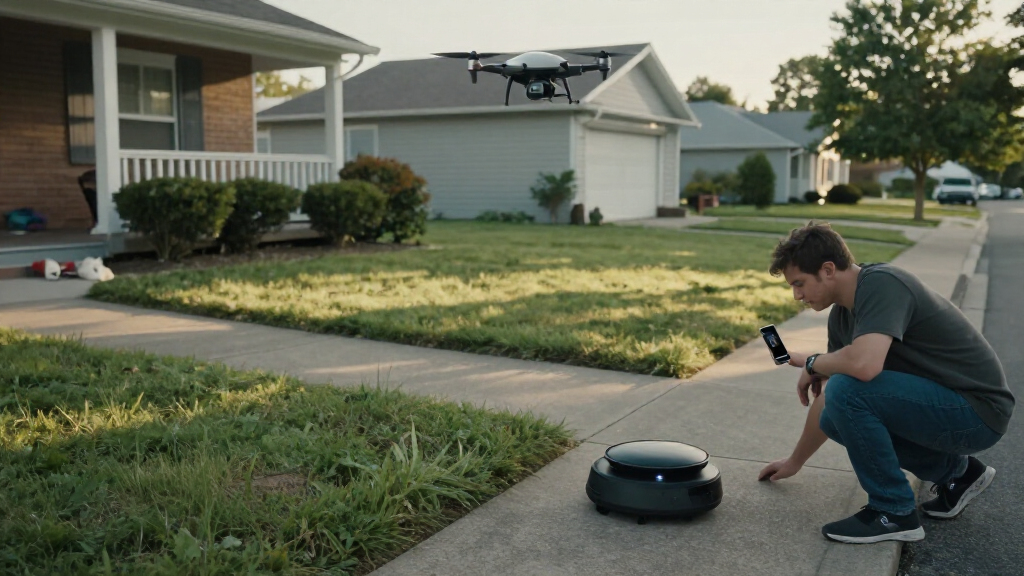
Amazon’s Ring announced two mobile security cameras on November 10, 2026: the Rover Cam, a wheeled patrol robot for businesses, and the Drone Cam, a small indoor drone for homes. The products extend Ring’s security system beyond fixed cameras, but they carry different launch dates and limitations: Rover is listed at $999.99 for US shipping beginning December 16, while the $249.99 Drone Cam cannot be sold until it receives required Federal Communications Commission authorization.
Ring calls the product line Ring Robotics and says both devices use a system named AI Pilot. According to the company, it maps spaces, proposes patrol points and steers around obstacles using cameras, vision models, sensors and cloud processing. When a connected Ring camera, sensor or alarm is triggered, either device can be directed to investigate. Scheduled patrols require a compatible Ring Protect plan, Ring says.
The Drone Cam is designed to fly inside a home on scheduled routes or in response to a request or alert. Ring lists a 148-degree field of view, 360-degree rotation, 2K video and two lights for dark areas. The company says its camera is off while it is docked. The Rover Cam is aimed at shops and offices: Ring says it can patrol on a schedule, travel to a triggered location and scan 360 degrees on arrival. Its features include an adjustable camera mast, siren, light tower and two-way audio.
Ring lists Rover at $999.99, with US shipping starting December 16, 2026, and Drone at $249.99, with US shipping planned for January 27, 2027. Those dates do not remove the regulatory hurdle for the drone: Ring says it has not been authorized as required by FCC rules and may not be sold before that authorization. The Verge reported that the drone depends on an internet connection; without Wi-Fi, it can only land. The publication also reported an estimated five-to-eight-minute flight time. These details come from press coverage of the launch, rather than the listed product specifications in Ring’s announcement.
Ring’s mobile cameras meet real-world limits
Ring’s Rover Cam patrols businesses, while the Drone Cam is designed for homes. Their launch plans depend on different constraints, including FCC authorization for the drone.
Two devices, different settings
Both can investigate alerts, but each is designed for a different place.
- Wheeled patrol robot for businesses
- Can travel to triggered locations and scan 360 degrees
- Includes a siren, light tower and two-way audio
- Indoor flying camera for homes
- Ring lists 2K video and a 148-degree field of view
- Camera is off while docked, according to Ring
What launches depend on
Listed dates and features do not guarantee every device will be available or work without limits.
Ring plans US shipping from December 16, 2026.
Ring says FCC authorization is required before the Drone Cam can be sold.
The Verge reported the drone needs an internet connection to do more than land when offline. Scheduled patrols require a compatible Ring Protect plan, according to Ring.
Privacy claims and open questions
Ring describes controls for mobile cameras, while outside groups have raised concerns about its encryption approach.
Visible controls
Ring says recording indicators and the drone’s docked camera-off state help users control recording.
Encryption protections
The EFF said TAKE was “still not even close” to end-to-end encryption protections.
Everyday performance
Press reports described short flight time and cloud dependence; the announcement does not establish how these limits affect daily use.
Mobile Cameras Change the Patrol
Ring’s announcement brings a mobile camera into a product category built largely around devices fixed to doors, walls and windows. A camera that moves after an alarm could show users a different angle or check a location outside a fixed camera’s field of view. That is the central promise Ring is selling: not just recording a trigger, but sending a device to inspect it.
The products also broaden the settings in which Ring cameras may operate. The Drone Cam is intended to move through private home interiors, while Rover is designed to patrol workplaces and record while moving. That raises practical questions about where a camera travels, what it captures and who can access footage. The products’ listed prices, the Protect-plan requirement for scheduled patrols and the drone’s authorization status will shape whether customers can actually use the advertised functions.
Ring’s privacy design choices matter because these cameras are mobile and may record across multiple parts of a property. The company says recording indicators, a docked camera-off state for the drone and Rover’s Sleep Mode help make recording visible and controllable. Those are company-stated safeguards, not independent proof that all privacy concerns are resolved. The distinction is especially relevant given Ring’s earlier regulatory history and criticism of its current encryption approach.
Popular right now

Bose QuietComfort True Wireless Earbuds with Active Noise Cancellation, Bluetooth 5.3, USB-C Charging, IPX4, Black

Philips 3300 Series Fully Automatic Espresso Machine with Milk Frother, Grinder, Hot and Iced Coffee Presets, SilentBrew, 15-Bar Pressure (E

De'Longhi Rivelia Automatic Espresso Machine with Grinder and Milk Frother, Beige
As an affiliate, we earn on qualifying purchases.
Ring’s Earlier Robot and Privacy Record
The mobile-camera concept is not new for Ring. CNBC reported that the company previewed an indoor drone called the Always Home Cam in 2020. The Verge reported that founder Jamie Siminoff said development had begun in 2016. Ring now presents the Drone Cam as part of a broader robotics line, alongside a business-focused rover.
Rover also draws on a previous Amazon product. Ring says it used customer feedback from Amazon Astro, including users who valued its roving security features. The Verge reported that Amazon launched Astro for Business in 2023 and discontinued it about a year later. That history provides context for Ring’s new business device, but does not establish how Rover will perform or whether it will have the same commercial trajectory.
Privacy concerns have a documented history. In May 2023, the Federal Trade Commission charged Ring with compromising customer privacy by allowing employees or contractors to access private videos and by failing to put basic privacy and security protections in place. The material supplied for this report describes charges and allegations; it should not be read as a finding about the new devices. Ring announced its TAKE encryption in August 2026, describing it as its strongest default encryption yet. The Electronic Frontier Foundation said in September 2026 that TAKE was “still not even close to the privacy protections of end-to-end encryption.”
“For years, customers told us they wanted eyes in the places a fixed camera couldn’t reach, and peace of mind in the spots they’d never want one.”
— Jamie Siminoff, Ring founder and chief inventor, in the company announcement
The most immediate uncertainty is whether and when the Drone Cam will receive FCC authorization. Ring says it may not be sold until it does; the supplied announcement gives no authorization date. Its January 27, 2027, shipping date is therefore a stated plan, not confirmation that sales will begin then.
Some performance details come from reporting at the launch rather than Ring’s announcement. The Verge estimated Rover’s battery life at about 30 minutes and its coverage at around 5,000 square feet on a single floor; it also reported that the drone flies for five to eight minutes per charge and requires an internet connection to do more than land when offline. Ring’s announcement does not provide enough detail to independently establish how those limits will affect everyday use.
Privacy claims also remain contested. Ring says TAKE temporarily gives its servers access to encryption keys for cloud features, then deletes them; full end-to-end encryption is an optional setting. The EFF disputes whether TAKE offers comparable protections. The available material does not establish how the new devices’ footage will be handled in every use case, how often cloud access occurs or how the privacy controls will work in practice.
FCC Review and Product Shipments
The next reported milestone is Rover’s planned US shipping date of December 16, 2026. Ring lists the Drone Cam for January 27, 2027, but its commercial availability depends on the required FCC authorization. Ring has not provided an approval date in the supplied announcement, so customers will need to wait for a regulatory update or revised availability information.
Further product information may clarify real-world battery life, coverage, connectivity and the operation of privacy settings. Ring has also not announced performance results from customers or independent testing. Until those details are available, the prices and specifications describe the announced products, while reported estimates and the company’s privacy assurances should be treated according to their sources.
Key Questions
What did Ring announce?
Ring announced Ring Robotics, a line beginning with the Rover Cam, a wheeled security robot for businesses, and the Drone Cam, an indoor flying camera for homes.
How much do the two devices cost?
Ring lists the Rover Cam at $999.99 and the Drone Cam at $249.99. Scheduled patrols require a compatible Ring Protect plan, according to Ring.
When will the devices be available?
Ring lists US Rover shipping from December 16, 2026, and Drone Cam shipping from January 27, 2027. The drone may not be sold until it receives required FCC authorization, so its listed date is not a guarantee of availability.
What privacy protections does Ring describe?
Ring says the Drone Cam’s camera is off while docked, Rover has a Sleep Mode that retracts its periscope and turns off its microphone, and both devices have recording indicators. It says videos use TAKE encryption; the EFF has criticized that approach as falling short of end-to-end encryption.
Can the Drone Cam operate without Wi-Fi?
The Verge reported that the drone depends on an internet connection and, without Wi-Fi, can only land. Ring’s announcement does not provide further detail on offline operation.
Source: ThorstenMeyerAI.com