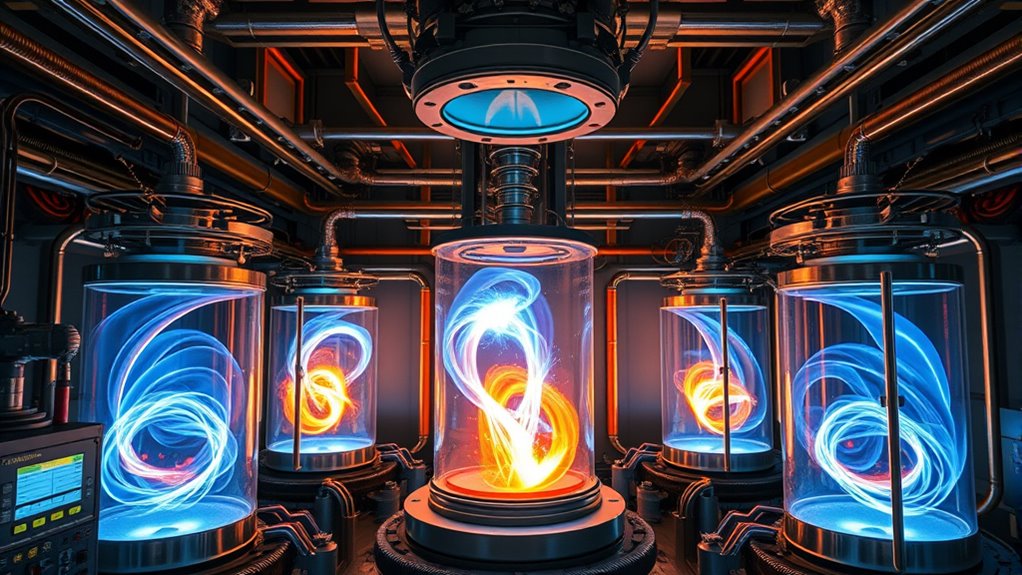

In 2025, fusion research has made significant strides toward unlimited power. Advances in magnetic confinement and inertial fusion have led to higher plasma temperatures, longer confinement times, and improved control over fuel compression. While commercial fusion isn’t here yet, these breakthroughs suggest we’re closer than ever to tapping into a clean, limitless energy source. Keep exploring, and you’ll discover how ongoing innovations continue to push fusion toward reality.
Key Takeaways
- Significant advances in magnetic confinement have achieved higher plasma temperatures and longer stability durations in 2025.
- Inertial fusion experiments show improved pellet compression control, increasing the likelihood of reaching fusion conditions.
- Both approaches are approaching practical energy output, with record-breaking plasma parameters indicating progress.
- Technical challenges remain for continuous, reliable fusion power, but ongoing innovations are addressing these hurdles.
- Overall, 2025 marks notable progress toward fusion energy becoming a viable, nearly unlimited power source in the near future.
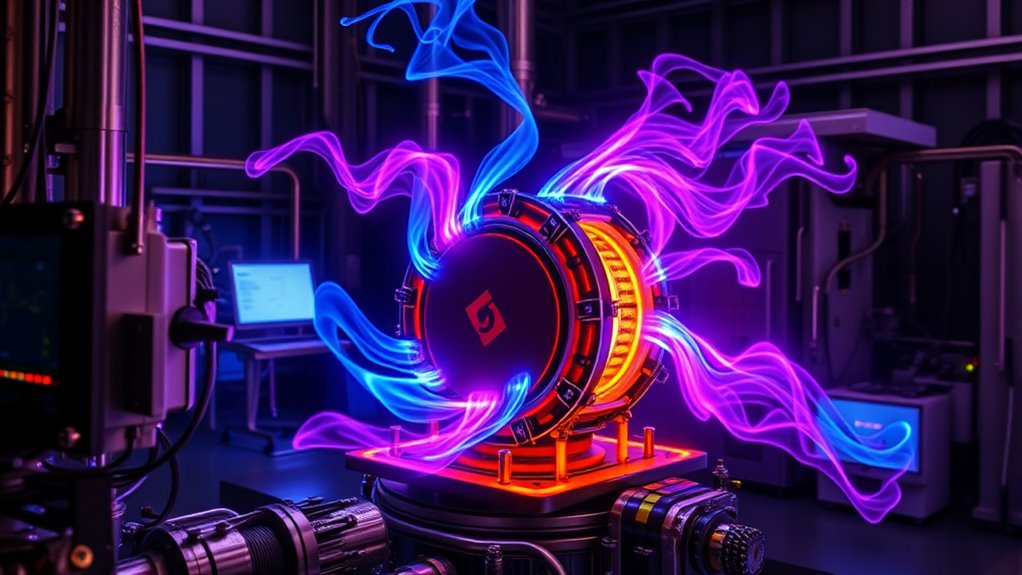
Have recent breakthroughs brought us closer to harnessing the power of fusion energy? The answer is increasingly yes. Advances in magnetic confinement methods, which are used in devices like tokamaks, have pushed the boundaries of plasma stability and energy retention. These systems use powerful magnetic fields to contain the superhot plasma where fusion reactions occur, preventing contact with the reactor walls. Achieving sustained plasma confinement at higher temperatures and longer durations has been a significant milestone. It means scientists are inching closer to creating conditions necessary for net energy gain, where the energy produced surpasses the energy input. These improvements have been driven by innovations in magnetic coil design, advanced plasma diagnostics, and real-time control systems, making the process more efficient and reliable. Additionally, progress in energy retention techniques is helping to extend the duration of plasma stability, further advancing fusion research.
Recent breakthroughs in magnetic confinement bring us closer to practical, sustainable fusion energy.
Meanwhile, inertial fusion has also seen notable progress. Unlike magnetic confinement, inertial fusion relies on delivering an intense burst of energy—usually from lasers or particle beams—to compress and heat small fuel pellets rapidly. Recent experiments have demonstrated more precise control over pellet implosion, increasing the likelihood of achieving the conditions needed for fusion. Researchers have refined their laser technology, improving energy delivery and symmetry of compression, which are critical for maximizing the fusion yield. These developments suggest that inertial confinement could become a more viable route for power generation, especially as laser technology continues to advance and become more cost-effective.
Both approaches are making strides, but they face different challenges. Magnetic confinement needs to sustain plasma at extremely high temperatures for longer periods, all while maintaining stability. Inertial fusion, on the other hand, must perfect the energy delivery process to ensure consistent and high-yield reactions. Yet, the progress in 2025 signals that scientists are closing in on practical solutions. Large-scale experiments like those at national laboratories have achieved record-breaking plasma temperatures and confinement times, fueling optimism that fusion could soon become a reliable energy source.
In essence, the year 2025 has seen tangible progress in both magnetic confinement and inertial fusion techniques. While we’re not yet at the point of commercial fusion power plants, these breakthroughs hint that unlimited, clean energy might not be a distant dream. Instead, it’s becoming more of a real possibility as research accelerates and technology matures. With continued investment and innovation, you might soon see fusion energy playing a pivotal role in meeting the world’s energy needs.
Top picks for "fusion energy update"
Open Amazon search results for this keyword.
As an affiliate, we earn on qualifying purchases.
Frequently Asked Questions
What Are the Main Technical Challenges Remaining for Commercial Fusion Power?
You still face major challenges like maintaining plasma stability and ensuring materials durability. Achieving consistent, controlled fusion requires keeping the super-hot plasma stable long enough for energy production. Plus, materials must withstand intense heat and neutron bombardment without degrading. Overcoming these hurdles involves developing advanced magnetic confinement and resilient materials, which are critical steps toward making commercial fusion power a reality.
How Does Fusion Energy Compare Economically to Existing Energy Sources?
Oh, you’ll love this—fusion energy’s cost comparison to existing sources isn’t quite ready to dethrone fossil fuels or renewables. Despite its promise, market viability remains uncertain because fusion still faces high development costs and technical hurdles. So, while it might seem like a game-changer, economically, fusion isn’t yet competitive, making it more of an intriguing possibility than a practical alternative for now.
What Environmental Impacts Does Fusion Energy Have?
Fusion energy offers a cleaner alternative, producing minimal radioactive waste compared to traditional nuclear power. You won’t need extensive resource extraction, as fusion primarily uses isotopes like deuterium from seawater. This reduces environmental strain. However, safety measures are essential to manage radioactive waste safely. Overall, fusion’s environmental impact is markedly lower, helping you reduce your carbon footprint and protect ecosystems while still generating substantial power.
When Can We Expect Widespread Adoption of Fusion Energy Worldwide?
Think of fusion energy as a sunrise gradually illuminating the horizon. Widespread adoption likely won’t happen before 2030 or beyond, as fusion timelines depend on technological breakthroughs and policy implications. You’ll see initial commercial fusion plants in the next decade, but global integration takes time. Governments and industries need to collaborate, invest, and set clear policies. Patience and persistence are key—soon, fusion could power your world sustainably.
Are There Any Geopolitical Risks Associated With Fusion Energy Development?
Yes, there are geopolitical risks linked to fusion energy development. You might see tensions over access to key materials or technology, potentially impacting international collaboration. Countries could compete for dominance, risking instability if cooperation breaks down. To mitigate this, fostering global partnerships and ensuring shared benefits are essential for maintaining geopolitical stability as fusion energy progresses. Your role in supporting open dialogue can help promote peaceful, cooperative development of this promising technology.
Conclusion
Like Prometheus stealing fire, humanity’s pursuit of fusion energy keeps the dream alive. While 2025 hasn’t yet delivered limitless power, each step forward brings us closer to lighting the way to a brighter future. Keep hope alive—just as the myth teaches us that perseverance sparks progress—and remember, the journey to fusion is a marathon, not a sprint. Soon, the sun’s promise might become your everyday reality.