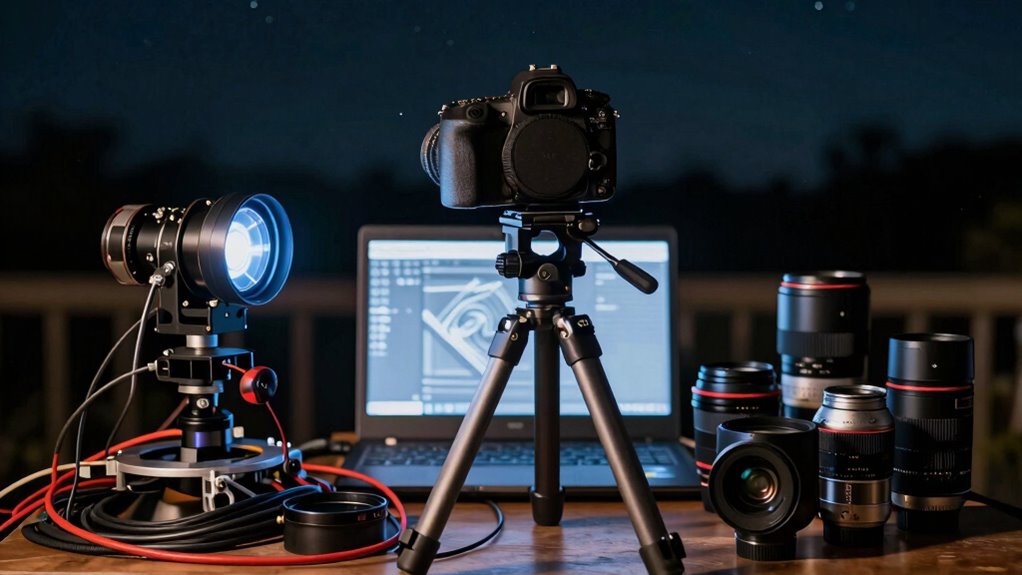

Astrophotography gear gets complicated quickly because you need to choose and coordinate specialized equipment to capture clear images of the night sky. You must balance lens choices, mount stability, and accuracy to avoid blurring or drifting during long exposures. Each component influences the others, making setup a complex puzzle. Investing in quality gear and understanding their interactions leads to better results. Keep exploring, and you’ll discover how to navigate this intricate but rewarding craft.

Prime made for students and young adults
- Fast, free delivery for dorm and study essentials
- Prime Video and Amazon Music included
- Member-only deals
Key Takeaways
- Multiple specialized lenses are needed for different sky conditions, making equipment choices complex.
- Mount stability and type directly impact image quality, requiring careful selection and calibration.
- Equipment components are highly interconnected, with each piece influencing overall system performance.
- Long exposure astrophotography demands precise alignment and tracking, increasing setup intricacy.
- Balancing gear quality, compatibility, and budget creates a challenging decision-making process.

Astrophotography gear can quickly become overwhelming because of the sheer number of specialized tools and accessories available. When you start exploring the options, it’s easy to feel lost, especially when it comes to choosing the right equipment for your needs. One of the first hurdles is lens selection. Unlike regular photography, astrophotography often requires specific lenses that can handle low-light conditions and capture vast sections of the night sky. You need to consider focal length carefully; wider lenses are great for capturing expansive star fields, while longer lenses help zoom in on distant celestial objects. But choosing the right lens isn’t just about focal length—it’s also about quality. High-quality lenses with minimal chromatic aberration and good light-gathering ability are essential for clear, sharp images. This variety can be confusing, especially if you’re new to the craft.
Beyond lenses, mount stability plays an essential role in the quality of your astrophotos. A sturdy, reliable mount ensures your camera or telescope stays perfectly aligned with the stars, preventing blurry images caused by vibrations or drift. You might think a good camera is enough, but without a stable mount, even the best lens can’t deliver sharp results during long exposures. Mounts come in different types—equatorial, altazimuth, and motorized—each with its advantages and complexities. For astrophotography, an equatorial mount with precise tracking capabilities is often recommended because it compensates for Earth’s rotation, allowing you to take longer exposures without star trails. But these mounts can be expensive and require careful setup and calibration, adding to the gear complexity.
As you navigate through lens choices and mount options, you’ll notice that each piece of equipment interacts with others. The stability of your mount affects how well you can utilize your lens’s capabilities, and your lens choice impacts the kind of mount you’ll need. It’s like a puzzle: selecting the right components involves understanding their interplay. The more you learn, the more you realize that investing in quality gear—especially in stable mounts and suitable lenses—is vital for capturing stunning astrophotos. It’s this interconnected nature of gear that makes astrophotography setup so complicated, but also so rewarding once you get everything aligned and working together perfectly.
As an affiliate, we earn on qualifying purchases.
Frequently Asked Questions
What Are the Best Beginner-Friendly Astrophotography Gear Options?
For beginner-friendly astrophotography gear, start with a DSLR or mirrorless camera with manual controls and good low-light performance. Choose a versatile lens, like a wide-angle or a lens with a fast aperture, to capture more stars. Focus on understanding your camera settings, such as ISO, shutter speed, and aperture, to improve your shots. Simple tripods or basic tracking mounts also help keep your images sharp and make learning easier.
How Do I Choose the Right Telescope for Deep-Sky Imaging?
To choose the right telescope for deep-sky imaging, focus on mounting stability and focal length. You want a sturdy mount that can handle long exposures without vibrations, ensuring clear images. Opt for a telescope with a suitable focal length—typically longer for detailed deep-sky shots—so you can capture faint objects effectively. Consider your budget and experience level, but prioritize stability and focal length to get the best results.
What Accessories Are Essential for Successful Astrophotography?
Imagine your camera and telescope aligning perfectly under a starry sky—that’s where essential accessories come in. You need a sturdy mount with precise alignment capabilities to keep your images sharp, and weather protection gear to shield your equipment from unexpected elements. A remote shutter release or intervalometer helps avoid vibrations, while extra batteries and memory cards guarantee you won’t miss a shot. These essentials make your astrophotography journey smoother and more successful.
How Do I Balance Cost Versus Quality in Astrophotography Gear?
To balance cost versus quality, consider your budget carefully and prioritize essential gear that offers good durability and performance. Look for reputable brands with positive reviews to guarantee equipment longevity, even if it means spending a bit more upfront. Avoid the temptation to buy cheap, low-quality gear that quickly wears out or underperforms. Investing wisely in reliable, mid-range gear helps you capture stunning images without breaking the bank.
Are There Any Common Mistakes to Avoid With Astrophotography Equipment?
Avoid common mistakes like neglecting proper camera mounts, which can lead to shaky images, and overlooking light pollution, which diminishes your photo quality. Always guarantee your mounts are stable and compatible with your equipment. Plan your shoots to minimize light pollution, perhaps using filters or choosing darker locations. These steps help you get clearer, sharper astrophotos and prevent wasteful re-shoots, saving you time and money.
equatorial mount for astrophotography
As an affiliate, we earn on qualifying purchases.
As an affiliate, we earn on qualifying purchases.
Conclusion
You might think starting with simple gear is enough, but as you dive deeper into astrophotography, the complexity quickly ramps up. It’s like the theory that the more you learn, the more you realize how much there is to master. Embracing this complexity isn’t a sign of failure; it’s part of the journey. With patience and curiosity, you’ll find that each new piece of gear and technique reveal even more stunning night sky images.
long exposure astrophotography tripod
As an affiliate, we earn on qualifying purchases.
As an affiliate, we earn on qualifying purchases.
As an affiliate, we earn on qualifying purchases.
Evergreen bestsellers Picks
bestsellers
As an affiliate, we earn on qualifying purchases.