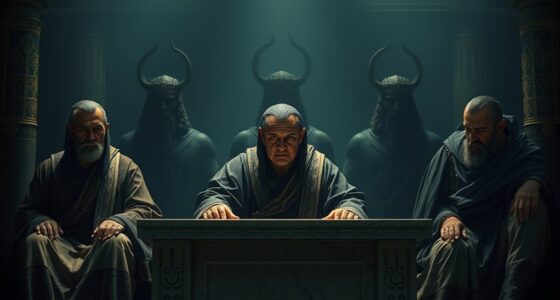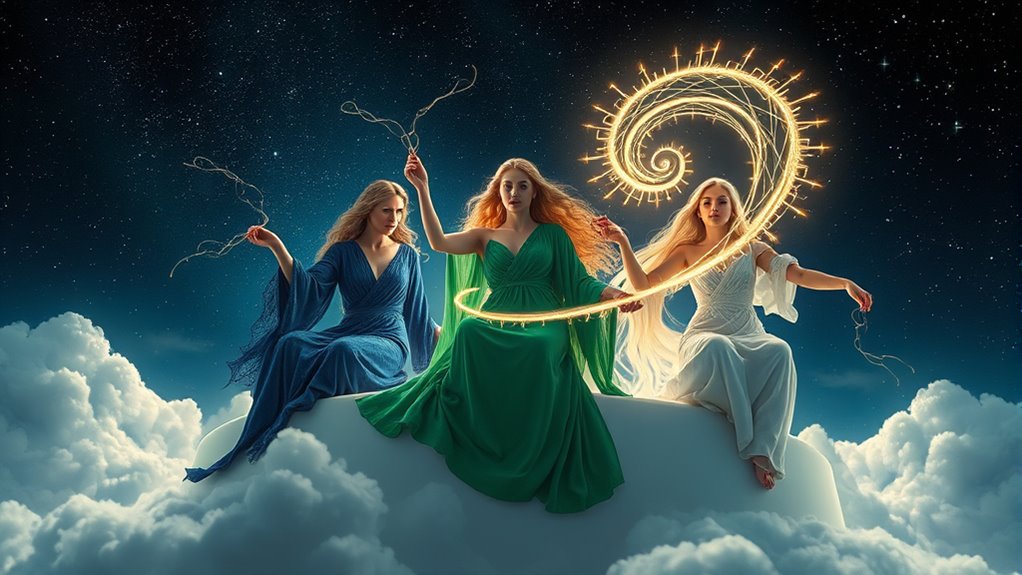

In Greek mythology, the Three Fates—Clotho, Lachesis, and Atropos—are divine women who control your destiny by weaving, measuring, and cutting the thread of life. Clotho spins your life’s beginnings, Lachesis measures its length and experiences, while Atropos ends it when the time comes. Their roles symbolize the cycle of creation, existence, and mortality, showing how fate shapes your journey. If you keep exploring, you’ll discover more about how they influence human lives and beliefs.
Key Takeaways
- The Three Fates, or Moirai, are Greek mythological figures who determine individual destinies by weaving, measuring, and cutting the thread of life.
- Clotho spins the thread, Lachesis measures its length, and Atropos cuts it, symbolizing life’s creation, duration, and end.
- Their control over the thread signifies the inescapable nature of fate, blending destiny with human free will.
- The Fates embody life’s cycle—birth, lifespan, and mortality—and reflect universal truths about human existence.
- Their myth encourages contemplation of how fate and personal choices shape individual lives.

In Greek mythology, the Three Fates, also known as the Moirai, play a essential role in determining the destiny of every individual. They are often depicted as three women who weave, measure, and cut the thread of life, symbolizing the inescapable nature of fate. Their mythological symbolism extends beyond mere storytelling; it embodies fundamental concepts about human existence, fate, and free will. You might think that your choices shape your life, but the Fates suggest that there’s a predetermined thread running through your story, one that even the gods respect. This interplay between fate and free will is central to understanding their mythological significance. The Fates remind you that life isn’t entirely within your control, yet they also highlight the importance of your actions within the boundaries set by destiny.
Clotho, the first Fate, is the spinner who begins the process by creating the thread of life. She represents the start of your journey, the initial conditions that set the stage for everything that follows. Lachesis, the second Fate, measures the thread, determining the length of your life and, consequently, the scope of your experiences. Her role emphasizes that while your lifespan may be fixed, how you spend that time is still within your power. At the end, Atropos, the third Fate, cuts the thread, symbolizing the inevitable end that awaits everyone. Her scissors serve as a stark reminder of mortality and the limits of free will in the face of fate. Together, these three figures embody the mythological symbolism of life’s cycle—creation, measurement, and conclusion—implying that your destiny is woven from the same cloth that the Fates manipulate.
Despite their control over the thread of life, Greek mythology offers room for interpretation regarding fate and free will. You are not entirely powerless; your choices, actions, and responses influence how your story unfolds within the framework of what’s already determined. The Fates don’t necessarily deny free will but suggest that it operates within a predetermined structure. This nuanced relationship invites you to reflect on whether life is about shaping your destiny or accepting it. The mythological symbolism of the Fates underscores that, while some aspects of your life are fixed, your decisions still matter—your free will is exercised within the limits set by the threads spun at the beginning of your life. Their story remains a profound reminder that life’s ultimate course is intertwined with both destiny and individual agency.
Veronese Design Greek Gods Miniature Figurine (Artemis, Bronze)
Made with high quality designer resin and hand painted by master artisan
As an affiliate, we earn on qualifying purchases.
As an affiliate, we earn on qualifying purchases.
Frequently Asked Questions
How Are the Fates Depicted in Different Greek Regions?
You’ll notice regional variations and local interpretations shape how the Fates are depicted across Greece. In some areas, they’re seen as gentle guides, while in others, they’re more threatening, emphasizing control over destiny. These differences reflect local beliefs and cultural nuances, giving each region a unique perspective. So, your understanding of the Fates might shift depending on where you encounter their stories, highlighting Greece’s diverse mythological landscape.
Do the Fates Influence Modern Concepts of Destiny?
You’re influenced by modern ideas of fate determinism, which trace back to mythological influence like the Fates. They symbolize the belief that destiny is woven and out of your control, shaping how you see life’s events. This mythological concept continues to inspire contemporary discussions about free will versus predestination, reminding you that ancient stories still impact your understanding of fate and how much control you have over your own life.
Are There Any Symbols Associated With Each Fate?
You’ll find that each Fate has unique fate symbols in mythological iconography. Clotho’s spindle represents life’s thread, Lachesis’s measuring rod signifies fate’s course, and Atropos’s shears cut the thread, symbolizing death. These mythological symbols visually express their roles in shaping destiny. Recognizing these symbols helps you understand how ancient cultures visualized fate, emphasizing its inescapable, woven nature.
How Did the Fates’ Roles Evolve Over Greek History?
Imagine fate as an unchanging thread, yet over Greek history, its interpretation shifts like the wind. You see, the Fates’ roles evolved from strict controllers of destiny to symbols of inevitable natural order, reflecting mythological evolution. As Greek culture grew, their stories expanded, emphasizing human vulnerability and divine influence. This transformation deepens your understanding of fate, revealing it as both a personal journey and a universal truth woven through time.
Are There Parallels Between the Fates and Other Mythologies?
You’ll find mythological parallels and cultural comparisons across various traditions. For example, the Norse Norns also weave destinies, similar to the Greek Fates, while the Roman Parcae serve a comparable role. These mythological parallels highlight humanity’s universal attempt to understand fate, emphasizing that different cultures often personify and personify forces beyond control, making the concept of destiny a shared theme across mythologies worldwide.

Medieval Vintage Tapestry Wall Hanging – Jacquard Art Replica of Three Nymphs & Cupid,Woven Aesthetic Complete Set with Tassels, Telescopic Rod, Rope & Hooks for Bedroom & Living Room Decor (27"x42") (Yellow:Spring – inspired Soft Tones of Three Nymphs)
SUPERB JACQUARD – WOVEN WALL DÉCOR: This large – sized wall tapestry, crafted with jacquard weaving, is a…
As an affiliate, we earn on qualifying purchases.
As an affiliate, we earn on qualifying purchases.
Conclusion
As you reflect on the Three Fates, remember they’re the silent weavers of your life’s tapestry, their threads spun from destiny’s loom. Their ancient hands guide every twist and turn, unseen yet unstoppable. Like stars charting your course across the night sky, they shape your story with gentle but unyielding precision. Embrace the mystery of their craft, for in their woven fabric, your fate is both a work of art and a voyage of discovery.

WSNANG Movie Arwen Evenstar Earrings Necklace Movie Inspired Jewelry Gift for Fans (Evenstar NL)
◆ Movie Arwen Evenstar Necklace◆The Necklace with design – Aragorn Arwen Evenstar Pendant.
As an affiliate, we earn on qualifying purchases.
As an affiliate, we earn on qualifying purchases.

Sisyphos Statue – Mythology Inspired Desk Decor | Modern Minimalist Greek Sculpture | Unique Handmade PLA Art Figurine
🏛 Mythology Inspired Design – A modern take on the legendary figure of Sisyphos, symbolizing strength and persistence.
As an affiliate, we earn on qualifying purchases.
As an affiliate, we earn on qualifying purchases.