
TL;DR

Prime made for students and young adults
- Fast, free delivery for dorm and study essentials
- Prime Video and Amazon Music included
- Member-only deals
Researchers have deciphered mathematical texts from a Maya site in Guatemala, revealing details about an ancient astronomer. This discovery offers new insights into Maya scientific knowledge and practices.
Archaeologists and linguists have confirmed that mathematical texts excavated from a Maya site in Guatemala identify an individual as an ancient astronomer. This discovery, announced today, provides new evidence of advanced scientific knowledge among the Maya civilization and challenges previous assumptions about their technological capabilities.
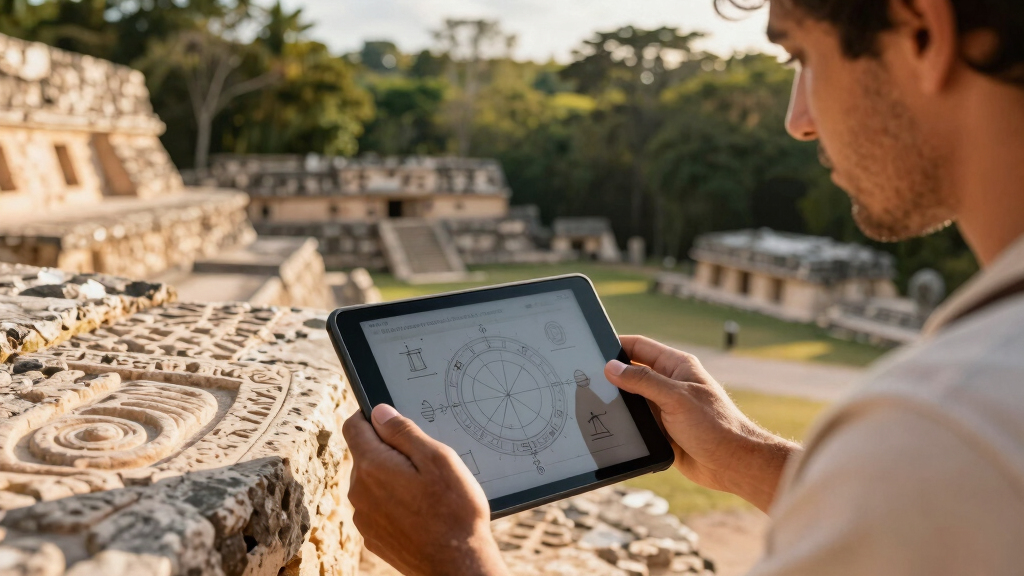
Researchers involved in the project deciphered a series of mathematical inscriptions found at the archaeological site of Kaminaljuyu, Guatemala. These texts, dating back to the Late Classic period (roughly 600-900 AD), include complex calculations and astronomical references. The texts explicitly mention a person named ‘Ah Kin,’ which translates to ‘He of the Sun,’ identified by scholars as an ancient Maya astronomer.
The decipherment was carried out by a team of linguists and archaeologists from the University of San Carlos and the National Museum of Guatemala, utilizing newly developed algorithms for Maya hieroglyphs. The texts describe observations of celestial events, including solar and lunar cycles, and suggest the individual played a key role in calendar calculations and astronomical predictions.
While the texts do not specify the individual’s full identity or title, the references imply a position of high status and specialized knowledge, akin to a priest-astronomer. This is the first direct textual evidence linking a specific person to astronomical expertise in Maya civilization, according to the research team.
Implications for Understanding Maya Scientific Knowledge
This discovery significantly enhances our understanding of the depth of scientific and mathematical knowledge in Maya society. It demonstrates that the Maya not only observed celestial phenomena but also documented and systematized their knowledge through written texts, challenging earlier views that their astronomy was primarily mythological or ritualistic.
The identification of a named astronomer suggests the existence of specialized roles within Maya society, indicating a sophisticated division of scientific labor. It also provides a tangible link between Maya mathematics, astronomy, and daily governance, as these sciences likely influenced agricultural cycles, rituals, and political decisions.
As an affiliate, we earn on qualifying purchases.
Recent Advances in Maya Archaeological and Linguistic Research
Over the past decade, breakthroughs in deciphering Maya hieroglyphs and dating archaeological sites have transformed our understanding of Maya civilization. Recent discoveries include the identification of complex calendar systems, hieroglyphic inscriptions detailing royal lineage, and now, the recognition of individual roles such as astronomers.
The site of Kaminaljuyu has yielded numerous artifacts and inscriptions, but this is the first time that mathematical texts have been conclusively linked to an individual known as an astronomer. Previous research often relied on iconography and indirect references; this new textual evidence provides a more direct understanding of Maya scientific practices.
The decipherment process involved interdisciplinary collaboration, combining linguistic analysis with digital imaging techniques, which allowed scholars to read previously illegible inscriptions.
“This is a groundbreaking discovery that confirms the Maya had a well-developed scientific tradition, with individuals dedicated to understanding the cosmos.”
— Dr. Maria Lopez, lead researcher
astronomy educational kit for kids
As an affiliate, we earn on qualifying purchases.
As an affiliate, we earn on qualifying purchases.
Unanswered Questions About the Astronomer’s Role
While the texts identify an individual associated with astronomical knowledge, many details remain unclear. It is not yet confirmed whether ‘Ah Kin’ was a priest, a ruler, or a specialized scientist. The full extent of their influence on Maya society and governance is still under investigation.
Additionally, the precise dating of the texts and how widespread this role was across different Maya city-states require further research. The possibility that other similar texts exist at different sites remains to be explored.
As an affiliate, we earn on qualifying purchases.
Next Steps in Maya Scientific Research
Researchers plan to continue deciphering Maya inscriptions at Kaminaljuyu and other sites, aiming to identify more individuals associated with scientific roles. Excavations are ongoing, and new imaging technologies will be employed to uncover additional texts.
Further interdisciplinary studies are expected to clarify the scope of Maya astronomy and its integration into political and religious life. The team also intends to publish detailed analyses of the texts and their implications for understanding Maya knowledge systems.
As an affiliate, we earn on qualifying purchases.
Key Questions
What does this discovery tell us about Maya science?
This discovery shows that the Maya had advanced mathematical and astronomical knowledge, with documented roles for individuals dedicated to observing and recording celestial events.
Who is ‘He of the Sun’?
The texts identify this individual as an astronomer, but their full identity and societal role remain uncertain pending further research.
How were the texts deciphered?
Researchers used new digital imaging and linguistic analysis techniques to interpret the hieroglyphic inscriptions, revealing references to astronomical observations and calculations.
Why is this discovery important?
It provides direct evidence of specialized scientific roles in Maya society, challenging previous assumptions and enriching our understanding of their intellectual achievements.
Source: hn
Fall Picks
fall essentials
As an affiliate, we earn on qualifying purchases.