
📊 Full opportunity report: Keeping Parental Consent Records In Youth Services on IdeaNavigator AI — validation score, market gap, and execution plan.

Prime made for students and young adults
- Fast, free delivery for dorm and study essentials
- Prime Video and Amazon Music included
- Member-only deals
TL;DR
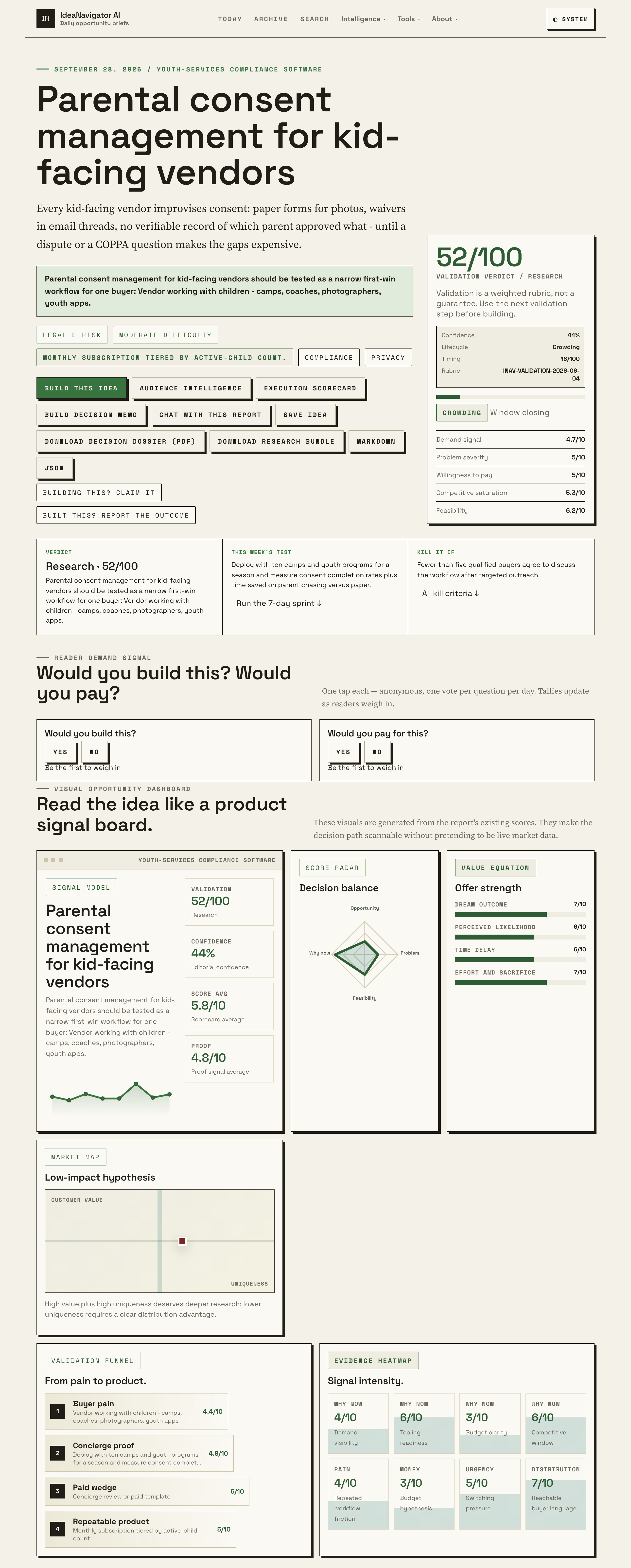
IdeaNavigator AI has outlined a proposed consent-management product for vendors working with children, including camps, coaches, photographers and youth apps. The concept would replace scattered forms and email records with mobile consent flows and per-child records, but it remains an idea to validate, not a launched service or verified market trend.
IdeaNavigator AI’s proposal describes a consent-management platform for camps and other vendors working with children, aiming to put parent approvals for photos, data use, medical information and liability waivers into phone-based forms and per-child records. The proposal recommends testing the service with ten camps and youth programs for a season; no pilot results, launch date or participating organizations are identified.
In its proposal, IdeaNavigator AI describes a recordkeeping problem for businesses and programs that serve children: consent may be gathered through paper forms, email threads or other separate processes, leaving staff without a single, readily verifiable account of which parent approved which use. The proposal says those gaps could become costly when a dispute arises or an organization faces a question about children’s privacy practices. It does not document a specific dispute or enforcement action.
The suggested minimum viable product would offer vendor-branded consent flows that parents can complete on a phone. Forms could cover photo use, data collection, medical details and liability. The platform would keep a consent ledger for each child, track expirations, apply identity checks suited to the risk level and allow records to be exported for an audit. These are features described in IdeaNavigator AI’s proposal; the material does not establish that a working product exists.
IdeaNavigator AI’s concept targets camps, coaches, photographers and youth apps, with a monthly subscription priced by active-child count. To assess demand, it suggests a seasonal trial with ten camps and youth programs. The proposal recommends measuring completion rates and staff time spent following up with parents compared with paper-based collection. It supplies no pricing, completion benchmark or time-saving estimate.
A Defensible Record for Each Child
For organizations that work with children, consent records can affect whether staff can show that a parent approved a particular activity or use of information. IdeaNavigator AI’s proposal says a centralized record could make it easier to find who gave permission, what they approved and whether that approval has expired. That may help staff respond to parent questions and organize records if a concern is raised.
The proposed tool also focuses on the administrative burden of gathering approvals. Phone-based forms and expiration tracking could reduce repeated follow-ups and make it easier to see which children still lack a completed form. Whether that saves meaningful time, improves completion or provides records adequate for a particular organization’s obligations has not been demonstrated. IdeaNavigator AI identifies these as questions for the proposed pilot to examine.
The idea is aimed at a varied group of providers, from small camps to youth-focused apps. Their activities and the sensitivity of the information they collect can differ. A shared workflow could be useful, but the proposal does not show how one product would handle those differences or what level of identity verification each use would require.
From Paper Forms to Digital Ledgers
IdeaNavigator AI frames the proposal’s timing around children’s privacy rules and parent concerns. It refers generally to updates to the U.S. Children’s Online Privacy Protection Act, commonly known as COPPA, and state laws, as well as parents questioning the use of children’s photos and data. The proposal does not cite particular legal changes, enforcement cases or survey findings, so those references are its stated rationale for the product rather than evidence of a specific recent development.
Consent is not one uniform approval in the proposed workflow. A parent may be asked separately about a child’s photo, personal data, medical information or participation under a liability waiver. The suggested ledger and expiry tracking would keep those approvals associated with an individual child, rather than treating a completed form as blanket permission for every use. The proposal does not specify record-retention periods or how consent changes would be documented.
IdeaNavigator AI presents this as a narrow first product for youth-service vendors, rather than a platform already adopted across the sector. Its suggested ten-organization seasonal trial is a way to test operational demand and measure parent completion and staff follow-up time. No participating camps or programs are named.
Pilot Scope and Legal Fit
IdeaNavigator AI’s proposal confirms no pilot, product launch or customer adoption in the available details. The timing, participating organizations, product build status and results are not given. It is also unclear how the proposed service would verify a parent’s identity, protect sensitive medical or personal data, handle access by separated guardians, or respond when consent is withdrawn.
The proposal refers broadly to COPPA updates and state laws but does not identify specific provisions or explain which types of vendors and data practices would be covered. It does not establish that using a digital ledger would by itself meet legal requirements or resolve disputes. The appropriate records and consent process may depend on the organization, activity and information involved.
Commercial viability is also untested. IdeaNavigator AI provides no subscription prices, operating costs, competing products, buyer interviews or evidence of willingness to pay. The suggested active-child pricing model and pilot measures remain proposals, not reported findings.
A Seasonal Trial Would Test Demand
IdeaNavigator AI outlines a next step of deploying the service with ten camps and youth programs for one season. The proposed evaluation would track how often parents complete consent forms and compare staff time spent chasing approvals with the time required under paper-based processes.
The proposal provides no schedule, recruitment plan or decision threshold. If a trial proceeds, its findings could show whether organizations will adopt the workflow and whether the proposed measures improve in practice. Until those details or results are available, the platform remains a product concept rather than a confirmed operational service.
Source: IdeaNavigator AI proposal
Key Questions
What is the proposed platform?
IdeaNavigator AI describes a proposed service for collecting and organizing parent approvals for children in camps, youth programs and other child-facing services. The suggested features include mobile forms, per-child consent records, expiry tracking and audit exports.
Has the service launched?
IdeaNavigator AI’s available material describes a product idea and a proposed pilot. It does not confirm a launch, a working product or existing customers.
What kinds of consent would it record?
The proposal lists approvals for photo use, data collection, medical information and liability waivers. It does not specify how each form would be tailored to an organization’s activities.
How would the idea be tested?
IdeaNavigator AI suggests a one-season trial with ten camps and youth programs, measuring parent form completion and staff time spent following up compared with paper collection. No trial results or start date are reported.
Source: IdeaNavigator AI
Fall Picks
fall essentials
As an affiliate, we earn on qualifying purchases.