📊 Full opportunity report: Could A Backyard Home Fit Your Property And Plans? on IdeaNavigator AI — validation score, market gap, and execution plan.

Prime made for students and young adults
- Fast, free delivery for dorm and study essentials
- Prime Video and Amazon Music included
- Member-only deals
TL;DR
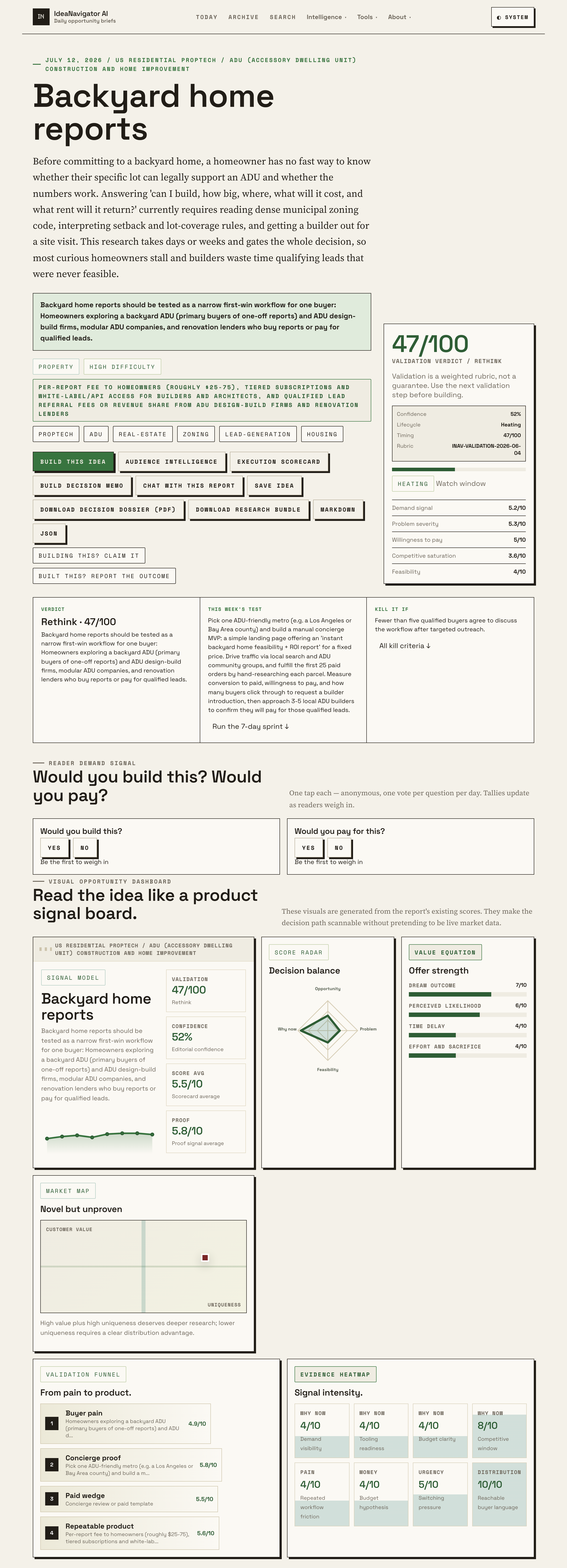
An IdeaNavigator AI analysis proposes paid per-address ‘backyard home reports’ that tell homeowners whether their lot can legally support an ADU and what the economics look like. The idea taps a surge in ADU permitting — Los Angeles County permitted over 45,000 ADUs in 2023, and ADUs now account for roughly one in five new California housing units.
A new IdeaNavigator AI analysis proposes building a paid web service that answers a question most homeowners currently cannot resolve quickly: can my specific lot legally support a backyard accessory dwelling unit (ADU), how big can it be, what will it cost, and what rent could it return? The analysis argues that answering those questions today requires days or weeks of reading municipal zoning code and scheduling builder site visits, and that mature parcel data plus LLM-based code parsing now make instant per-address feasibility reports practical.
The proposed product is a web app where a homeowner enters their property address and pays for a homeowner-ready PDF report. According to the analysis, the report would ingest county parcel data — lot boundaries, lot size, and existing footprint — and check the lot against state ADU law plus a manually curated rule set for a single launch market, such as a few California counties. The output would cover allowed ADU types, maximum size, setback and lot-coverage constraints, a buildable-area estimate, a realistic build-cost band, and projected rental income drawn from local rent comps.
The recommended first step is deliberately small: a manual concierge MVP in one ADU-friendly metro, such as a Los Angeles or Bay Area county, with a simple landing page selling an “instant backyard home feasibility + ROI report” at a fixed price. The first 25 paid orders would be fulfilled by hand-researching each parcel, measuring conversion to payment, willingness to pay, and how many buyers click a ‘connect me with a vetted ADU builder’ button. The analysis then calls for approaching 3-5 local ADU builders to confirm they would pay for qualified leads.
The revenue model has three parts: a per-report fee of roughly $25-75 to homeowners, tiered subscriptions and white-label or API access for builders and architects, and qualified lead referral fees or revenue share from ADU design-build firms and renovation lenders. The target market is US residential proptech and ADU construction and home improvement, with homeowners as primary buyers of one-off reports and firms and lenders as secondary customers.
Why Feasibility Reports Fill a Real Gap
The analysis identifies a structural bottleneck in the ADU market: the feasibility question gates the entire decision. Homeowners who cannot cheaply determine whether their lot qualifies tend to stall, while builders waste time qualifying leads that were never feasible. A fast, standardized report could shorten that funnel for both sides and create a lead-generation channel that design-build firms and lenders already have an incentive to pay for.
The timing argument rests on confirmed policy and market trends. California legalized ADUs statewide in 2016 and has loosened rules nearly every year since, and other states and cities are following. ADU permitting has surged: according to figures cited in the analysis, Los Angeles County alone permitted over 45,000 ADUs in 2023, and ADUs now represent roughly one in five new housing units produced in California. A persistent US housing shortage, estimated in the millions of units, adds to demand pressure.
How Zoning Data and AI Made This Possible
ADU feasibility has historically been hard to self-serve. Setback rules, lot-coverage caps, and allowed unit types vary by jurisdiction and are buried in dense municipal code, which is why the current process typically involves manual research and a builder site visit. The analysis argues that two enabling factors have recently matured: widely available parcel and zoning data from counties, and language-model tools capable of parsing zoning text — though the MVP it describes relies on manually curated rules for one launch market rather than automated parsing.
The competitive positioning described in the analysis is that of a ‘narrow first-win workflow’: a single, well-defined report rather than a full ADU design or construction platform. That narrow scope is presented as the reason the product can be validated quickly with a small number of hand-fulfilled orders.
What the Analysis Hasn’t Proven
The analysis is a business proposal, not a launched product or validated company. No pricing has been tested with real customers, no builder partnerships are confirmed, and the $25-75 price band is an estimate rather than a measured willingness-to-pay figure. The accuracy of LLM-parsed or curated zoning rules against real municipal code — and the liability implications of giving homeowners a report they may rely on — are not addressed. The 2023 permitting figures are cited secondhand and were not independently verified for this article. Whether homeowners will pay before seeing results, and whether builders will pay for leads at a rate that supports the business, remains untested.
The Validation Roadmap Ahead
If pursued as described, the next steps would be selecting one ADU-friendly metro, launching a landing page for a fixed-price feasibility report, and hand-fulfilling the first 25 paid orders to measure conversion and willingness to pay. After that, the analysis recommends approaching 3-5 local ADU builders to confirm demand for paid qualified leads, then expanding the curated rule set county by county. Broader open questions include whether automated code parsing can eventually replace manual curation and whether subscription or white-label demand from builders and lenders materializes at scale.
Source: IdeaNavigator AI
Key Questions
What is a backyard home feasibility report?
According to the IdeaNavigator AI analysis, it is a paid PDF report for a specific property address covering whether an ADU is allowed, permitted types and maximum size, setback and lot-coverage constraints, a buildable-area estimate, a build-cost band, and projected rental income.
How much would a report cost?
The analysis estimates a per-report fee of roughly $25-75 for homeowners. This is an untested estimate, not a validated price.
Is the service available now?
No. The analysis describes a proposed MVP. The recommended first step is a manual concierge version in one California metro, fulfilling the first orders by hand before automating anything.
Why are ADUs attracting so much interest?
California legalized ADUs statewide in 2016 and has loosened rules repeatedly since; Los Angeles County permitted over 45,000 ADUs in 2023, and ADUs now represent roughly one in five new housing units in California, against a US housing shortage estimated in the millions of units.
Who would pay besides homeowners?
The analysis identifies ADU design-build firms, modular ADU companies, and renovation lenders as buyers of subscriptions, white-label or API access, and qualified leads generated by homeowners who request builder introductions.
Source: IdeaNavigator AI
Fall Picks
fall essentials
As an affiliate, we earn on qualifying purchases.