
🔍 Read the full analysis: What The Luddites’ Story Says About AI And Jobs on ThorstenMeyerAI.com

Prime made for students and young adults
- Fast, free delivery for dorm and study essentials
- Prime Video and Amazon Music included
- Member-only deals
TL;DR
A November 5, 2026 article from ThorstenMeyerAI.com revisits the Luddites as machine workers protesting reduced pay and worsening work, not simply people opposed to technology. It connects their disputes over wages, quality and worker voice to current AI debates, while noting that the historical comparison does not establish how AI will affect jobs or pay.
A November 5, 2026, episode of ThorstenMeyerAI.com’s Work After Work revisits the 1811–13 Luddite movement to examine what its history can—and cannot—say about AI and jobs. The account argues that the original frame breakers were skilled machine workers objecting to lower pay, cheaper goods and limited influence over how their work was organized, rather than people who simply hated technology.
The movement began among framework knitters in Nottinghamshire, who made stockings and other knitted goods using stocking frames. Many knitters did not own the machines: they rented frames and were paid by the piece for work distributed by hosiers, merchants who sold the goods. The source says protests spread to Yorkshire and Lancashire in 1812, where workers also attacked machinery associated with their trades.
The article draws on a February 6, 1812 report by Nottingham magistrate Robert Baker to the Home Office. Baker wrote that in some places a fifth of frame workers were out of work and linked the unrest to hosiers paying reduced prices. He said frame breakers targeted employers associated with “under-price” work and wider frames that enabled cheaper stockings. His account is evidence from an official investigating the unrest, not a complete record of every participant’s motives.
The state response was severe. The source says 900 cavalry and 1,000 infantry had been sent into Nottingham by December 1811. Parliament’s Frame-Breaking Act of March 20, 1812, made breaking a frame a capital felony; the account reports that 17 men were executed in 1813. The episode uses this history to frame modern AI disputes around pay, work quality and worker input, not as proof that the two periods are identical.
AI Debates Extend Beyond Job Loss
The comparison matters because arguments about workplace automation are not only about whether a machine can perform a task. The Luddite account highlights how pay, product quality and bargaining power can shape workers’ responses when technology changes how goods are made or work is paid for. Those questions remain relevant as employers adopt AI tools that may alter tasks, staffing and the value assigned to workers’ contributions.
The source points to Hollywood writers’ contracts, German works-council rights and the EU AI Act as examples of present-day efforts to set rules around technology and work. These examples differ in legal setting and purpose; they do not show that AI will produce the same outcomes as mechanized knitting. The historical lesson offered is narrower: examining who controls a tool and who receives the gains can clarify what today’s labor disputes are about.
Popular right now

Ninja Crispi 5-in-1 Glass Air Fryer System, Emerald, FN103BF

Dyson V8 Cyclone Cordless Vacuum

Dyson V15 Detect Cordless Vacuum
As an affiliate, we earn on qualifying purchases.
The Workers Behind the Frames
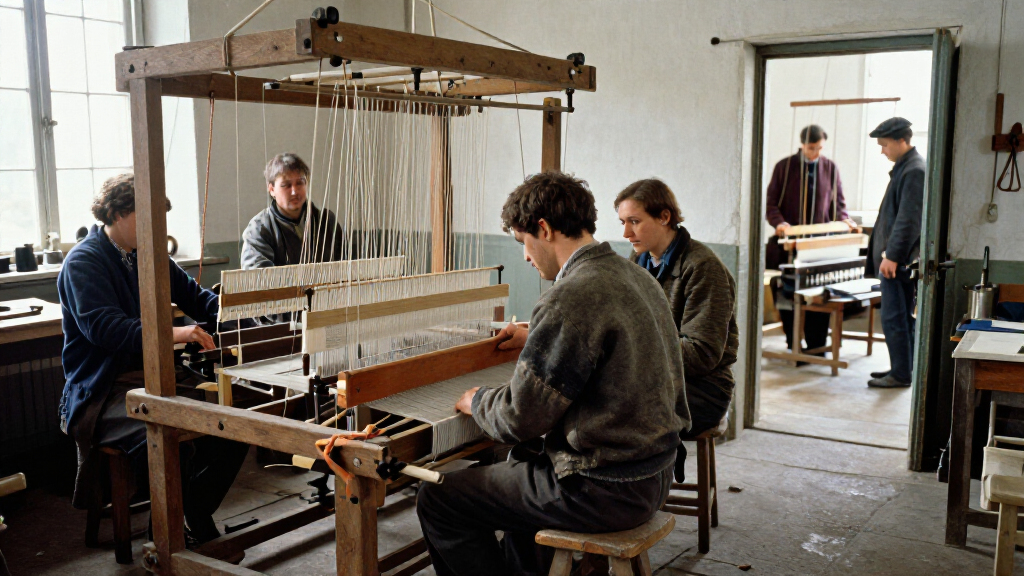
“Luddite” is now often used to mean someone opposed to new technology. The episode challenges that shorthand: the original Luddites worked with the machines they attacked. Stocking frames were mechanical knitting devices operated by hand and foot, often in homes or small workshops. Workers could depend on a frame for their livelihood without owning it or setting the rates paid for their work.
The movement’s name also needs care. Letters were signed by “General Ned Ludd” or “King Ludd,” but the National Archives describes Ned Ludd as a mythical figure; the source says there is no reliable evidence that a historical leader of that name directed the movement. The episode also cites Robert Allen’s estimate that British real wages rose 12% from 1780 to 1840, while output per worker rose 46%. It says later research narrows but does not close that gap, and that wages grew faster than output after 1840. These figures describe a long historical period, not a forecast for AI.
““For some time before these troubles broke out, in many places a fifth of the frame workers were out of employ.””
— Robert Baker, Nottingham magistrate, in a February 6, 1812 report to the Home Office, as quoted by ThorstenMeyerAI.com
Limits of the Historical Comparison
The source presents the Luddite record as a way to frame questions about AI, not as evidence that AI will cause a particular level of job loss, wage change or worker protest. How AI adoption will affect employment and pay depends on decisions and conditions not established by this historical account. The piece does not provide new labor-market data on current AI use or measure its effects across industries.
Some evidence about the Luddites also comes through officials and later historians. Baker’s report described what a magistrate believed about the targets and motives; it cannot establish that every attack followed the same pattern. The source further says attacks were not always precise, citing a reward notice after five frames belonging to a worker reportedly paid the full rate were broken. The precise motives of all participants, and the extent to which the episode’s modern examples will shape AI workplace rules, remain unclear.
Rules Will Shape AI at Work
The next developments to watch are the rules employers and governments set for AI in workplaces, and how workers respond to them. The source identifies labor agreements, works-council rights and the EU AI Act as current arenas where questions about technology and work are being addressed. It does not give a schedule for new decisions or identify a single forthcoming milestone.
For readers, the episode’s framework points to concrete questions as AI tools spread: Who controls their use? How might they affect pay, job quality and staffing? What say do workers have in changes to their work? Answers will require current evidence from workplaces and policy decisions, rather than a direct prediction from the events in Nottingham.
Key Questions
Who were the Luddites?
They were workers, including framework knitters in Nottinghamshire, who used stocking frames to make goods. In the 1811–13 movement, some attacked machinery amid disputes over pay and working conditions.
Were the Luddites simply against technology?
The account says they worked with the machines they targeted. It describes objections tied to reduced prices, unemployment and changes in production, rather than a general rejection of technology.
What is the connection to AI and jobs?
The episode draws a comparison around who benefits from workplace technology and who has a say in its use. It does not establish how AI will affect employment or wages.
What happened to people who broke the frames?
The Frame-Breaking Act of March 20, 1812, made frame breaking a capital felony. The source reports that 17 men were executed in 1813.
Source: ThorstenMeyerAI.com