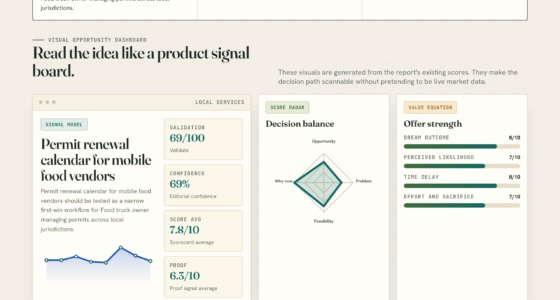
📊 Full opportunity report: Week Three — Foundation model vs Brownian motion. Kronos on five-minute BTC. on ThorstenMeyerAI.com — validation score, market gap, and execution plan.

Prime made for students and young adults
- Fast, free delivery for dorm and study essentials
- Prime Video and Amazon Music included
- Member-only deals
TL;DR
A recent study tested the Kronos foundation model against a Brownian motion baseline for 5-minute Bitcoin trading predictions. Results show Kronos does not outperform Brownian motion on out-of-sample data, raising questions about AI-based trading advantages.
Recent testing shows that the Kronos foundation model does not outperform a Brownian motion baseline in predicting 5-minute Bitcoin price movements, based on out-of-sample data.
Over the past week, researchers conducted a rigorous offline comparison of Kronos-small, an open-source foundation model trained on global exchange data, against a geometric Brownian motion model used by a trading bot for short-term BTC predictions. The test involved analyzing 497 historical trades, reconstructing market conditions, and evaluating each model’s probability forecasts against actual outcomes.
The results indicated that Kronos’s predictive performance, measured via Brier score and log-loss, was statistically indistinguishable from Brownian motion. Specifically, on the out-of-sample subset of 249 trades, the difference in Brier scores was only 0.0011, well within the margin of statistical noise. Consequently, the hypothesis that Kronos could deliver a meaningful edge over the traditional model was not supported.
As a result, integrating Kronos into the trading bot as a live predictive component is not justified based on current data, challenging assumptions that modern learned models inherently outperform classical stochastic models in short-term crypto trading.
Implications for AI in Short-Term Crypto Trading
This finding questions the perceived advantage of sophisticated foundation models in high-frequency or short-term trading scenarios. While Kronos is a credible research model trained on extensive data, its inability to outperform a simple Brownian motion baseline in this context suggests limitations in applying AI for immediate market prediction. This has implications for traders and developers investing resources into AI-based trading systems, emphasizing the need for rigorous validation before deployment.
Bitcoin short-term trading prediction tools
As an affiliate, we earn on qualifying purchases.
As an affiliate, we earn on qualifying purchases.
Background on Model Testing in Crypto Markets
Previous efforts to improve short-term crypto prediction relied heavily on classical stochastic models like geometric Brownian motion, which assume independent, normally-distributed returns. Recent advances in AI, especially foundation models trained on vast datasets, promised potential improvements. However, early tests, including those by Thorsten Meyer and others, have shown mixed results, often revealing that perceived edges are artifacts or overfitting.
The current study builds on Meyer’s ongoing research, which has previously demonstrated that most trading edges found by open-source bots tend to collapse in out-of-sample testing, raising skepticism about AI’s short-term predictive power. Kronos, a recent open-source foundation model with 25,000+ GitHub stars, was tested specifically to see if it could challenge this pattern.
“Kronos does not outperform Brownian motion in out-of-sample tests for 5-minute BTC predictions, challenging assumptions about AI advantage in this space.”
— Thorsten Meyer
As an affiliate, we earn on qualifying purchases.
Limitations of the Current Testing Approach
While the study provides a thorough offline comparison, it remains unclear how Kronos might perform in live trading environments or with different market conditions. The analysis was limited to historical data and did not account for market impact, liquidity, or real-time execution factors. Additionally, the model’s performance could vary with different configurations or training data, which remain areas for further investigation.
high-frequency trading analysis software
As an affiliate, we earn on qualifying purchases.
As an affiliate, we earn on qualifying purchases.
Next Steps for AI-Driven Crypto Prediction Research
Further research is needed to evaluate whether more advanced or differently trained foundation models can outperform classical stochastic models in real-time trading. Live testing, incorporating market impact and adaptive strategies, could provide additional insights. Researchers and traders will likely explore hybrid approaches combining AI predictions with traditional models to find practical edges.
As an affiliate, we earn on qualifying purchases.
Key Questions
Does this mean AI models are useless for crypto trading?
No, this study indicates that current foundation models like Kronos do not outperform simple stochastic models in short-term predictions. AI may still offer advantages in other contexts or longer-term strategies, but immediate short-term prediction remains challenging.
Could different training data improve Kronos’s performance?
Potentially. The current model was trained on a wide dataset, but specialized or more recent data might yield better results. Further experimentation is needed to assess this possibility.
Will live testing produce different results?
It is uncertain. Offline tests do not capture all market dynamics, and live environments may introduce variables that could affect performance. Caution is advised before deploying such models in real trading.
What does this mean for traders relying on AI predictions?
Traders should remain skeptical of claims that AI models automatically generate profitable short-term trades without rigorous validation. Empirical testing is essential.
Source: ThorstenMeyerAI.com
Columbus Day / Indigenous Peoples' Day Picks
long weekend sales
As an affiliate, we earn on qualifying purchases.