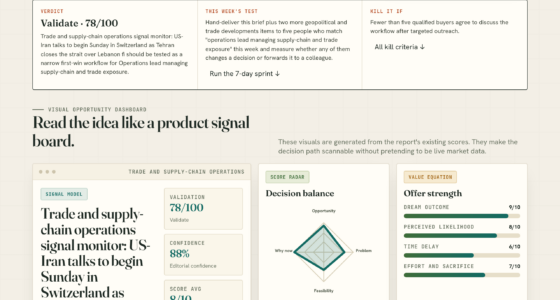

📊 Full opportunity report: The Door: Why the Interface Is Worth More Than the Model on ThorstenMeyerAI.com — validation score, market gap, and execution plan.

Prime made for students and young adults
- Fast, free delivery for dorm and study essentials
- Prime Video and Amazon Music included
- Member-only deals
TL;DR
SpaceX acquired a $60 billion coding interface company, emphasizing that owning the interface—the ‘door’—is now more valuable than owning the AI model itself. This shift impacts AI distribution and control strategies.
SpaceX announced it has acquired a coding interface company for $60 billion, marking a strategic shift in AI industry dynamics. This move underscores the importance of owning the interface—the point where developers and users interact—over simply controlling AI models, which are increasingly becoming commodities.
The company, known as Anysphere, built a highly profitable coding interface on top of existing AI models, reaching approximately $4 billion in annualized revenue. Despite rebuffing attempts by OpenAI and Microsoft, it was purchased by SpaceX, which already owns extensive AI infrastructure, emphasizing the value of the interface layer rather than the models beneath.
This transaction exemplifies the industry’s evolving focus: ownership of the interface—the ‘door’—is now a strategic asset. The interface captures user habits, routing decisions, and data feedback, making it a critical chokepoint in AI distribution. SpaceX’s purchase grants control over the demand flow, user engagement, and the ability to influence which models are used first, rather than just developing or owning the models themselves.
The Door: Worth More Than the Model
SpaceX paid $60B for a coding tool — not a model. As the model commoditizes, the surface the human touches captures the value: the default, the habit, the data, and the choice of which model gets called.
Perplexity
The most valuable chokepoint — and, strangely, the most winnable. You can’t bootstrap a gigawatt or a 555K-GPU cluster, but a small team can still build the door (Cursor was a few founders on rented models). Own the interface and the user relationship even if you rent everything underneath — and never let a platform’s default be your only door to your users.
Why Interface Ownership Reshapes AI Power Structures
This development signifies a fundamental shift in AI industry power: controlling the interface means controlling access, habits, and data flow. As models become commoditized, the interface layer—where users interact—becomes the most valuable asset, influencing which models are used and how demand is routed. For companies and developers, owning this ‘door’ means shaping user behavior and accumulating proprietary data, creating a new form of competitive advantage.
For consumers and businesses, this means that future AI experiences will be heavily influenced by who owns the interface. The company controlling that surface can prioritize certain models, set defaults, and influence the flow of information, making the interface a critical battleground for AI dominance.
coding interface development tools
As an affiliate, we earn on qualifying purchases.
As an affiliate, we earn on qualifying purchases.
Industry Shift Toward Interface Control in AI Distribution
Over the past few years, the AI industry has seen a trend where the underlying models become more accessible and commoditized, with prices for compute and weights decreasing. Meanwhile, the interface layer—such as chat windows, browsers, or developer tools—remains a controlled environment. Notably, in October 2025, OpenAI launched Atlas, a browser-like interface that integrates AI with web browsing, aiming to control user interaction and demand flow.
Leading tech giants like Google, Microsoft, and smaller startups are investing heavily in interface-based products, recognizing that the real value lies in the habit formation and routing capabilities they enable. The recent SpaceX acquisition underscores this shift, emphasizing that owning the ‘door’ to AI access is now a strategic priority.
“Our acquisition of Anysphere positions us at the forefront of AI distribution and interface control.”
— SpaceX spokesperson
As an affiliate, we earn on qualifying purchases.
Unclear Implications for Model Developers and Users
It remains uncertain how widespread the shift toward interface ownership will become across the industry. While the trend suggests increasing control over user routing and habits, the impact on smaller developers, open-source models, and end-users is still developing. Additionally, regulatory responses to this concentration of control are not yet clear.
As an affiliate, we earn on qualifying purchases.
Next Steps in AI Interface and Distribution Strategies
Expect further consolidation around interface ownership, with companies racing to build and control habit-forming surfaces. Regulatory scrutiny may increase as market power concentrates, and new standards for agent and web interaction emerge. The industry will likely see more acquisitions focused on interface control, shaping the future landscape of AI distribution and access.
As an affiliate, we earn on qualifying purchases.
Key Questions
Why is owning the interface more valuable than owning the model?
Because the interface controls user habits, demand routing, and data flow, making it a strategic chokepoint that influences which models are used and how data is collected, rather than just the raw capabilities of the models themselves.
How does this shift affect AI developers and users?
Developers may find it harder to access or distribute models without controlling the interface, and users may experience more influence from companies that own these surfaces, affecting choices, defaults, and data privacy.
Could regulation limit the power of interface owners?
Potentially, as regulators examine issues of market dominance and data control, but current legal developments are still in early stages and uncertain.
Source: ThorstenMeyerAI.com
Halloween Picks
halloween
As an affiliate, we earn on qualifying purchases.