
TL;DR
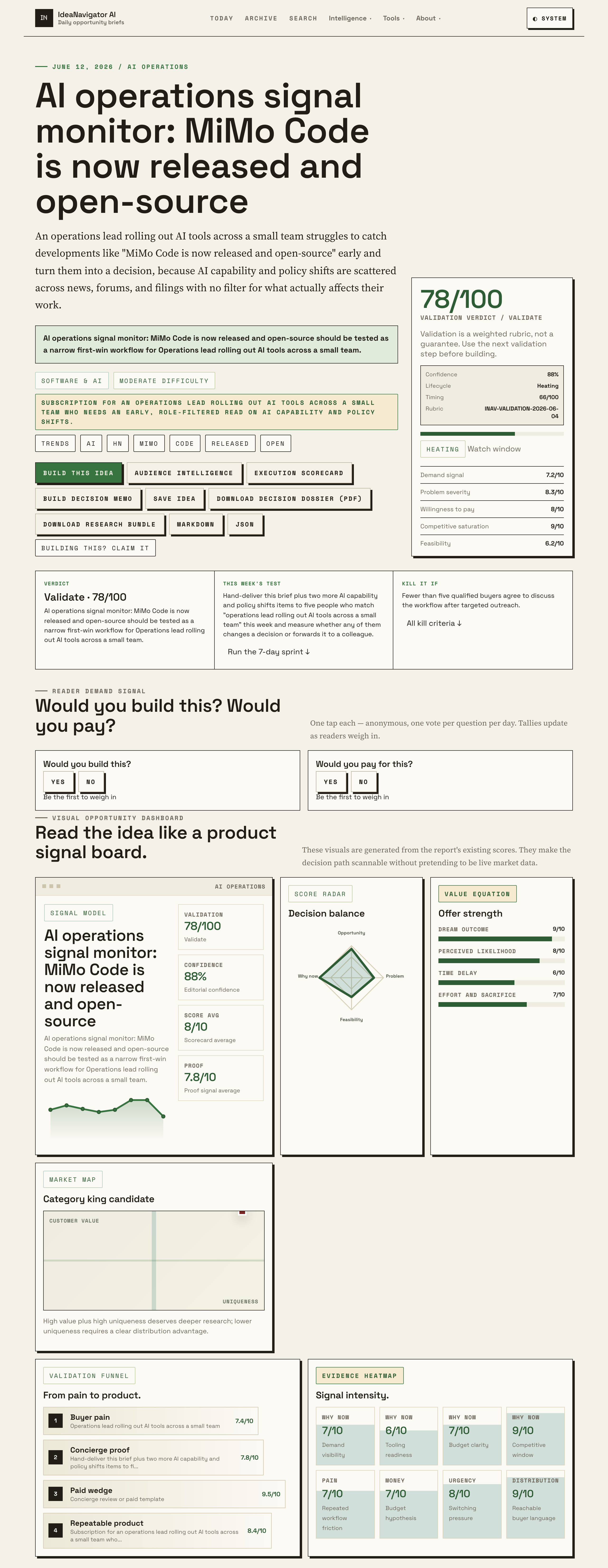
MiMo Code, an open-source AI operations signal monitor, has been released to help small team operations leads track AI capability and policy shifts quickly. It filters relevant news from sources like Hacker News, aiding faster decision-making.
MiMo Code, an open-source signal monitoring tool for AI operations, has been released to help operations leads track relevant AI capability and policy shifts in real-time. This development aims to address the challenge of quickly turning scattered news and policy updates into actionable decisions, especially for small teams deploying AI tools.

Prime made for students and young adults
- Fast, free delivery for dorm and study essentials
- Prime Video and Amazon Music included
- Member-only deals
The MiMo Code project is now available as an open-source solution designed to filter and highlight AI capability and policy shifts from sources like Hacker News and similar feeds. It is targeted at operations leads managing AI tool rollouts within small teams, who often struggle to stay informed of developments that directly impact their work.
According to IdeaNavigator AI, the tool prioritizes role-specific signals, providing brief summaries and assessments of why each update matters and what actions might be necessary. The initial focus is on a narrow workflow—monitoring early signals that could influence AI deployment decisions.
Developers plan to validate the tool by delivering briefings based on its outputs to five operations leads this week, measuring whether it influences decision-making or prompts further sharing among colleagues.
Impact of MiMo Code on AI Operations Management
The release of MiMo Code as an open-source monitoring tool could significantly streamline how small team operations manage AI deployment. By providing role-specific, timely alerts on AI capability and policy shifts, it can reduce delays caused by information overload and scattered news sources. This can lead to faster, more informed decisions, potentially giving small teams a competitive edge in AI integration.
Popular right now

Dyson Airstrait Styling Brush

De'Longhi Magnifica Duo Fully Automatic Espresso Machine with Milk Frother, Silver

Hisense E7 Cinema Series 55-Inch Hi-QLED Mini-LED 4K UHD Smart Fire TV
As an affiliate, we earn on qualifying purchases.
Background on AI Signal Monitoring and Small Team Needs
As AI capabilities rapidly evolve, operations teams face increasing challenges in tracking relevant developments. Existing news sources and forums like Hacker News generate a high volume of updates, many of which are not immediately actionable for small teams managing AI deployment. Prior efforts have lacked role-specific filtering, leading to delays and missed opportunities. The open-source release of MiMo Code aims to fill this gap, offering a focused, role-tailored monitoring solution.
“MiMo Code is designed to filter out noise and deliver only the most relevant signals for small team AI operations.”
— an anonymous researcher
Unclear Aspects of MiMo Code’s Adoption and Effectiveness
It remains uncertain how widely MiMo Code will be adopted by small teams or how effectively it will influence decision-making in practice. Its initial validation is ongoing, and the actual impact on deployment speed and decision quality has yet to be demonstrated through broader use or case studies.
Next Steps for Testing and Expanding MiMo Code’s Use
Developers plan to deliver initial briefings based on the tool’s outputs to five operations leads this week, aiming to assess its influence on decision-making. Future steps include gathering user feedback, refining filtering algorithms, and potentially expanding the tool’s scope to include additional sources and features based on early results.
Key Questions
What is MiMo Code?
MiMo Code is an open-source signal monitoring tool designed to track AI capability and policy shifts relevant to small team operations.
Who is the target user for MiMo Code?
The primary users are operations leads managing AI tool rollouts within small teams who need timely, role-specific updates.
How does MiMo Code work?
It filters news from sources like Hacker News to identify and summarize relevant AI capability and policy shifts, providing briefings on why they matter and what actions are needed.
When will its effectiveness be known?
Initial validation is ongoing, with assessments planned after delivering briefings to five users this week. Broader impact remains to be seen.
Will MiMo Code be expanded beyond its current scope?
Future development may include additional sources and features based on early user feedback, but specifics are not yet confirmed.
Source: IdeaNavigator AI