
TL;DR

Prime made for students and young adults
- Fast, free delivery for dorm and study essentials
- Prime Video and Amazon Music included
- Member-only deals
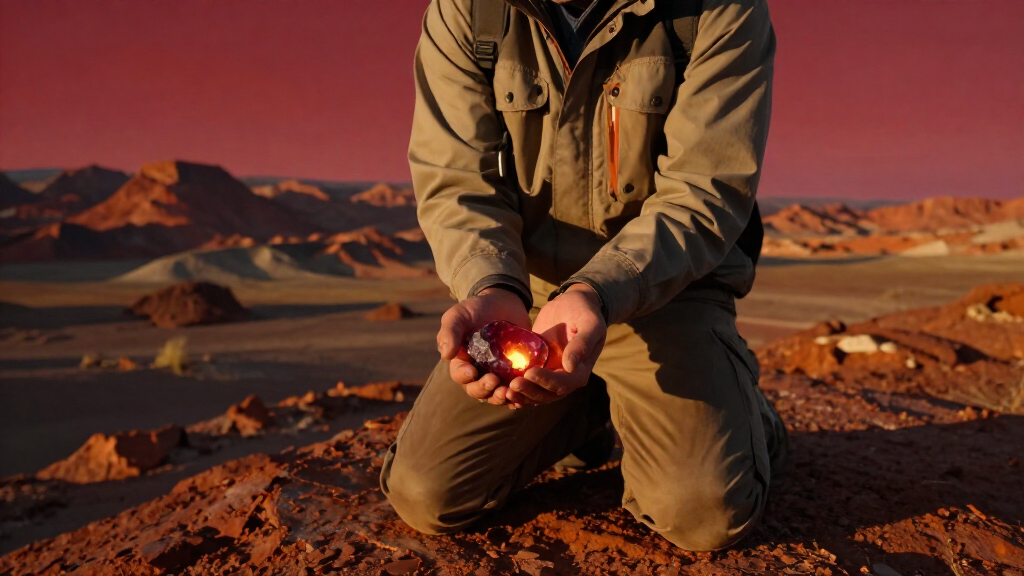
NASA’s Perseverance rover has detected light-emitting chromium-bearing corundum in Martian rocks using its SuperCam instrument. Corundum’s gemstone variety is ruby, but the team says it has not found collectible rubies; the mineral may offer clues about localized heating from ancient impacts.
NASA’s Perseverance rover has detected light-emitting, chromium-bearing corundum in rocks on Mars, a finding that may help scientists investigate ancient heating from impacts. The mineral’s gemstone variety is ruby, but mission scientist Roger C. Wiens says the rover has not found collectible rubies on the planet.
The signal was first detected about two years before Wiens’s Nov. 4, 2026, report, when the rover’s SuperCam laser examined a light-colored rock. The instrument recorded two narrow luminescence peaks at 692.7 and 694.1 nanometers. SuperCam can measure the delay in light emitted after a laser pulse, and the team used that timing to identify chromium atoms in a corundum mineral structure.
Corundum is the mineral form of aluminum oxide; when it contains chromium, its gemstone variety is ruby. The observations do not establish that Mars has large or gem-quality rubies. Wiens described the material as small corundum crystals, and said the observations are useful as evidence for understanding the planet’s geological history, not as a gemstone discovery.
The findings were published earlier in 2026 in Geophysical Research Letters, in a paper led by Ann Ollila, according to Wiens. The team initially used time-resolved luminescence only occasionally, but has more recently applied it more often to light-toned rocks. The method adds a way to search for mineral and geological clues alongside SuperCam’s other measurements.
Clues From Ancient Impact Heating
The detection matters because corundum is associated with metamorphic and pegmatitic processes that researchers would not normally expect to find on Mars, which lacks Earth-like plate tectonics. Its presence may point to localized conditions capable of changing rocks, rather than to broad, ongoing geological activity.
Wiens says large asteroid and meteor impacts can produce local metamorphism through prolonged heating. Perseverance is working in ancient terrain near Jezero crater’s rim, where the team expects signs of such impact effects. The corundum observations may help researchers test that interpretation and reconstruct events in Mars’ deep past. They are a clue, not proof of a particular impact or a full account of how the mineral formed.
The result also shows how instruments designed to study rock chemistry and minerals can provide additional evidence through unexpected measurements. SuperCam’s time-resolved luminescence capability lets the team identify a distinctive signal from chromium-bearing corundum while examining Martian rocks in place.
Popular right now

LG 77-Inch OLED evo C6 4K Smart TV

Breville Barista Touch Impress Espresso Machine, Noir (BES881NRE)

Bose QuietComfort True Wireless Earbuds with Active Noise Cancellation, Bluetooth 5.3, USB-C Charging, IPX4, Black
As an affiliate, we earn on qualifying purchases.
How SuperCam Read the Signal
Perseverance carries several instruments for studying the composition of Martian rocks. NASA’s report names PIXL and SuperCam as tools for detecting elements, while SuperCam, PIXL and SHERLOC can identify minerals using techniques that include X-ray fluorescence, Raman spectroscopy and infrared spectroscopy.
SuperCam’s Raman measurements can also capture time-resolved luminescence: light emitted after the instrument’s laser hits a target. In this case, the two narrow red peaks and their timing helped the researchers connect the signal to chromium in corundum. Wiens notes that the team had tested SuperCam’s response on a ruby before installation; that demonstration is distinct from the small crystals detected by the rover on Mars.
The team’s current search builds on that initial observation. According to Wiens, researchers are now using the technique more frequently on light-toned rocks to look for further evidence of impact-related effects. Perseverance’s work in this ancient terrain is providing observations from a setting the mission team describes as a new one for exploration.
“As the first mission in such terrain, we are learning new things.”
— Roger C. Wiens, describing the team’s work
How the Crystals Formed
The reported measurements identify chromium in a corundum structure, but the NASA article does not establish precisely how or when the crystals formed, or tie them to a specific impact. Impact-related heating is presented as a possible explanation grounded in the local geology, not as a confirmed origin for each detected crystal.
The report also gives no estimate of the crystals’ abundance, distribution or size beyond describing them as little crystals. It does not report a gem-quality sample or a larger deposit. Further observations may help establish whether the signal is common in light-toned rocks in this terrain and whether it consistently corresponds with other evidence of impact effects.
More Luminescence Surveys Ahead
The Perseverance team says it has recently been carrying out time-resolved luminescence observations more frequently on light-colored rocks. Those measurements can add to the rover’s record of mineral composition and help researchers look for signs of localized heating in the ancient terrain.
NASA’s report does not announce a specific next target, publication date or mission milestone tied to the corundum work. The next useful developments will be additional rover observations and analysis showing whether more crystals are detected, how they relate to surrounding rocks, and whether the evidence supports an impact-heating explanation.
Key Questions
Did Perseverance find rubies on Mars?
The rover detected chromium-bearing corundum, the mineral whose gemstone variety is ruby. The NASA report says the crystals are small and that the team has not found collectible rubies.
How did the rover detect the mineral?
SuperCam fired a laser at a light-colored rock and measured delayed luminescence. The two narrow peaks, at 692.7 and 694.1 nanometers, were used to identify chromium in a corundum structure.
Why is corundum unexpected on Mars?
Corundum is associated with metamorphic and pegmatitic processes. Since Mars lacks plate tectonics, researchers are considering whether localized heating from ancient impacts could have helped form it.
Does the discovery prove an impact formed the crystals?
No. The NASA report presents impact-related heating as a possible explanation, but does not identify a specific impact or confirm the crystals’ formation history. Further observations may help test that interpretation.
Source: science.nasa.gov