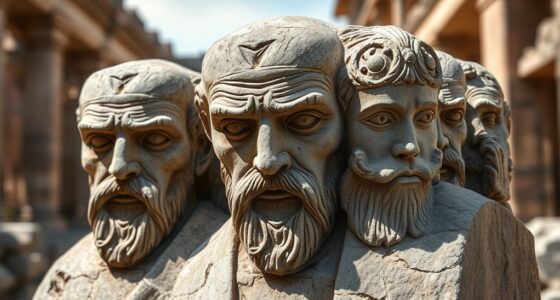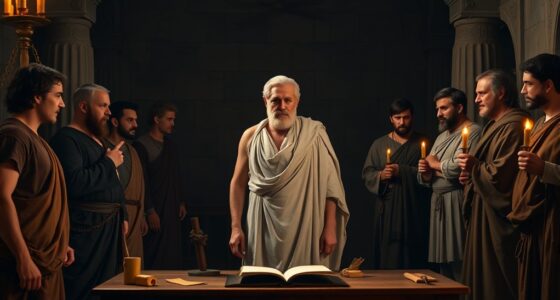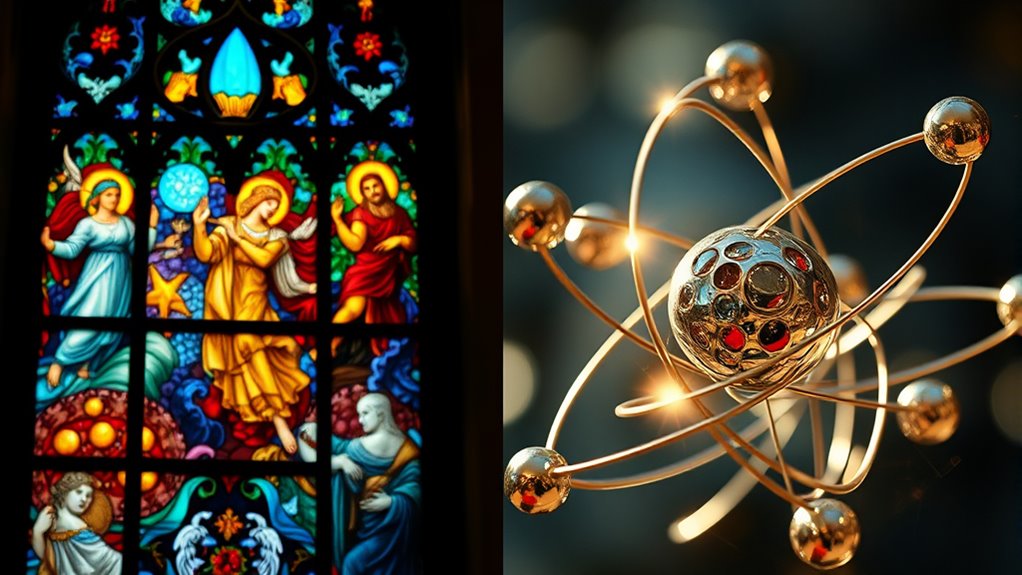

Throughout history, you see cultures debating whether divine gods or basic atoms form the universe’s true essence. Early thinkers like Thales and Anaximenes focused on elemental substances, seeking a unifying material. Others believed divine forces, like Greek gods or Indian Brahman, created and ordered everything. These debates reveal humanity’s effort to understand whether spiritual beings or fundamental matter define reality. If you’re curious, there’s much more to uncover about how these ancient ideas shaped our view of the cosmos.
Key Takeaways
- Early philosophers debated whether the universe is composed of divine substances like gods or basic elements like atoms.
- Many ancient cultures attributed cosmic origins to gods, viewing divine forces as the fundamental creators.
- Pre-Socratic thinkers sought physical explanations, proposing elements like water or air as the universe’s building blocks.
- Indian philosophies combined divine principles like Brahman with elemental ideas to explain cosmic emergence.
- These debates laid the groundwork for modern science, transitioning from spiritual to material explanations of the universe.
Have you ever wondered what ancient thinkers believed the universe was made of? Long before modern science, people sought to understand the cosmos’s true nature, and their ideas laid the groundwork for centuries of philosophical and scientific inquiry. One of the earliest debates centered around the cosmic origins and elemental composition of everything around us. Did the universe stem from divine beings or from fundamental, invisible building blocks? These questions fueled intense discussions among thinkers from different cultures.
Ancient thinkers debated whether the universe was created by divine beings or fundamental unseen elements.
In ancient Greece, the earliest philosophers proposed that the universe was composed of basic substances called elements. Thales suggested everything came from water, while Anaximenes believed air was the fundamental element. These ideas reflected a desire to find a single, unifying material that made up all existence. They thought that understanding the elemental composition of the cosmos would reveal how everything was connected. These early ideas, focused on the elemental composition, marked a shift from mythological explanations to more rational, naturalistic views.
However, not everyone believed that the physical world was all there was. Many cultures held that divine forces or gods shaped the universe’s structure and origin. The Greeks, for example, saw gods like Zeus as the creators and rulers of the cosmos, controlling its order and chaos. Similarly, ancient Egyptians viewed gods as the divine architects of the universe, responsible for its formation. These beliefs emphasized that divine power, not just elemental substances, dictated the universe’s cosmic origins. The gods were seen as the ultimate cause, giving meaning and purpose to the physical world.
Meanwhile, in early Indian philosophy, thinkers like the Vedas explored the idea that the universe’s origins lay in a cosmic principle called Brahman, an all-encompassing divine essence. Although these ideas acknowledged divine forces, they also contemplated the elemental composition of the universe, often describing it as emerging from a primal, unchanging substance. This blend of divine and material explanations showed that ancient thinkers struggled to reconcile the physical and spiritual aspects of the universe. Additionally, the development of early scientific ideas about fundamental substances gradually shifted focus toward understanding the universe through natural principles rather than solely divine or mythological explanations.
The debates about cosmic origins and elemental composition reveal how ancient civilizations tried to understand their world. Some looked inward, seeking divine explanations, while others focused on discovering the fundamental materials that make up everything. Whether gods or atoms, these ideas reflect humanity’s enduring quest to grasp the essence of existence. As you look at the universe today, it’s fascinating to realize that these early debates laid the foundation for the scientific investigations that continue to explore the universe’s true nature.
Cosmos of the Ancients: The Greek Philosophers on Myth and Cosmology
As an affiliate, we earn on qualifying purchases.
As an affiliate, we earn on qualifying purchases.
Frequently Asked Questions
How Did Ancient Beliefs Influence Modern Scientific Discoveries?
Ancient beliefs shaped modern science by laying the groundwork through ancient cosmology and mythological influences. You can see this in early atomic theories, where mythological ideas about divine particles persisted. These beliefs encouraged curiosity and exploration, pushing scientists to question the universe’s nature. Over time, ancient cosmology’s symbolic frameworks evolved, transforming myth into empirical investigation, ultimately shaping our current understanding of matter and the universe.
What Role Did Philosophical Debates Play in Shaping Scientific Thought?
Imagine your mind as a vast ocean, where philosophical debates like metaphysical realism and epistemological skepticism stir the waters. These debates challenge you to question what’s truly real and how you can know it. They shape scientific thought by urging you to explore assumptions, refine theories, and seek truth beyond surface appearances. Without them, your pursuit of understanding would lack depth, leaving questions uncharted in the unending voyage of discovery.
Are There Any Current Theories That Echo Ancient Ideas?
Yes, current theories echo ancient ideas by exploring fundamental forces like quantum fields and string theory. You might find it fascinating that quantum field theory describes particles as excitations of underlying fields, similar to ancient notions of a universe made of interconnected elements. String theory, meanwhile, seeks to unify these ideas, proposing tiny vibrating strings as the building blocks of everything, echoing ancient notions of a universe composed of fundamental, indivisible components.
How Have Religious Perspectives Evolved Alongside Scientific Explanations?
You see, religious perspectives have evolved by integrating scientific ideas like cosmic dualism, which highlights the contrast between spiritual and physical domains, while still emphasizing divine intervention in the universe’s workings. Today, many believers see science and faith as complementary, rather than opposing, acknowledging that divine intervention might influence natural laws. This ongoing dialogue reflects a dynamic shift from ancient views, blending spiritual understanding with modern scientific discoveries.
What Is the Significance of the Debate Between Materialism and Spiritualism Today?
You might find it fascinating that the debate between the materialist perspective and spiritualist viewpoint shapes how you see the world today. It’s a coincidence that these ideas influence everything from science to personal beliefs. This ongoing discussion helps you question what truly matters—whether physical matter or a deeper spiritual essence—guiding your understanding of existence, morality, and purpose. It keeps the conversation alive and relevant in your life.

Argentina – Passion
As an affiliate, we earn on qualifying purchases.
As an affiliate, we earn on qualifying purchases.
Conclusion
Imagine standing in a bustling marketplace centuries ago, where philosophers debate whether the world’s fabric is woven from divine threads or tiny, invisible particles. Just like those traders, you now hold the choices—believing in gods or atoms—shaping how you see everything around you. These debates, like ancient tapestries, remind us that understanding the universe is still a journey, woven from mysteries waiting to be unraveled, one thread at a time.

Spirituality Before Religions: Spirituality is Unseen Science…Science is Seen Spirituality
As an affiliate, we earn on qualifying purchases.
As an affiliate, we earn on qualifying purchases.

Early Greek Philosophy, Volume III: Early Ionian Thinkers, Part 2 (Loeb Classical Library)
As an affiliate, we earn on qualifying purchases.
As an affiliate, we earn on qualifying purchases.