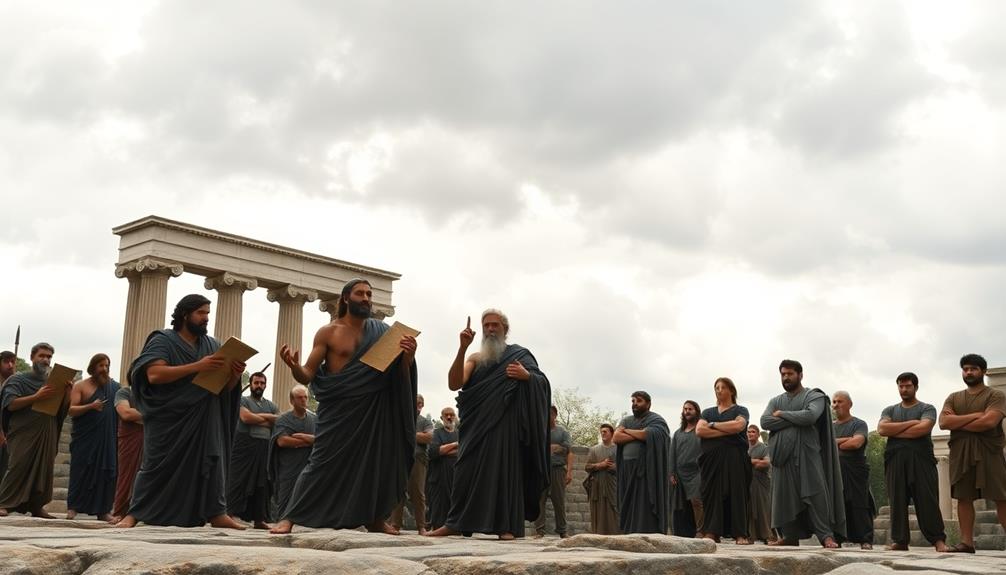
In ancient Greece, mythical automaton like Talos captured your imagination as giant bronze guardians protecting Crete, blending legend with early engineering. Alongside these stories, real inventors built mechanical devices using water, air, and gear systems, showcasing impressive ingenuity. These mythical and actual creations fuel your curiosity about humanity’s long-standing fascination with lifelike machines. Continuing this exploration reveals how myth and innovation intertwined, shaping the roots of modern robotics and autonomous guardians.
Key Takeaways
- Talos was a giant bronze automaton from Greek mythology, tasked with guarding Crete from invaders.
- Ancient Greek engineers created real automata using water, air, and gear mechanisms for entertainment and function.
- Mythical stories of Talos and early automata reflect both cultural fascination and real engineering experimentation.
- These legends and inventions laid foundational ideas influencing modern robotics and autonomous mechanical systems.
- The concept of mechanical guardians in myth and history highlights humanity’s long-standing desire to mimic life through machines.
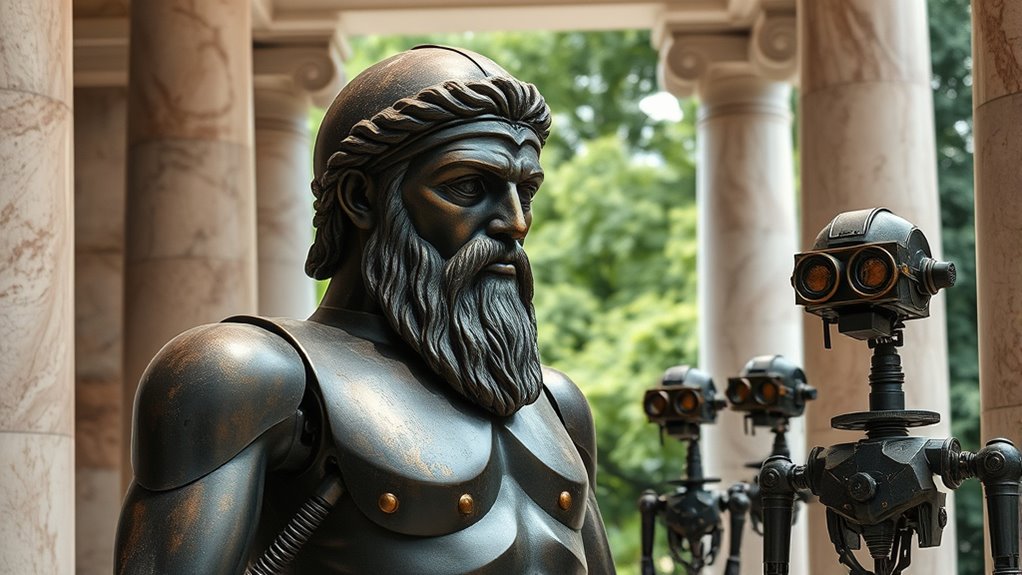
Have you ever wondered about the existence of robots that blur the line between myth and reality? Throughout history, many cultures have woven stories of mechanical beings, often blending legend with early forms of automation. These automaton myths hint at an ancient fascination with creating life-like machines, showcasing the ingenuity of legendary engineering. One of the most captivating figures in this domain is Talos, a giant bronze automaton from Greek mythology. Built by Hephaestus, the god of blacksmiths, Talos was designed to protect Crete from invaders. According to stories, he would patrol the island’s shores, hurling stones at approaching enemies or sealing them with a single touch. This myth reflects the ancient Greeks’ imagination about mechanical guardians, embodying their hopes and fears about automation’s potential power.
But beyond legend, ancient Greece also explored the idea of automata through real inventions and engineering feats. The Greeks developed mechanical devices that, while primitive by today’s standards, demonstrated remarkable ingenuity. These early machines often used water, air, or gear systems to mimic life or perform simple tasks. Think of the famous automata created by inventors like Hero of Alexandria, who designed wind-powered statues and self-operating machines. These inventions weren’t just entertainment; they represented a form of legendary engineering, pushing the boundaries of what machines could do. They served as proof that humans had long been intrigued by creating devices that could imitate life, blurring the lines between myth and tangible innovation. Additionally, some of these early devices employed sustainable building practices, reflecting an awareness of resourcefulness in engineering.
The stories of Talos and these early automata serve a dual purpose. They are mythic narratives that inspired awe and fear, but they’re also rooted in genuine curiosity and experimentation. These legendary engineering feats laid the groundwork for later technological advances. While Talos might be a myth, the concept behind him—an automaton guarding a sacred place—mirrors real innovations in mechanical design. Ancient engineers crafted complex devices using available materials and principles, laying the foundation for modern robotics. These stories and inventions reveal that the desire to create autonomous, life-like machines has fascinated humanity for millennia. They remind you that the boundary between myth and reality often blurs, driven by our enduring curiosity about mimicking life through mechanical means. In the end, tales like Talos encapsulate a timeless human quest: to breathe life into machines and to craft legendary engineering that echoes through history.
Ancient Greek Bronze Museum Statue Replica of Pegasus (176)
Ancient Greek Bronze Museum Statue Replica Of Pegasus
As an affiliate, we earn on qualifying purchases.
As an affiliate, we earn on qualifying purchases.
Frequently Asked Questions
Are There Modern Robots Inspired by Talos?
Yes, modern robots are inspired by Talos, blending mythical ideas with real automata. You’ll find that the cultural impact of automata has shaped current robotics, emphasizing strength and ingenuity. Unlike mythical robots, today’s machines are practical and programmable, but their design often echoes ancient concepts. These innovations continue to bridge myth and reality, inspiring engineers and artists alike to explore automata’s legacy and push technological boundaries.
What Materials Were Used to Build Ancient Automata?
Ancient automata were built using a variety of materials, primarily metal mechanisms like bronze and brass, which allowed for intricate movements. You’ll find that creative craftsmanship played a vital role, combining gears, levers, and pulleys to create lifelike actions. Sometimes, they incorporated water or air-powered systems to enhance functionality. These materials and techniques showcase the ingenuity of ancient engineers, making their automata impressive feats of early engineering and artistry.
Did Ancient Greeks Record How Talos Was Created?
You’d be surprised to learn that ancient Greeks didn’t record exactly how Talos was created. They described it as a mythical automaton, a marvel of ancient engineering, but details about its construction remain elusive. Historians believe it involved bronze and complex mechanisms, yet no concrete records explain its exact origin. So, while myths celebrate Talos’s abilities, the precise methods behind its creation are lost to history.
Are There Any Surviving Ancient Automata Artifacts?
You won’t find ancient automata artifacts gathering dust; they’re mostly lost to history, leaving mythological engineering to our imagination. Some bronze fragments and intricate mechanisms hint at automata symbolism, but no complete relics survive. These remnants remind us that ancient Greeks loved blending myth with engineering marvels, showcasing their fascination with creating life-like machines. So, while no full automaton endures, their legend persists in stories and symbolic artifacts.
How Did Ancient Automata Influence Later Technological Developments?
Ancient automata profoundly influenced later technological developments through their blend of mythology and engineering, inspiring engineers to create complex machines. You can see their cultural influence in early clockwork devices, robotic concepts, and mechanical systems that mimic life. By dreaming of autonomous machines, ancient Greeks laid a foundation that fuels modern robotics and automation, showing how mythological ideas can shape real-world engineering innovations over centuries.

Thames & Kosmos Mechanical Engineering: Machines & Vehicles STEM Experiment Kit | Build 20 Mechanical Models, Explore Physics of Force & Motion | Hands-on, Introductory Science Learning for Ages 8+
THE SCIENCE OF MACHINES & VEHICLES: Kids ages 8-14+ get an introduction to mechanical engineering through 20 hands-on…
As an affiliate, we earn on qualifying purchases.
As an affiliate, we earn on qualifying purchases.
Conclusion
As you reflect on Talos and the ancient automata, you realize they’re more than mere legends—they’re echoes of humanity’s relentless quest to breathe life into metal and stone. These mythic guardians stand as timeless sentinels at the crossroads of imagination and ingenuity, whispering secrets of a past where dreams of creation danced with reality. In their silent watch, you see the sparks of modern robotics, a affirmation to our endless pursuit of turning myth into reality’s masterpiece.

Automaton Water Wizard Figurine – 36mm Fantasy Collectible Miniature for Painting, Display & RPG Settings – Aquatic Robotic Spellcaster Figure – 3D Printed in Canada
🌊 Oceanic Wizard Design – Depicts a water mage automaton with wave-sculpted armor, shell motifs, and a staff…
As an affiliate, we earn on qualifying purchases.
As an affiliate, we earn on qualifying purchases.

LA REPLICA: El Legado (Spanish Edition)
As an affiliate, we earn on qualifying purchases.
As an affiliate, we earn on qualifying purchases.