
In ancient Greece, sacred geometry combined mystical symbolism with practical science to shape architecture, art, and spiritual understanding. You see it in the use of ratios like the golden ratio, which promotes harmony and aesthetic perfection, while also reflecting deeper universal truths. Shapes like spirals and circles weren’t just decorative—they symbolized wholeness and eternity. If you explore further, you’ll discover how these principles continue to influence both ancient and modern perceptions of beauty and meaning.

Prime made for students and young adults
- Fast, free delivery for dorm and study essentials
- Prime Video and Amazon Music included
- Member-only deals
Key Takeaways
- Ancient Greece integrated sacred geometry both as mystical symbolism and practical mathematical tools for architecture and art.
- The golden ratio exemplifies how mystical beliefs and scientific principles converge in Greek design.
- Greek architects used geometric ratios to achieve aesthetic harmony, reflecting both spiritual significance and structural stability.
- The Greeks viewed geometry as a means to understand divine order, blending mystical symbolism with empirical science.
- Modern interpretations recognize Greek sacred geometry as a harmonious fusion of spiritual symbolism and practical mathematical science.
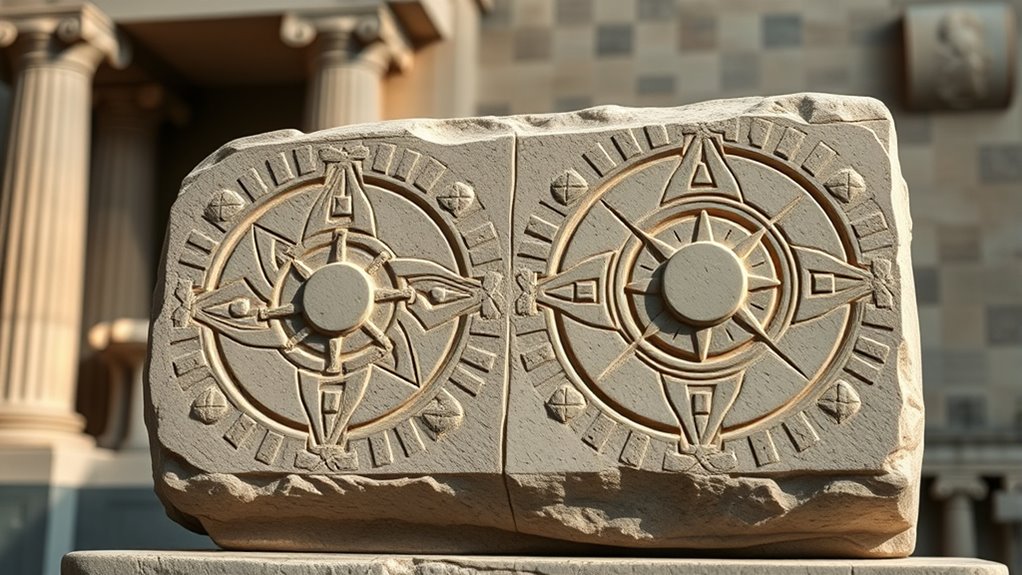
Have you ever wondered why certain shapes and patterns appear repeatedly in nature, art, and architecture? It’s as if there’s an underlying code that guides the way things are built and grow. This is where sacred geometry comes into play, blending mystical symbolism with practical science. When you look at ancient structures, you’ll notice that many of them are designed using specific shapes and ratios that seem to transcend mere aesthetics. These aren’t random choices; they’re rooted in the belief that certain forms hold spiritual significance and embody universal truths. Symbolism in architecture often reflects these ideas—arches, spirals, and circles aren’t just visually appealing but are thought to connect us with higher spiritual realms or fundamental order.
At the core of this practice is the use of mathematical ratios, which ancient builders understood as the key to harmony and balance. The golden ratio, for instance, appears in many sacred sites and artworks and is believed to foster a sense of aesthetic perfection. When you examine structures like the Parthenon or the pyramids, you’ll see how architects intentionally employed these ratios to create beauty that’s pleasing to the eye and spiritually resonant. These ratios aren’t just mathematical curiosities—they symbolize the unity between the physical and spiritual worlds. The idea is that by applying these ratios, builders could channel divine harmony into their constructions, making them more than just functional spaces.
The harmony created by these ratios isn’t accidental; it’s based on an understanding that certain proportions evoke feelings of order, stability, and transcendence. In ancient Greece, architects and mathematicians explored these relationships deeply, believing that geometry reflected the divine principles underlying the universe. They saw shapes like the pentagon, the spiral, and the circle as symbols with specific meanings—wholeness, growth, eternity—that could be integrated into human-made structures. This fusion of symbolic meaning and mathematical precision gave their architecture a sense of purpose that went beyond mere shelter or decoration.
As you study these ancient designs, it’s clear that sacred geometry bridges the mystical and the scientific. It’s a system where symbolism in architecture and mathematical ratios work together to create spaces that feel both beautiful and meaningful. Whether you’re appreciating the intricate proportions of a Greek temple or contemplating the spirals of a nautilus shell, you’re witnessing how ancient civilizations used geometry not just to construct, but to connect with something greater—an eternal order that still influences us today. Moreover, understanding the role of color accuracy in visual perception helps us appreciate how these proportions can evoke emotional and spiritual responses through their harmonious design.
As an affiliate, we earn on qualifying purchases.
Frequently Asked Questions
How Did Sacred Geometry Influence Ancient Greek Architecture?
You see, sacred geometry heavily influenced ancient Greek architecture through geometric proportions that created architectural harmony. By applying principles like the Golden Ratio, you can design structures that feel balanced and pleasing to the eye. These proportions guided the building of temples and public spaces, making them not only functional but also aesthetically harmonious. Sacred geometry served as a blueprint for achieving beauty and order in Greek architecture, shaping timeless structures.
Are There Modern Applications of Sacred Geometry in Technology?
You might notice that sacred geometry influences modern technology through fractal algorithms and geometric design software. Coincidentally, these tools mimic natural patterns and proportions, creating efficient, aesthetically pleasing designs. Applications range from computer graphics to architectural modeling. By embracing these principles, you harness ancient geometric wisdom to innovate in fields like digital art, engineering, and data visualization, blending mystical insights with practical advancements that shape today’s technological landscape.
What Are the Key Differences Between Mystical Math and Practical Science?
You see, the key differences lie in their focus; mystical math emphasizes spiritual symbolism and numerical symbolism to explore the universe’s divine aspects. Practical science, however, relies on empirical evidence and experiments to understand natural laws. While mystical math seeks spiritual insight through geometry, practical science aims for technological and scientific advancements. Both use geometry, but their goals and methods set them apart distinctly.
Did Ancient Greeks Have Formal Training in Sacred Geometry?
Yes, ancient Greeks did have formal training in sacred geometry. They received ancient training through specialized education, often in philosophical schools like Plato’s Academy, where geometry was taught as part of their formal education. This training emphasized understanding geometric principles both for mystical insights and practical applications, blending mystical math with scientific reasoning. As a student, you’d learn these concepts systematically, gaining both spiritual understanding and practical skills.
How Is Sacred Geometry Connected to Other Ancient Philosophical Systems?
Think of sacred geometry as the blueprint connecting ancient philosophies like Pythagoreanism and Platonism. You see, it provides symbolic representations that illustrate their core ideas about harmony, balance, and the cosmos. These geometric principles carry deep philosophical implications, revealing how the universe’s structure reflects spiritual truths. By studying sacred geometry, you uncover a visual language that links mathematical patterns to profound metaphysical concepts across different ancient systems.
As an affiliate, we earn on qualifying purchases.
Conclusion
As you explore sacred geometry, you gently discover how ancient mysteries blend with practical insights, inviting you to see the universe’s subtle harmony. These timeless patterns hint at deeper connections, encouraging you to embrace curiosity without rushing to answers. In appreciating both mystical math and science, you’re encouraged to find your own balance, trusting that the universe’s quiet wisdom quietly guides your journey. Sometimes, the most profound truths are simply waiting to be softly uncovered.
ancient Greek architectural tools
As an affiliate, we earn on qualifying purchases.
As an affiliate, we earn on qualifying purchases.
As an affiliate, we earn on qualifying purchases.
Halloween Picks
halloween
As an affiliate, we earn on qualifying purchases.