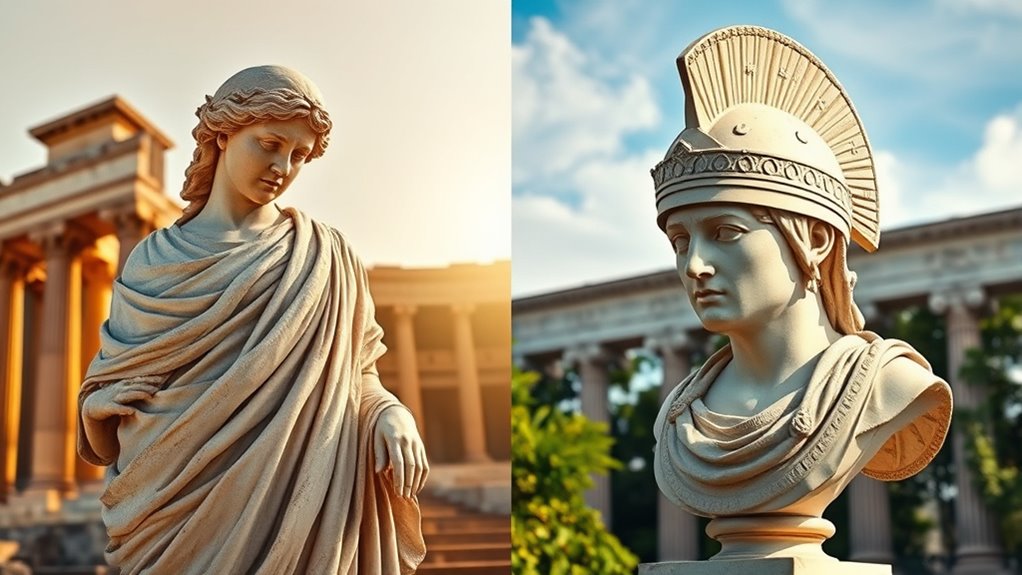

Greek and Roman gods share many stories and qualities because their myths and archetypes remained similar over time. While their names changed—Zeus became Jupiter, Aphrodite turned into Venus—the core narratives often stayed intact, highlighting themes like heroism, love, and justice. The differences reflect cultural priorities: Greek myths focus on individual struggles, while Roman stories emphasize duty and societal order. Curiosity about these timeless myths will reveal even more fascinating connections.

Prime made for students and young adults
- Fast, free delivery for dorm and study essentials
- Prime Video and Amazon Music included
- Member-only deals
Key Takeaways
- Greek and Roman gods often share similar roles and stories, with only their names changing.
- The core mythological narratives remained consistent, highlighting universal themes like heroism, love, and power.
- Greek gods tend to be more humanized and emotionally complex, while Roman gods emphasize duty and societal values.
- Names shifted to reflect cultural differences, but gods retained similar functions and symbolism across both mythologies.
- Mythological themes and archetypes serve as cultural bridges, expressing natural phenomena and human experiences in both traditions.
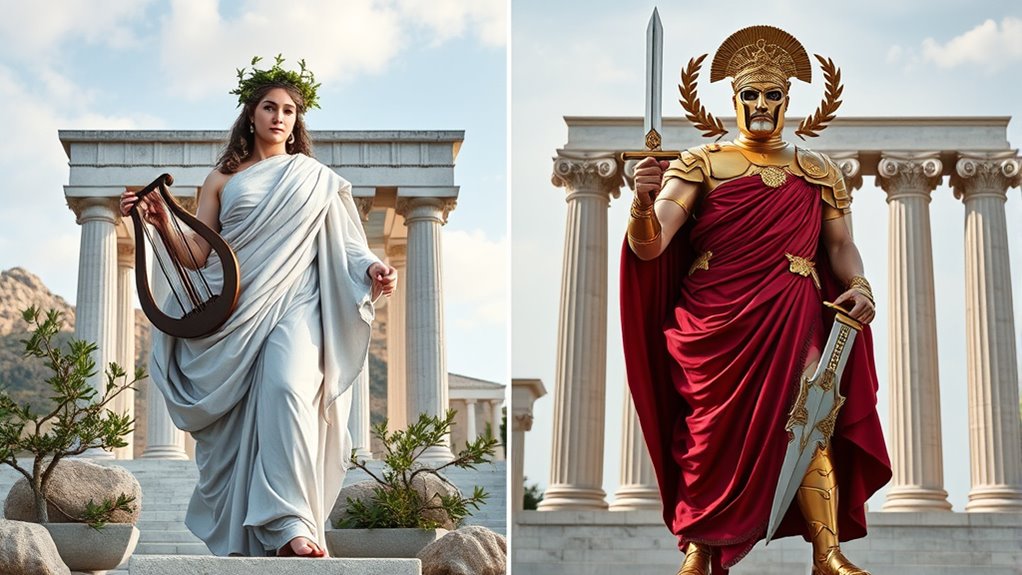
When exploring the gods of Greek and Roman mythology, you’ll notice they often share similar roles and stories but differ in their names and personalities. These gods embody mythological symbolism that reflects the values, fears, and aspirations of their respective cultures. For example, Zeus, the king of Greek gods, symbolizes authority and the sky, while his Roman counterpart, Jupiter, upholds similar themes but with a different cultural flavor. The nuances in their personalities and stories reveal much about Greek and Roman society—Greek gods tend to be more humanized and emotionally complex, whereas Roman gods emphasize duty, order, and societal stability.
Understanding these differences helps you grasp how cultural influences shape mythological figures. Greek mythology, with its focus on individual heroism and personal flaws, mirrors a society that values exploration, curiosity, and human experience. Conversely, Roman mythology emphasizes collective virtues like discipline and loyalty, reflecting a culture centered on empire-building and civic responsibility. These cultural influences are embedded in the mythological symbolism associated with each deity. For instance, Aphrodite in Greek myth symbolizes love and beauty, portraying human passions and vulnerabilities. Meanwhile, Venus in Roman tradition also embodies love but is often linked to the ideals of beauty and civic harmony, aligning with Rome’s emphasis on societal order.
Greek mythology highlights individual heroism, while Roman mythology emphasizes collective virtues like discipline and loyalty.
These differences in mythological symbolism extend beyond names and personalities. They influence the stories told about these gods and their interactions with mortals. Greek myths often explore themes of hubris, fate, and personal struggle, highlighting the gods’ capricious and sometimes flawed nature. Roman myths, however, tend to underscore moral lessons and the importance of duty, often portraying gods as embodiments of societal virtues. This shift in storytelling reflects the broader cultural influences, where Greek myths serve as a mirror to individual human experience, and Roman myths reinforce community values and social cohesion.
Additionally, the mythological symbolism associated with each deity reveals how each culture used their gods to explain natural phenomena and human experiences, reinforcing their societal ideals. Despite the differences in names and personalities, the core narratives remain remarkably similar. This continuity underscores how both cultures used their deities to interpret the natural world and human nature. The mythological symbolism embedded in their stories offered a way to understand complex ideas like justice, love, and power. While the gods’ names changed, their roles as divine archetypes persisted, shaped by the cultural influences that defined each civilization. In essence, Greek and Roman gods serve as different expressions of similar universal themes, adapted to fit the values of their respective societies.
As an affiliate, we earn on qualifying purchases.
Frequently Asked Questions
How Did Greek and Roman Gods Influence Modern Culture?
Greek and Roman gods influence modern culture through their enduring myths and cultural symbolism, shaping art, literature, and entertainment. You see their impact in movies, books, and even branding, where gods like Zeus or Jupiter symbolize power and wisdom. Modern adaptations often reimagine these deities, keeping their stories alive and relevant. Their influence helps you connect ancient beliefs with contemporary themes, enriching your understanding of human nature and cultural identity.
Are There Any Gods Unique to Greek or Roman Mythology?
Yes, some gods are unique to Greek or Roman mythology. For example, Greek mythology features Hypnos, the god of sleep, and Pan, the god of nature and mythological creatures like satyrs. Roman mythology has Janus, the god of beginnings and endings, and Vesta, goddess of the hearth. These deities often played key roles in divine rituals, influencing stories with mythological creatures and unique attributes that set them apart from each other.
How Did the Roles of Gods Differ Between Greek and Roman Beliefs?
Imagine gods as actors on different stages—Greek gods focus on personal passions, with divine responsibilities like love, war, and wisdom shaping their stories. Roman gods emphasize duty, discipline, and state, reflecting societal priorities. These differences in divine responsibilities lead to variations in mythological stories; Greek tales often explore individual heroism, while Roman myths highlight communal values. You see how each culture’s gods mirror their unique worldview and priorities.
Did Greek and Roman Gods Ever Syncretize or Merge?
Yes, Greek and Roman gods did syncretize through cultural syncretism and mythological merging. When the Romans encountered Greek deities, they often merged their gods’ identities, blending myths and attributes. This process allowed Roman gods to adopt Greek characteristics, creating a shared religious framework. It helped unify diverse beliefs, making it easier for the two cultures to coexist and exchange ideas while maintaining their unique traditions.
What Are Some Lesser-Known Gods From Both Pantheons?
Did you know there are over 2,000 mythological hybrids and obscure deities across Greek and Roman pantheons? Among them, Greek gods like Asclepius, god of medicine, and Roman gods such as Cloacina, goddess of sewage, stand out. These lesser-known deities often had niche roles, like the obscure Roman goddess Cardea, protector of door hinges. Exploring these hidden figures reveals the rich diversity of myth and belief beyond the famous gods.
As an affiliate, we earn on qualifying purchases.
Conclusion
As you explore the gods’ stories, remember how their names are like different labels on the same timeless treasure chest. Imagine discovering a ancient coin with Greek and Roman engravings—though the surface changes, the stories of love, power, and betrayal inside remain remarkably similar. Just like those coins, these myths remind us that no matter the name, human nature’s struggles and desires stay constant, linking us across time and cultures in an unbreakable bond.
As an affiliate, we earn on qualifying purchases.
As an affiliate, we earn on qualifying purchases.
Halloween Picks
halloween
As an affiliate, we earn on qualifying purchases.