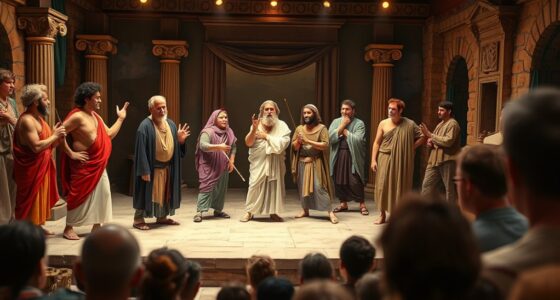
In ancient Greece and Rome, you’d celebrate the New Year as a time for renewal, with rituals, feasts, and gift-giving. Greeks honored gods like Apollo and Demeter, focusing on fertility and divine blessings, while Romans marked January 1st as the start of the year dedicated to Janus, god of beginnings. These festivities aimed to secure divine favor and symbolize fresh starts. If you keep exploring, you’ll discover how these traditions shaped modern New Year customs.
Key Takeaways
- Greeks celebrated New Year around spring, honoring gods like Apollo and Demeter through rituals, sacrifices, and feasts for divine favor.
- Romans marked January 1st as Kalends, dedicated to Janus, the god of beginnings, with gift-giving and ceremonial rituals.
- Both civilizations linked New Year celebrations to divine blessings, renewal, and mythological stories emphasizing rebirth and prosperity.
- The Julian calendar reforms standardized January 1st as the start of the year, aligning time with seasons and divine symbolism.
- Ancient practices emphasized faith, hope, and community renewal, influencing later cultural and religious New Year traditions.
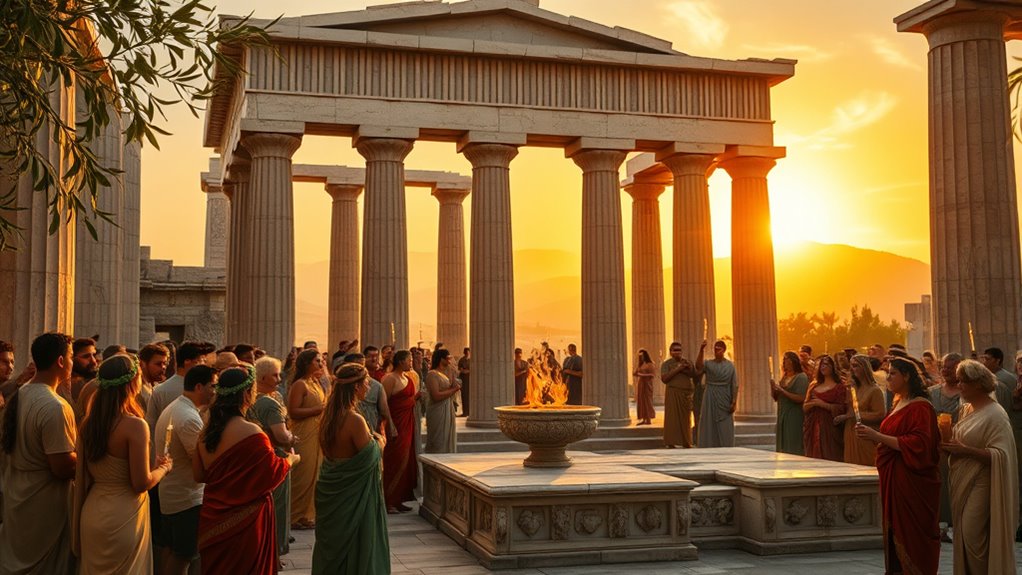
Have you ever wondered how ancient civilizations celebrated the arrival of a new year? Back then, marking the passage of time wasn’t just about changing dates on a calendar; it was deeply rooted in their mythological beliefs and societal structures. The way Greeks and Romans celebrated these moments reveals a lot about how they viewed beginnings, gods, and the cosmos. Their calendars, including the Julian reforms, played a significant role in shaping these traditions, blending practical adjustments with mythological roots.
The Greeks, for instance, often aligned their New Year celebrations with mythological stories and religious festivals. Their New Year, typically observed around the arrival of spring, was a time to honor gods like Apollo or Demeter, goddesses of light and fertility. These celebrations were filled with rituals, sacrifices, and feasts that aimed to secure divine favor for the year ahead. The mythological origins of their traditions often linked to stories of gods and heroes, emphasizing renewal, rebirth, and divine intervention. They believed that gods governed the cycles of nature and human life, so starting the year with divine blessings was essential for a prosperous future.
The Romans, on the other hand, formalized their New Year celebrations with the adoption of the Julian calendar reforms initiated by Julius Caesar in 45 BCE. Before this reform, their calendar was a mess, often drifting out of sync with the seasons. The Julian reform fixed this by introducing a more precise solar calendar, which became the basis for the calendar we still use today. But it wasn’t just about accuracy; the reform also influenced Roman festivities. The New Year, called Kalends, was celebrated on January 1st, a date dedicated to Janus, the god of beginnings and doors. Janus was depicted with two faces, symbolizing looking both forward and backward, embodying the spirit of new beginnings. Romans celebrated January 1st with gift-giving, feasts, and rituals to invoke Janus’s favor, ensuring a smooth transition from the old to the new.
Both civilizations integrated their mythological origins into their New Year celebrations, emphasizing divine influence over human affairs. Whether through Greek festivals honoring gods of fertility and renewal or Roman rites invoking Janus, their festivities reflected a common desire: to start fresh with divine blessing and hope for prosperity. Interestingly, these ancient practices also incorporated calendar reforms that helped synchronize their way of marking time with the natural world. These ancient practices remind us that even in antiquity, marking the start of a new year was more than just a date—it was a profound act of myth, faith, and community.

Ergonomic Office Chair, Mesh Desk Chair with Headrest, Lumbar Support, Thick Seat Cushion, Flip-up Arms, High Back Computer Task Chairs for Home Office, Black/Silver
【Ideal for Long Hours, Back Pain, and Focused Work】Whether you're working, studying, or creating, this ergonomic chair is...
As an affiliate, we earn on qualifying purchases.
Frequently Asked Questions
How Did Ancient Greeks Determine the Specific Date for New Year Celebrations?
You learn that ancient Greeks determined their New Year based on their ancient calendar, which varied by city-state. They often aligned the festival timing with lunar or solar cycles, like the Athenian New Year celebrated in March. The timing was influenced by agricultural cycles or astronomical events, ensuring the new year aligned with seasonal changes. This flexible approach helped them mark new beginnings at appropriate points in the year.
What Symbolic Rituals Were Performed to Mark New Beginnings in Antiquity?
You perform symbolic offerings, such as sacrifices or libations, to honor gods and seek blessings for the new year. Ritual purification is common, where you might cleanse yourself with water or ashes to shed past misdeeds and start fresh. These acts symbolize renewal and hope, reinforcing your connection to divine forces and emphasizing the importance of beginning anew with a clean and blessed slate.
Did Roman New Year Customs Influence Later Western New Year Traditions?
Roman influence profoundly shaped Western customs, including New Year celebrations. You can see this in practices like exchanging gifts, making resolutions, and calendar reforms that carry through today. Romans popularized January 1st as the start of the year, which Western societies adopted and adapted over centuries. Their traditions, blended with local customs, continue to influence how you celebrate new beginnings, emphasizing renewal, reflection, and hope for the year ahead.
Were There Any Superstitions Associated With the New Year in Ancient Greece?
When you’re talking about ancient Greece, you’ll find they definitely had superstitions linked to the New Year, like rituals to ward off bad luck. They believed certain actions or offerings could influence their fortunes, so they’d perform specific rituals to guarantee a fresh start. It’s clear they thought the first moments of the year were essential, and they used these superstitions to tip the odds in their favor.
How Did the Calendar Changes Affect New Year Celebrations Over Time?
Calendar reforms considerably impacted your New Year celebrations by shifting festival timing. When societies adopted new calendars, like the Julian or Gregorian, you experienced changes in when the New Year was marked, often moving it to different months. These reforms aimed to align the calendar with astronomical events, influencing traditions and customs. As a result, your New Year observances adapted to these calendar changes, reflecting evolving cultural and religious priorities over time.

LG 27US500-W Ultrafine Monitor 27-Inch 4K UHD (3840x2160) HDR10 IPS Borderless Design Reader Mode Flicker Safe Switch App HDMI DisplayPort - White
4K UHD with 1000:1 Contrast Ratio - This UltraFine display with a 1000:1 contrast ratio displays deeper blacks...
As an affiliate, we earn on qualifying purchases.
Conclusion
As you imagine celebrating a new beginning in ancient Greece or Rome, think of the hope and renewal each festival brought. Picture a young Roman, enthusiastic for fresh starts, participating in a Janus ritual, feeling the weight of the past fade away. These traditions remind you that no matter the era, embracing new beginnings offers a timeless opportunity to leave behind old burdens and welcome the promise of a brighter future.

Samsung T7 Portable SSD, 1TB External Solid State Drive, Speeds Up to 1,050MB/s, USB 3.2 Gen 2, Reliable Storage for Gaming, Students, Professionals, MU-PC1T0T/AM, Gray
MADE FOR THE MAKERS: Create; Explore; Store; The T7 Portable SSD delivers fast speeds and durable features to...
As an affiliate, we earn on qualifying purchases.

Crucial X9 2TB Portable SSD, Up to 1050MB/s, USB 3.2 USB-C, External Solid State Drive, Compatible with Windows, Mac, & Android, Reliable Storage for Games, Files, & Backups, Black - CT2000X9SSD902
High-speed Performance: Designed for casual gamers and everyday use, this external SSD with up to 1050MB/s accelerates large...
As an affiliate, we earn on qualifying purchases.