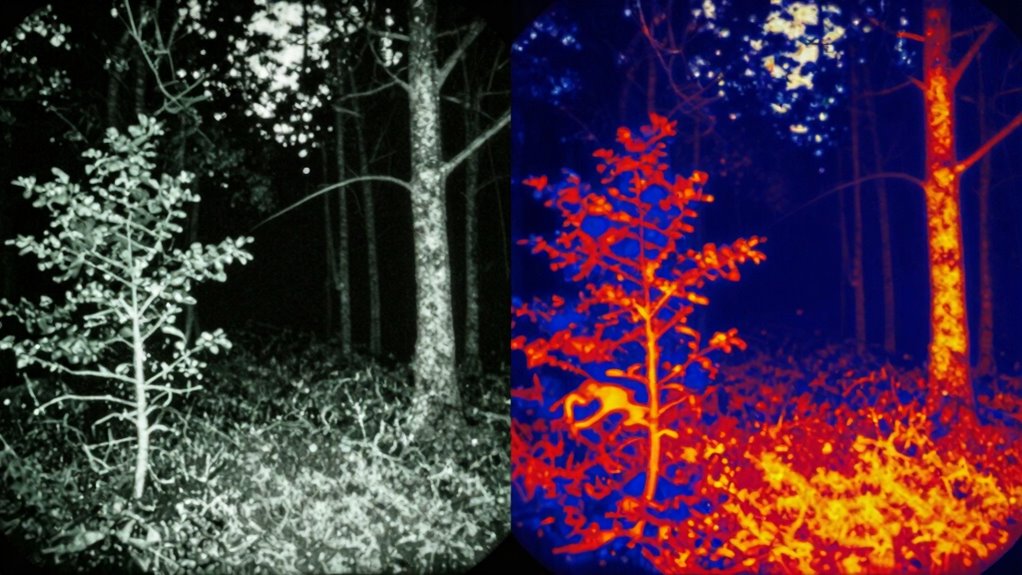

Night vision and thermal imaging aren’t the same because they work differently to help you see in the dark. Night vision amplifies ambient light, like moonlight or starlight, to produce a visible image, relying on contrast and detail. Thermal imaging detects heat emitted by objects, showing heat differences regardless of light levels. If you want to understand how each technology operates and when to use them, keep exploring these differences further.

Prime made for students and young adults
- Fast, free delivery for dorm and study essentials
- Prime Video and Amazon Music included
- Member-only deals
Key Takeaways
- Night vision amplifies ambient light to produce visible images, while thermal imaging detects heat emitted by objects.
- Night vision enhances shapes and outlines based on light, whereas thermal imaging highlights temperature differences.
- Night vision relies on ambient light sources; thermal imaging works independently of light conditions.
- Thermal imaging can see through fog, smoke, or foliage, unlike night vision, which needs some ambient light.
- They serve different purposes: night vision is for visual detail in low light, thermal is for detecting heat sources.
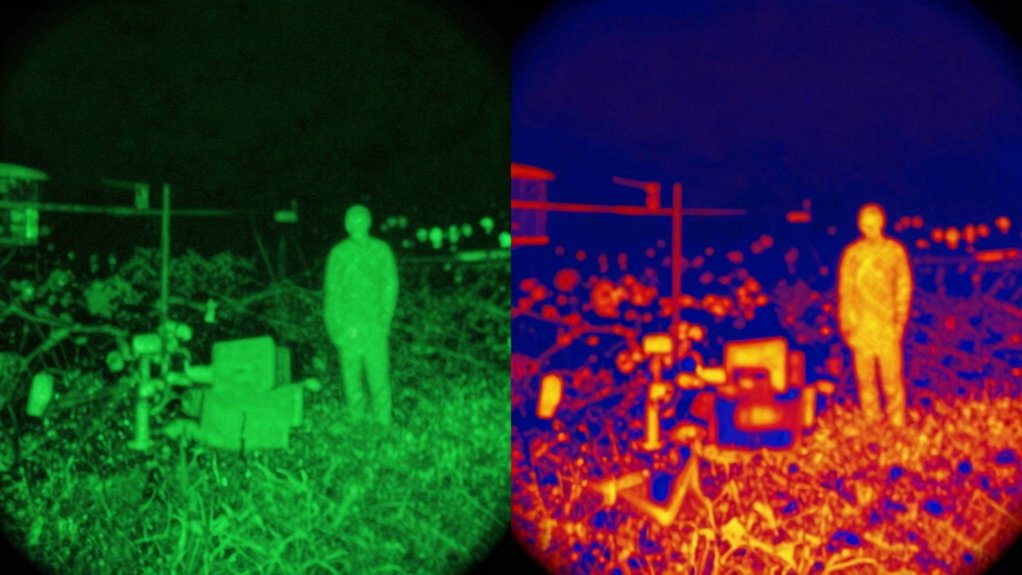
Understanding the differences between night vision and thermal imaging is essential if you want to choose the right technology for your needs. Night vision devices work by collecting ambient light—such as moonlight or starlight—and amplifying it to produce a visible image. This process relies heavily on how your eyes perceive color and contrast, leading to what’s known as color perception. When you look through a night vision device, you often see a green-tinted image because most night vision systems are designed to maximize contrast and detail using a green phosphor screen. The emphasis is on image enhancement—making faint light sources clearer and objects more distinguishable in dark environments. This technology doesn’t detect heat; instead, it enhances the available light, allowing you to see shapes and outlines more clearly in low-light conditions.
On the other hand, thermal imaging works differently. It detects heat emitted by objects and converts that information into a visible image, often in shades of black, white, or color palettes designed to highlight temperature differences. Unlike night vision, thermal imaging isn’t dependent on ambient light or color perception. Instead, it provides a representation based on temperature variations, so you can see living beings, machinery, or even hidden objects based on their heat signatures. This makes thermal imaging especially useful in complete darkness or through obscurants like fog, smoke, or foliage. The image enhancement here emphasizes thermal contrasts rather than detail or color, and color palettes can be used to distinguish different temperature ranges, making it easier to interpret heat differences quickly. Additionally, advancements in thermal sensor sensitivity have improved the detail resolution of thermal imaging devices, making them more effective for specific applications.
Furthermore, the technology often employs infrared radiation detection, which allows it to operate in conditions where visible light is absent or minimal. Infrared detection is a key component that enables thermal devices to function efficiently in the dark. The key distinction lies in what each technology emphasizes: night vision enhances the available light to improve detail and contrast, relying on your eye’s perception of color and contrast, while thermal imaging detects heat differences, offering an entirely different perspective that’s not limited by light but by temperature. Understanding the fundamental differences between these two technologies can help you choose the right tool for your specific needs, whether for outdoor adventures, security, or professional applications. If your priority is to identify objects based on visual detail in low light, night vision is the better choice. But if you need to detect living beings or hidden heat sources in complete darkness or obscured conditions, thermal imaging provides a critical advantage. Understanding the fundamental differences in how these technologies operate helps you decide which one suits your specific situation, whether it’s for outdoor adventures, security, or professional use.
night vision binoculars for wildlife
As an affiliate, we earn on qualifying purchases.
As an affiliate, we earn on qualifying purchases.
Frequently Asked Questions
Can Night Vision Work in Complete Darkness Without Any Light Sources?
Night vision typically can’t work in complete darkness without any light sources. It relies on ambient light or infrared illumination to enhance images. Infrared light is invisible to the naked eye but can be detected by night vision devices, allowing image enhancement even in low-light conditions. Without some form of infrared illumination, your night vision gear won’t produce clear images, making complete darkness a challenge for standard night vision technology.
How Do Thermal Cameras Detect Temperature Differences?
Imagine your eyes turning into heat detectives—thermal cameras sense temperature differences through infrared sensing. They detect variations in heat emitted by objects, translating these into images. This temperature sensing allows them to reveal hidden details, like a warm trail in the dark. By picking up infrared radiation, thermal cameras turn invisible heat into visible images, helping you see what’s hidden beneath the surface, regardless of light or darkness.
Are Night Vision Devices Affected by Fog or Rain?
Night vision devices are affected by fog interference and rain impact because they rely on amplifying ambient light. Fog and rain scatter this light, reducing visibility and making it harder to see through your device. You’ll notice diminished clarity and contrast in such conditions. To improve performance, consider using thermal imaging instead, as it detects heat signatures and isn’t affected by fog or rain, providing clearer images in adverse weather.
What Is the Typical Cost Difference Between Night Vision and Thermal Devices?
Imagine holding a sleek night vision device in one hand and a rugged thermal scope in the other. The price range for night vision devices typically falls between a few hundred to several thousand dollars, while thermal devices often start around $2,000 and can go well beyond $10,000. The cost comparison shows thermal technology generally costs more, reflecting its advanced capabilities and detailed heat signature detection.
Can Thermal Imaging Detect Small or Hidden Objects?
Yes, thermal imaging can detect small or hidden objects, but with limitations. Its strength lies in identifying temperature differences, making it effective for small target detection if the object contrasts with its surroundings. However, object concealment, like camouflage or dense foliage, can hinder thermal detection since the heat signature may be masked. So, while thermal imaging improves small target detection, it’s not foolproof against complex concealment techniques.
thermal imaging camera for hunting
As an affiliate, we earn on qualifying purchases.
As an affiliate, we earn on qualifying purchases.
Conclusion
Think of night vision as a flashlight, illuminating what’s already there by amplifying available light, like a painter highlighting details with a brush. Thermal, on the other hand, is a heat-sensing camera, revealing the invisible warmth of objects, like a dragon’s fiery breath glowing in the dark. Understanding these tools is like knowing when to use a spark and when to ignite a flame—each has its own power to see what’s hidden in the shadows.
night vision scope with green display
As an affiliate, we earn on qualifying purchases.
As an affiliate, we earn on qualifying purchases.
thermal monocular for surveillance
As an affiliate, we earn on qualifying purchases.
As an affiliate, we earn on qualifying purchases.
Halloween Picks
halloween
As an affiliate, we earn on qualifying purchases.