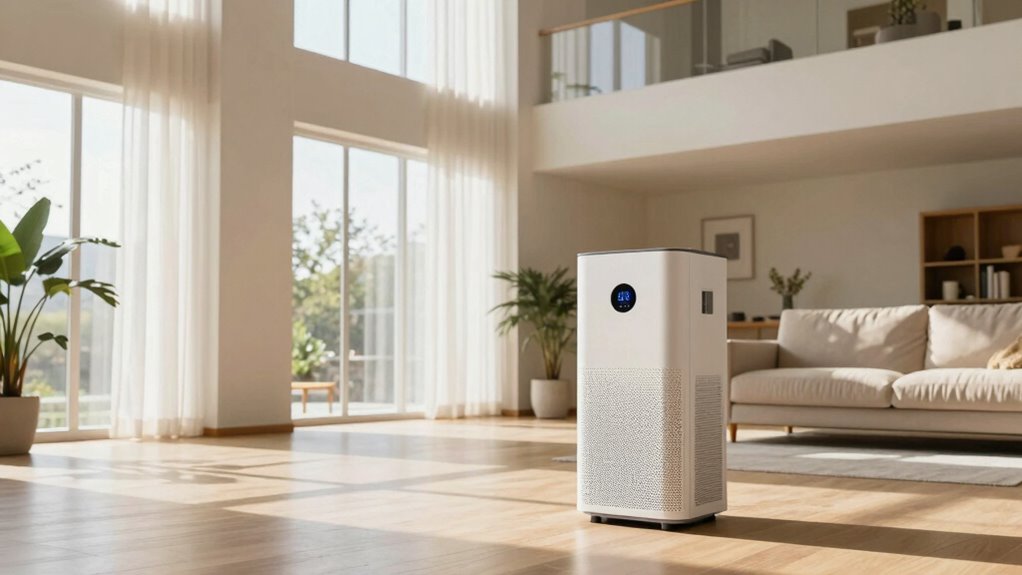

Air purifier room size claims can be misleading because they are based on tests in ideal conditions that rarely match your real-world environment. Manufacturers often assume perfect airflow, minimal pollution, and standard ceiling heights, which don’t account for factors like high pollution levels, pets, or complex room layouts. As a result, the device might not perform as well at home as it does in lab tests. Keep exploring to understand what truly impacts air purifier effectiveness in your space.
Key Takeaways
- Manufacturer ratings are based on ideal laboratory conditions, not real-world environments.
- Air purifier effectiveness depends on factors like pollution levels, room layout, and airflow, which ratings may not account for.
- High ceilings or poor ventilation can reduce an air purifier’s performance beyond its rated capacity.
- Marketing claims often oversimplify or exaggerate the device’s true coverage area.
- Accurate room size calculation, including ceiling height and air circulation, is essential for effective purification.

When shopping for an air purifier, you might notice that manufacturers often specify a maximum room size for ideal performance. This number is usually based on the device’s air purifier technology and how it handles air filtration. But keep in mind, those claims can be misleading if you’re not careful. The room size calculation manufacturers use is often simplified or based on ideal conditions, which aren’t always realistic for your home. They typically assume a standard ceiling height, minimal air pollution, and good air circulation—all factors that rarely match real-life environments. So, when a box says an air purifier can handle a certain square footage, it might not be as effective in your space if those conditions aren’t met. Understanding air purifier technology is key to making an informed choice. Most devices rely on filters like HEPA or activated carbon, which are rated for certain capacities. These ratings are often based on laboratory tests that measure how well the purifier captures particles or removes odors within a controlled environment. But those tests don’t always translate directly to your home’s conditions. If your room has high levels of pollution, pets shedding fur, or poor airflow, the purifier might struggle to perform as promised, even if it’s suitable for the stated room size. Additionally, factors like air circulation and room layout can significantly influence how well the purifier distributes and cleans the air, meaning a higher capacity may be necessary for larger or complex spaces. Properly assessing your room layout can help you determine if a higher-capacity purifier is needed for your specific environment. Calculating your room size accurately is crucial before making a purchase. Many people simply measure the length and width of a space and multiply those to get the square footage. But that’s not enough. You also need to consider ceiling height, air circulation, and specific air quality concerns. For example, a room with a high ceiling or poor ventilation might require a larger-capacity purifier than the room size claim suggests. Additionally, understanding air quality indicators can help you better assess your needs and select the right device. If you don’t factor in these elements, you risk choosing an air purifier that’s underpowered, leaving you with subpar air quality. Manufacturers often oversimplify or exaggerate their claims to appeal to consumers, knowing that many people will take those numbers at face value. The reality is, the effectiveness of an air purifier depends on various factors beyond just its rated room size. It’s also important to consider real-world testing and user reviews to get a clearer picture of actual performance in typical home environments. It’s wise to look beyond the marketing claims and consider your actual environment, how you calculate your room size, and the specific air purifier technology. Doing so ensures you select a device that genuinely improves your air quality, rather than just meeting a number on a box.

Air Purifier for Home Bedroom Large Room 2200 Ft², MOOKA H13 HEPA Air Cleaner with Washable Pre-filter, Air Quality Monitor, Air Purifiers for Pets Hair Smoke Pollen, Auto Mode, KJ190H White
𝐇𝐢𝐠𝐡𝐞𝐫 𝐀𝐢𝐫 𝐈𝐧𝐭𝐚𝐤𝐞 & 𝐋𝐚𝐫𝐠𝐞𝐫 𝐂𝐨𝐯𝐞𝐫𝐚𝐠𝐞 𝐟𝐨𝐫 𝐏𝐞𝐭 𝐋𝐨𝐯𝐞𝐫𝐬: This air purifier for home pets is designed with…
As an affiliate, we earn on qualifying purchases.
As an affiliate, we earn on qualifying purchases.
Frequently Asked Questions
How Do Manufacturers Test Room Size for Air Purifiers?
Manufacturers test room size for air purifiers by measuring their effectiveness in controlled environments, often focusing on ideal conditions with minimal filter maintenance needed. They assess how well the unit filters air, considering noise levels during operation. However, real-world factors like filter maintenance and noise can affect performance, making these tests optimistic. Always check for real-world reviews to determine if the purifier suits your room size and needs.
Do Room Size Claims Account for Ceiling Height Variations?
Your air purifier’s room size claims often ignore ceiling height variations, which can dramatically impact air circulation. If you have towering ceilings, the purifier might struggle to clean the entire space effectively, no matter what the label says. Higher ceilings mean more air to circulate and purify, so always consider ceiling height alongside room size. Otherwise, you risk relying on a machine that’s just not powerful enough for your space’s true volume.
Are Larger Air Purifiers More Effective in Smaller Rooms?
Larger air purifiers aren’t necessarily more effective in smaller rooms because they can produce more noise and may be overkill, leading to unnecessary filter replacements. Instead, choose an air purifier with the right room size for your space to minimize noise and extend filter life. Properly sizing guarantees efficient air cleaning without disturbing your environment, making it easier to maintain fresh air and avoid frequent filter replacements.
How Does Furniture Placement Affect Air Purifier Efficiency?
Sure, furniture placement is essential. If you block airflow with bulky couches or stacked books, your air purifier becomes a paperweight. Furniture obstruction causes airflow disruption, making it less effective at capturing pollutants. To maximize efficiency, keep the purifier’s intake and outlet clear, and avoid clutter that hampers airflow. Remember, the cleaner your airflow, the cleaner your air—so place furniture wisely, not lazily.
Can Multiple Air Purifiers Improve Air Quality in Large Spaces?
Yes, using multiple air purifiers can improve air quality in large spaces. To maximize their effectiveness, you should strategically place them around the room, considering purifier placement to guarantee even coverage. This helps eliminate pollutants more efficiently and maintains consistent air quality throughout the space. Keep in mind that selecting purifiers suitable for the room size and avoiding interference from furniture will also boost their performance.

KNKA Air Purifiers for Home Bedroom Up to 1,695 Ft² in 1 Hr, APH4000, White
𝐀𝐇𝐀𝐌 𝐕𝐞𝐫𝐢𝐟𝐢𝐞𝐝 & 𝐇𝐢𝐠𝐡 𝐂𝐀𝐃𝐑 𝐕𝐚𝐥𝐮𝐞: Certified by the Association of Home Appliance Manufacturers, this air purifier provides…
As an affiliate, we earn on qualifying purchases.
As an affiliate, we earn on qualifying purchases.
Conclusion
So, next time you’re choosing an air purifier, remember to look beyond the room size claims. Don’t just rely on numbers—consider your space, your needs, and the purifier’s true capabilities. Don’t be fooled by big claims or flashy labels. Be informed, be cautious, and be confident. Because understanding the reality behind those claims guarantees cleaner air, healthier lungs, and a happier home. Choose wisely, breathe easier, and trust what truly matters.
KNKA Air Purifiers for Home Bedroom Up to 1,695 Ft² in 1 Hr, APH4000, White
𝐀𝐇𝐀𝐌 𝐕𝐞𝐫𝐢𝐟𝐢𝐞𝐝 & 𝐇𝐢𝐠𝐡 𝐂𝐀𝐃𝐑 𝐕𝐚𝐥𝐮𝐞: Certified by the Association of Home Appliance Manufacturers, this air purifier provides…
As an affiliate, we earn on qualifying purchases.
As an affiliate, we earn on qualifying purchases.

16 in 1 Air Quality Monitor Indoor 7" Large Display 9 AQI+7 Alerts, Wildfire CO2 Monitor Air Quality Tester for CO2, TVOC, PM2.5 PM1.0 PM10, HCHO Temperature Humidity AQI & Time Air Meter for Home
【16-in-1 Air Quality Monitor Indoor— Wildfire Season Ready】Experience the ultimate indoor air quality monitoring with our 16-in-1 Air…
As an affiliate, we earn on qualifying purchases.
As an affiliate, we earn on qualifying purchases.