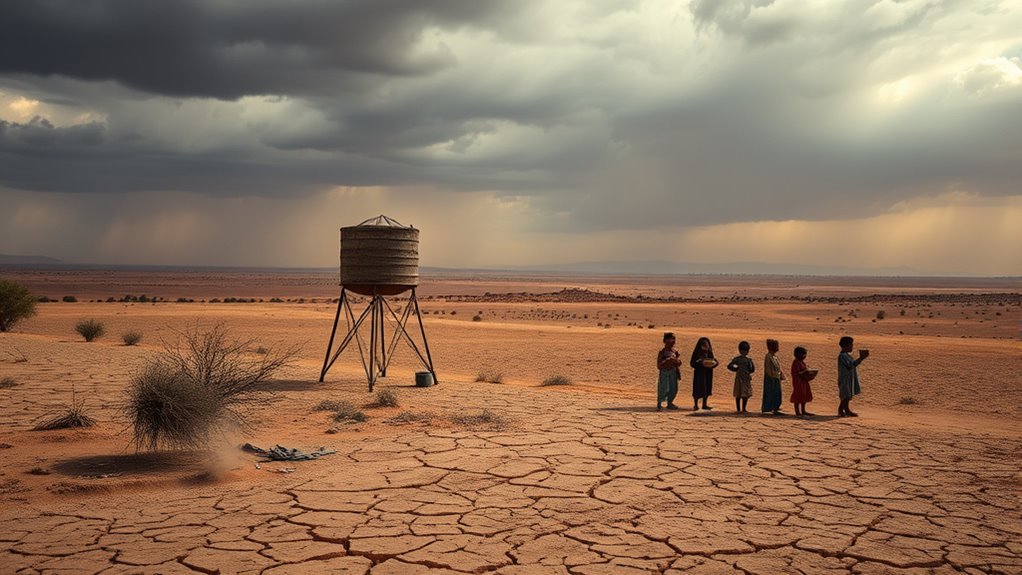

In 2025, climate change worsens droughts and food shortages, leading to shifting populations and strained resources. You’ll see communities face water scarcity, collapsing agriculture, and increased displacement as urban areas strain to accommodate newcomers. Humanitarian efforts struggle to keep pace, so innovative water management and climate resilience are essential. Addressing these interconnected crises requires collective action and sustainable solutions. Discover how global strategies adapt to meet these challenges and protect vulnerable populations.
Key Takeaways
- Address water scarcity through sustainable management, innovative technologies, and community-based conservation efforts.
- Strengthen climate resilience in vulnerable regions via infrastructure upgrades and climate-smart agriculture.
- Expand humanitarian aid and temporary relief while developing long-term solutions for food and water security.
- Promote global cooperation to reduce greenhouse gas emissions and mitigate climate change impacts.
- Support vulnerable populations with adaptive strategies and community resilience programs to withstand future crises.

By 2025, humanitarian crises have intensified across multiple regions, forcing millions to flee their homes and struggle for basic necessities. Among these challenges, urban migration and water scarcity stand out as critical issues, especially in areas affected by climate change. As droughts worsen and food supplies dwindle, more people are compelled to move to cities in search of safety and resources. You might find yourself in crowded urban centers, where infrastructure often struggles to keep pace with the influx of new residents. This rapid urban migration strains existing systems, creating a cycle of hardship as resources become even scarcer.
Urban migration escalates as climate crises worsen, straining infrastructure and deepening resource shortages.
In these sprawling cities, water scarcity becomes a daily reality. You may notice tap water running dry for hours or days, forcing residents to rely on unsafe sources or expensive bottled water. The lack of reliable water access affects hygiene, health, and livelihoods. Without sufficient water, agriculture collapses, and food production drops sharply, pushing prices higher and leaving many without enough to eat. As drought conditions persist, your community could face a stark choice: adapt to the scarcity or suffer the consequences of dehydration, disease, and malnutrition.
The intersection of urban migration and water scarcity creates a complex challenge. You might see people walking long distances to fetch water or standing in queues for limited supplies. The pressure on city infrastructure leads to overcrowded informal settlements, where sanitation is poor and disease spreads easily. Many migrants lack proper housing, making them vulnerable to exploitation and health risks. The government and aid organizations try to respond with emergency measures, but often, resources are stretched thin, and solutions are temporary. You may feel the urgency to support or advocate for sustainable water management and urban planning to address these intertwined crises.
Climate change worsens these issues by altering rainfall patterns and increasing the frequency and severity of droughts. As a result, water sources dry up faster than they can be replenished, and existing reservoirs become depleted. You might see communities resorting to groundwater extraction, leading to further depletion of aquifers. This cycle of depletion and drought deepens the crisis, making it harder for people to survive and rebuild. The challenge lies in implementing long-term solutions that promote water conservation, infrastructure development, and climate resilience, yet progress often lags behind the scale of the problem.
Furthermore, innovative water management strategies are essential to break this cycle and ensure sustainable access to water for future generations. In this landscape of mounting hardship, your awareness and action become essential. Supporting sustainable development, advocating for climate justice, and helping communities adapt to water scarcity can make a difference. As these crises unfold, understanding their interconnectedness helps you see the bigger picture and motivates collective efforts to create more resilient, equitable responses. The path forward demands urgent attention, innovative solutions, and shared responsibility to ensure that, despite these hardships, hope and stability can be restored.
solar-powered water pump for drought relief
As an affiliate, we earn on qualifying purchases.
As an affiliate, we earn on qualifying purchases.
Frequently Asked Questions
How Will Technological Innovations Prevent Future Famines?
Technological innovations, like crop monitoring and data analytics, will help prevent future famines by giving you real-time insights into crop health and soil conditions. You’ll be able to make smarter decisions about irrigation, fertilization, and pest control, reducing waste and maximizing yields. These tools also enable early warning systems for droughts or pests, so you can act swiftly and guarantee food security for communities at risk.
What Role Do Local Communities Play in Resilience Strategies?
Like a sturdy oak rooted in tradition, your community’s resilience hinges on local engagement and traditional knowledge. You play a crucial role by sharing expertise, participating in decision-making, and implementing sustainable practices. Your collective wisdom helps adapt strategies to changing climates, ensuring food security and resource management. By empowering local voices, you strengthen resilience, turning community strength into a beacon of hope amid environmental challenges.
Are There Ethical Concerns With Geoengineering Solutions?
You should consider that geoengineering raises significant ethical concerns rooted in environmental ethics, especially regarding potential unintended consequences and ecological impacts. Global governance becomes vital to guarantee responsible deployment, as decisions affect everyone worldwide. You must weigh the risks against benefits carefully, recognizing that manipulating the climate could lead to moral dilemmas about human intervention and responsibility, emphasizing the need for transparent, inclusive international oversight.
How Is Mental Health Addressed in Affected Populations?
Did you know that nearly 1 in 5 people affected by crises experience mental health issues? You can support affected populations by providing accessible psychological support and focusing on stigma reduction. Addressing mental health involves integrating counseling services into aid efforts and promoting awareness to normalize seeking help. This approach guarantees individuals receive the emotional care they need, fostering resilience and recovery amidst challenging circumstances.
What Policies Ensure Equitable Resource Distribution During Crises?
You can advocate for policies that prioritize equitable resource allocation by supporting policy reform focused on transparency and fairness. These reforms guarantee resources are distributed based on need, reducing disparities. During crises, push for mechanisms that monitor and adjust resource distribution continuously. By promoting such policies, you help create a system where vulnerable populations receive fair access to essentials, fostering resilience and reducing inequality in times of hardship.

Survivor Filter PRO – 0.01 Micron Portable Water Filtration System Survival – Tested in USA Labs – Bacteria, Parasite and Virus Removal – Ultimate Survival & Backpacking Gear
Compact And Easy To Use – Weighing 12.8oz, this is a light and compact backpacking water filter. A…
As an affiliate, we earn on qualifying purchases.
As an affiliate, we earn on qualifying purchases.
Conclusion
As you face the unfolding crisis, remember that just like a fragile sapling struggles to survive a harsh drought, our world’s vulnerable communities fight to stay alive amid famine and climate change. In 2025, over 200 million people could be affected, risking their futures. Your actions can be the rain that sustains hope. Together, we can turn the tide, nurturing resilience before our shared landscape becomes barren and unforgiving.

Upgraded Rain Barrel Diverter Kit, Rainwater Collection System for 2''x3'' & 3''x4'' Downspout, Gutter Diverter for Rain Barrel with Enhanced Water Capacity, Filter, Adjustable Valve, Brown
Upgraded Design Collects More Water, Even in Heavy Rain: Our rain barrel diverter features a deepened collection chamber…
As an affiliate, we earn on qualifying purchases.
As an affiliate, we earn on qualifying purchases.

Nature-Based Solutions for Cities: Sustainable Urban Planning with Green Infrastructure, Climate Resilience, Energy-Efficient Buildings, and Public Transportation
As an affiliate, we earn on qualifying purchases.
As an affiliate, we earn on qualifying purchases.