
When Socrates faces trial, you’re seeing a clash between questioning accepted beliefs and maintaining social order. He’s accused of undermining piety and corrupting youth through his persistent doubts and philosophical inquiry. His refusal to accept traditional authority threatens Athens’ norms, leading to his death sentence. If you want to understand how his stance on doubt and piety shaped his fate, there’s much more to uncover about his courageous stand for truth.
Key Takeaways
- Socrates’ trial highlighted the tension between questioning tradition and maintaining social order in Athens.
- His persistent doubt and dialectic questioning challenged accepted piety and moral beliefs.
- Accused of impiety and corrupting youth, Socrates refused to cease his philosophical inquiries.
- The court sentenced Socrates to death, viewing his questioning as a threat to societal stability.
- His death symbolizes the conflict between intellectual inquiry and authority, inspiring ongoing debates on justice and morality.
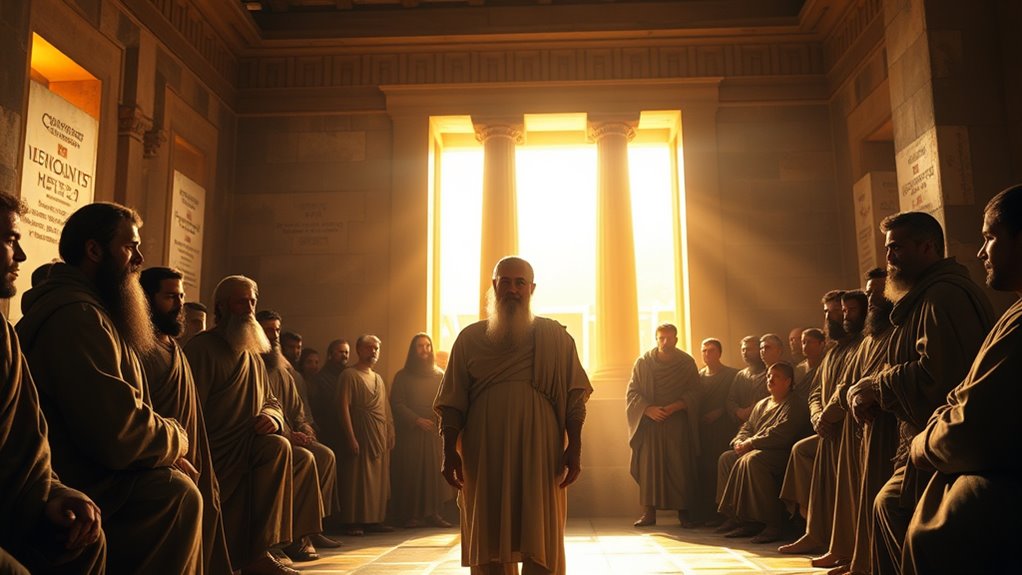
Socrates, the ancient Greek philosopher renowned for his probing questions and pursuit of truth, found himself on trial in 399 BCE, accused of corrupting Athenian youth and impiety. His case highlights the complexities of the justice system in Athens, which was designed not only to uphold laws but also to protect the city’s moral fabric. Yet, Socrates challenged this system through his philosophical inquiry, questioning authority and societal norms. You might see his trial as a clash between tradition and the relentless pursuit of truth, where the justice system becomes a battleground for ideas. Socrates refused to accept the prevailing notion that obedience alone defined justice; instead, he used dialectic methods to question what justice truly meant. His method involved rigorous questioning, exposing contradictions, and encouraging others to think deeply about their beliefs. Through this approach, Socrates aimed to illuminate moral truths, but in doing so, he often threatened the status quo, which relied on unquestioned authority and conformity. The court, however, saw his philosophical inquiry as dangerous, suspecting that his persistent challenges undermined the very foundations of Athenian society. They believed that his method of inquiry could destabilize social order, leading to accusations of corrupting youth and impiety. Socrates’s trial exemplifies how a justice system can sometimes clash with philosophical inquiry, especially when new ideas threaten existing power structures. Your understanding of his case reveals that justice isn’t always straightforward; it often involves balancing societal stability with individual pursuit of truth. Socrates’s defense was rooted in his commitment to questioning and dialogue, but the court ultimately judged him guilty, leading to his sentence of death. His refusal to abandon his philosophical pursuits, even under threat of execution, underscores the importance of intellectual integrity. The trial becomes a symbol of the tension between authority and inquiry—between conforming to laws and seeking moral understanding. By challenging the justice system, Socrates demonstrated that philosophy can serve as a form of resistance, questioning the very foundations of societal norms. His death marked the end of one phase of philosophical inquiry but also ignited future debates about justice, morality, and the role of philosophy in society. You can see his trial as an enduring reminder that true justice often demands courage to question authority and the resilience to pursue truth despite risks. Socrates’s legacy encourages you to reflect on how justice and inquiry intersect, urging a continuous quest for understanding that challenges established norms. Additionally, his trial underscores the importance of philosophical inquiry in shaping ethical perspectives and societal values.
Frequently Asked Questions
What Were Socrates’ Main Philosophical Teachings?
You learn that Socrates’ main teachings focus on moral virtue and the importance of seeking it. He uses the dialectical method to challenge assumptions, encouraging critical questioning to uncover truth. Socrates believed that true knowledge leads to moral virtue, and that understanding oneself is essential for living a good life. His approach promotes continual questioning and dialogue, emphasizing that ethical living stems from wisdom and self-awareness.
How Did Socrates Influence Later Philosophical Thought?
Oh, how Socrates, the original ancient dialectics maestro, subtly nudged your mind to question everything, fostering ethical relativism and challenging dogma. You now ponder moral truths beyond black-and-white, inspired by his relentless questioning. His legacy fuels modern debates, pushing thinkers to embrace doubt and dialectical dialogue. Thanks to Socrates, you see philosophy not as mere answers but as a dynamic process of relentless questioning—an eternal quest for wisdom.
What Legal Defenses Did Socrates Present During His Trial?
During his trial, Socrates employs legal strategies by defending his philosophical mission and challenging accusations. His defensive arguments emphasize that he’s not corrupting youth or disrespecting gods, but seeking truth and wisdom. He asserts his role as a gadfly, provoking critical thought. Socrates’s approach showcases his commitment to intellectual honesty, even if it ultimately leads to his death, demonstrating his unwavering dedication to philosophical inquiry.
How Did Socrates’ Trial Impact Ancient Athenian Society?
You’d find that Socrates’ trial deeply shook Athenian society—around 30% of citizens believed he threatened their traditional values, sparking fierce debates. His conviction and death polarized public opinion, leading to lasting political repercussions. It challenged Athenians to question authority and the role of philosophy in democracy, encouraging more critical thinking. This event ultimately provoked a reevaluation of societal norms, impacting political and cultural life for generations to come.
Were There Any Alternative Punishments Considered for Socrates?
During Socrates’ trial, alternative punishments were considered, but ultimately, his sentencing was death by drinking hemlock. You might wonder if other options like exile or a lesser fine were discussed; some Athenians suggested exile, but Socrates’ reputation and his refusal to compromise his philosophy made death the chosen punishment. This decision reflected Athens’ struggle between tradition and its evolving ideas about free thought and justice.
Conclusion
As you reflect on Socrates’ trial, you see how doubt and questions are the sparks that ignite true wisdom. His unwavering stance reminds you that standing by your principles can be a lonely road, yet it’s the path that defines a philosopher. Like a flame resisting the wind, Socrates’ unwavering dedication to truth endures beyond his death, inspiring you to question boldly and seek truth relentlessly, even when the world resists.